The Economics of Forgotten Items: Vast Wealths Hidden Within Our Homes
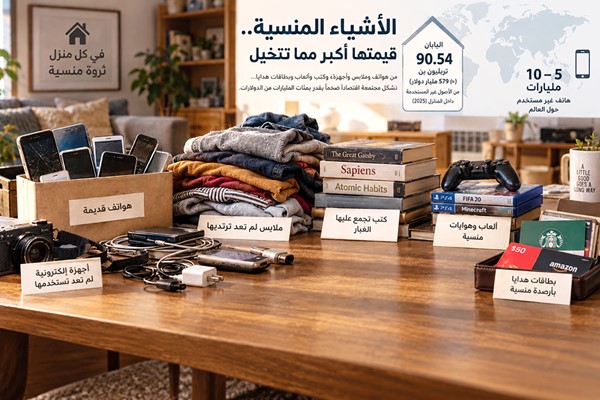
You may have an old mobile phone at home that you haven’t opened in years, clothes you no longer wear, electronic devices you’ve replaced with newer models, books and games gathering dust, and perhaps a gift card with a balance you no longer remember. Each item may seem insignificant on its own, but aggregating these items across millions of households reveals a massive economy of forgotten assets, valued at hundreds of billions of dollars.
Japan offers a striking example of the scale of this hidden wealth. A 2025 study by the Mercari platform estimated the value of resale-ready property items that had not been used for more than a year in Japanese households at approximately 90.54 trillion yen, or roughly $579 billion, averaging about $4,570 per person. Notably, these billions are not necessarily hidden in rare paintings or luxury watches, but in extremely ordinary items. Fashion products accounted for 33.6% of the estimated value of hidden assets in Japan, followed by hobbies and entertainment at 22.2%, books, music, and games at 21.2%, and furniture, appliances, and household tools at 20%.
Drawers containing old mobile phones have become one of the world’s largest underutilized “warehouses.” In 2025, the GSMA estimated that between 5 and 10 billion unused mobile phones were stored in homes worldwide.
Their value extends beyond the potential for resale; collectively, these devices contain approximately 100,000 tons of copper, 7 million ounces of gold, and 1 million ounces of palladium, with raw material values nearing $20 billion.
In the UK alone, a study cited by Material Focus estimated that 20.7 million unused but still functional electronic devices exist in households, with a potential resale value of approximately £5.63 billion. On average, a household could collect around £200 by selling its unwanted devices.
Closet contents are not much different. A study by WRAP showed that the average British person owns 118 clothing items, 31 of which have not been worn for a full year, meaning that approximately 26% of wardrobe contents remain unused.
These clothes are no longer just “clutter” waiting to be discarded; they have become fuel for a growing global market. Research projects that the global second-hand clothing market will reach $393 billion by 2030.
Wasted money does not always require a closet or a drawer. In the United States, a survey revealed that 43% of adults possess at least one unused gift card, purchase voucher, or store credit, with an average unused balance of $244 per person among those holding such credits.
Ironically, what consumers forget can become a gain for companies. Starbucks recorded $222.4 million in revenue during its 2025 fiscal year from balances it expected would never be redeemed.
Thus, the household economy is not limited to salaries, savings, and investments. There is a “silent portfolio” within homes, composed of phones, clothes, appliances, balances, and collectibles whose owners have lost sight of their value. The longer these items remain forgotten, the more some of them depreciate or expire, while reselling or recycling them can convert them into real money that returns to households and the broader economy.
