Ministry of Agriculture opens first advanced marine hatchery in Kuwait to support food security
&cropxunits=450&cropyunits=355&w=770)
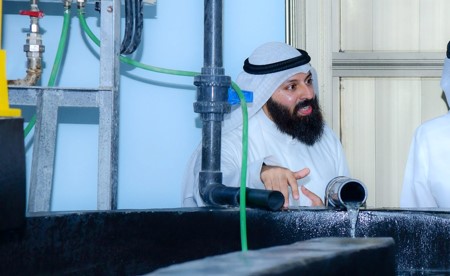
Darine Al-Ali The Kuwait Institute for Scientific Research (KISR) has inaugurated the Marine Hatchery, the first of its kind in the State of Kuwait, located at the Institute’s Marine Research Station in the Salmiya area. This step represents a significant addition to KISR’s research and technical infrastructure, enhancing its efforts to leverage scientific research and technology to address development and food security challenges.
Speaking at the inauguration ceremony, KISR Director General Dr. Faisal Al-Humaidan emphasized that the hatchery’s significance extends beyond its advanced technologies and equipment. It marks a transition from the Institute’s accumulated expertise in aquaculture research and development to an integrated system that supports production, facilitates technology transfer, and opens avenues for new partnerships with the private sector and investors.
He noted that KISR possesses decades of research and technical expertise in fisheries and aquaculture. During this period, its researchers have developed techniques for breeding and rearing various marine fish species of economic importance in Kuwait, improving larval and fingerling production, and refining feeding, rearing, and acclimatization methods to suit local environmental conditions.
Dr. Al-Humaidan highlighted that these efforts have yielded significant scientific achievements and helped build a national knowledge base and expertise that laid the foundation for advancing to a more sophisticated stage in the field. He pointed to the Institute’s success in developing aquaculture techniques for several local fish species and breeding them in research facilities.
This expertise is underpinned by a specialized research infrastructure established by KISR in the Marine Agriculture Building in Salmiya. For decades, this facility has housed laboratories and infrastructure for research on aquaculture, fisheries, and the marine environment, providing a comprehensive scientific environment to build and develop national capacities in these areas.
The new hatchery represents a continuation of this research trajectory. Designed with modern technologies, it forms an integrated system that begins with broodstock management and egg production, proceeds through live feed production and larval rearing, and culminates in nursery, acclimatization, and fingerling production. It also includes quarantine, research, and development facilities, as well as seawater treatment and recycling systems with continuous quality monitoring.
Dr. Al-Humaidan explained that the preparation and technical operation phase has seen the initiation of production trials to develop rearing protocols for targeted marine species. These efforts aim to localize knowledge and technologies related to their production, preparing the hatchery for efficient and sustainable operations. He stressed that the project holds particular importance in the context of food security efforts, noting that this concept is not limited to current production volumes but also involves the capacity to acquire the knowledge and technology needed to increase and sustain production in the future.
He added that fingerling production is a crucial link in the aquaculture industry. Localizing this link in Kuwait enables the establishment of a locally based production chain, reduces reliance on imported fingerlings, and provides a scientific and technical foundation for farmers and investment projects to raise fish to fattening and commercial production stages.
Dr. Faisal Al-Humaidan underscored the importance of this step given the gap between local production and fish demand. Local sources currently meet approximately 30% of Kuwait’s fish needs, with the remainder supplied through imports. Consequently, developing aquaculture takes on a dimension that transcends scientific research, becoming a key pathway for supporting national food security.
He clarified that the hatchery also opens the door to a broader role for the private sector by providing facilities, transferring knowledge and technical expertise, developing and testing technologies in the Kuwaiti environment, thereby creating new investment opportunities in the aquaculture sector. It also contributes to bridging the gap between research and development outcomes and production sectors, transforming scientific knowledge into valuable economic solutions that serve national priorities.
The Director General of the Kuwait Institute for Scientific Research emphasized that the opening of the hatchery marks the beginning of a new phase, during which the Institute aims to become a national platform for research, development, production, and technology transfer, as well as a bridge for cooperation with government entities, the private sector, and investors. This will contribute to building a more capable aquaculture sector that supports local production and enhances food security in the State of Kuwait.
In conclusion of his speech, Al-Humaidan expressed his appreciation for the researchers, technicians, engineers, and administrative staff at the Institute who contributed to the completion of the project, commending the scientific knowledge, expertise, and effort they provided, which brought the hatchery to the operational and opening stage. He also extended his thanks to Engineer Mubarak Al-Waqian, Chief Executive Officer of Al-Khassissiyah General Trading Construction Company, the contractor responsible for implementing the project, and to the company’s team, in recognition of their efforts and cooperation in constructing the facility.
