New AI-generated map of the “Land Scarf”
&cropxunits=450&cropyunits=293&w=770)
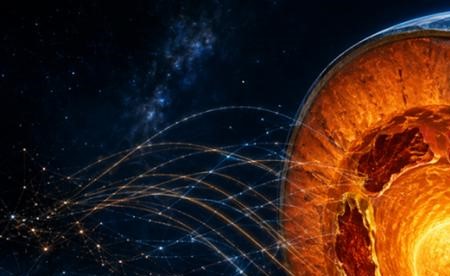
A new study revealed the use of artificial intelligence in analyzing more than two million seismic records, helping to explore the Earth’s interior to depths far exceeding what any mechanical drill can reach, and subsequently producing a new map of what is known as the “Earth’s mantle,” according to the news website Russia Today.
At extreme depths reaching 2,900 kilometers, the Earth’s mantle transitions into a liquid core. The dynamics of these depths control the movement of tectonic plates, contributing to earthquakes and volcanic eruptions. However, direct study of these depths has been impossible.
In the study, published in the Journal of Geophysical Research: Solid Earth, scientists from the Chinese Academy of Sciences used artificial intelligence algorithms to analyze a seismic data archive spanning 35 years, from 1990 to 2024. Scientists typically search manually through earthquake recordings for weak signals.
These waves scatter at small, heterogeneous structures near the boundary between the mantle and the core, returning to the Earth’s surface shortly before the arrival of the stronger main pulses. Manually searching for these subtle structures among millions of recordings is an extremely arduous and time-consuming task.
To accelerate the process, researchers trained a deep learning system. The algorithm sorted the recordings according to quality and analyzed more than two million seismic records generated by approximately 5,000 earthquakes. Researchers manually verified and corrected errors in the neural network, then fed the corrected examples back into the model to improve its performance.
Ultimately, the artificial intelligence system identified 174,929 high-quality weak signals—approximately ten times more than the total detected by previous studies. The new dataset has altered geologists’ understanding of the lower mantle. Rather than showing only isolated and random regions, as previous maps did, the new data reveal that these areas are connected, forming extended and interlinked belts.
