Wheat from the Past Saves Britain's Present Fields
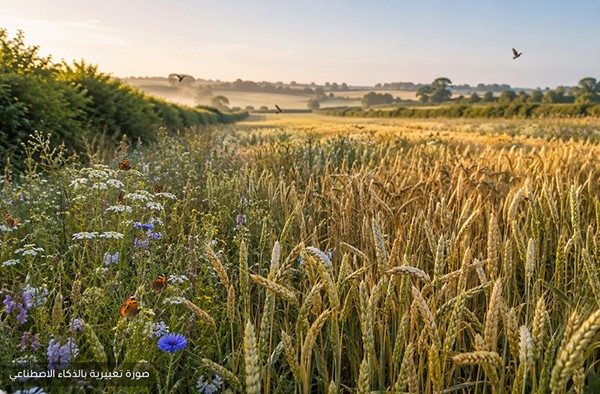
After decades of dominance by monoculture wheat farming across vast areas in Britain, ancient heritage wheat varieties are returning to British fields, bringing with them a different idea: producing food while restoring natural diversity, not at its expense.
The experiment relies on cultivating multiple wheat varieties, some grown together in the same field instead of a single genetically uniform crop.
This diversity helps plants withstand diseases and weather fluctuations, while the longer roots of some old varieties reach deeper soil layers in search of water and minerals.
However, reviving heritage wheat is not a standalone solution; it is accompanied by the planting of tens of thousands of trees, the expansion of hedgerows, the creation of wildflower meadows, and the establishment of corridors for insects and birds. Diverse crops and sheep grazing are also integrated into the farming cycle to improve soil fertility and reduce reliance on pesticides and fertilizers.
The experiment has led to a notable resurgence of wildlife, including some bird species threatened in Britain. Soil experts believe that diversifying plant life and minimizing soil disturbance help strengthen soil structure, support microorganisms, and reduce erosion and loss of organic matter.
Economically, grains are milled on-farm and sold directly to bakeries, reducing the number of intermediaries and allowing producers to secure better prices. Thus, heritage wheat becomes part of a model that combines nature conservation, improved food quality, and sustainable farming.
