President Aoun receives an Emirati delegation at Baabda: Your visit is a message of 'hope and trust' in Lebanon's stability and future
&cropxunits=450&cropyunits=300&w=600)
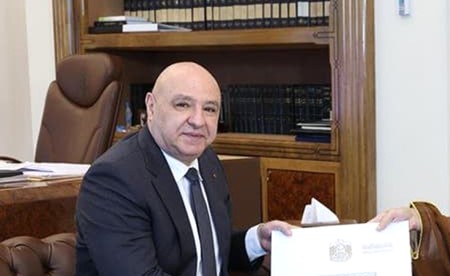
Beirut - Mansour Shaaban The President of the Republic, General Joseph Aoun, received the UAE Minister of Foreign Trade, Dr. Thani bin Ahmed Al Ziyoudi, and a delegation of Emirati businessmen at Baabda Palace yesterday.
Translated by Qiyas from الأنباء — Original source
Beirut - Mansour Shaaban
The President of the Republic, General Joseph Aoun, received the UAE Minister of Foreign Trade, Dr. Thani bin Ahmed Al Ziyoudi, and a delegation of Emirati businessmen at Baabda Palace yesterday. He emphasized that “the visit of the Emirati businessmen’s delegation to Lebanon is a message of hope and confidence in its stability and future, opening new horizons for cooperation and investment between the two countries,” while thanking “the United Arab Emirates for its constant support of Lebanon.”
President Aoun urged the Emirati businessmen’s delegation to “invest in Lebanon, which possesses human potential and resources that can be utilized in various sectors.” He stated, “Lebanon is your second country; we invite you to invest here.”
President Aoun extended his gratitude to His Highness Sheikh Mohamed bin Zayed Al Nahyan, President of the United Arab Emirates, “who has never hesitated to respond to any request from Lebanon. This is clear evidence of his love for Lebanon and of the Emirati people’s affection for the Lebanese people.”
For his part, Dr. Thani bin Ahmed Al Ziyoudi, UAE Minister of Foreign Trade, said in his speech during the meeting: “Our presence in Lebanon today is a positive message and the best proof of the UAE’s love for Lebanon and our appreciation for everything the Lebanese have contributed to the UAE’s development journey.”
Meanwhile, at the Second Presidency headquarters in the Ain al-Tineh district, Speaker of the Parliament Nabih Berri met with the Emirati delegation. He discussed with its members the general situation in Lebanon and the region, as well as ways to enhance cooperation, partnership, investment opportunities in Lebanon, and bilateral relations between the two brotherly countries.
On the sidelines of this visit, Lebanese Minister of Economy and Trade Dr. Amer Hamzeh and UAE Minister of Foreign Trade Dr. Thani bin Ahmed Al Ziyoudi signed a memorandum of understanding (MoU) between the two sides, aimed at enhancing cooperation in the fields of trade and investment, and developing economic partnership between the two countries, in a manner that serves common interests and strengthens bilateral relations.
Both sides affirmed that the MoU represents a practical step to translate the historical and entrenched economic relations between Lebanon and the UAE into further governmental cooperation.
The Emirati minister described the visit to Lebanon as “successful,” noting that it “allowed for the exploration of new sectors and opportunities for trade and investment cooperation, paving the way for establishing clear work paths between government entities and opening broader horizons for the private sector and business councils, particularly in supporting vital sectors, including energy, technology, and logistics.”
For his part, Minister Hamzeh affirmed that “the memorandum of understanding reflects a shared will to elevate Lebanese-UAE relations toward a deeper and more integrated economic partnership,” stressing that “Lebanon possesses significant potential and capacities that can be transformed into sustainable growth through reforms, enhancing the role of the private sector, and expanding partnerships with Arab countries, foremost among them the UAE.”
The MoU falls within the framework of enhancing economic partnership between the two countries based on common interests, thereby opening the door to new opportunities that benefit both economies and peoples.
Locally, Maronite Patriarch Cardinal Bechara Boutros al-Rahi followed up on his activities from his summer residence in Deir el-Qamar, where he met with former Minister Waam Wahab, discussing with him the issue of calling for a “new social contract.”
Patriarch al-Rahi said in his sermon in Kafrsaghba, in the Zgharta district, that “negotiations must yield clear results and be accompanied by seriousness in implementation and commitment to what is agreed upon.”
People no longer measure progress by the sheer number of meetings, but by what is actually achieved on the ground. Foremost among these achievements is the issue of sovereignty and the prestige of state institutions. Prestige is not built on slogans, but on tangible presence and responsible decision-making. He added, “Disagreements must not devolve into sectarian rhetoric or create new divisions. Lebanon needs a unifying national discourse.”
