Al-Filikaawi: Al-Naqour replaces Al-Rakseh Al-Shamaliya
&cropxunits=255&cropyunits=450&w=770)
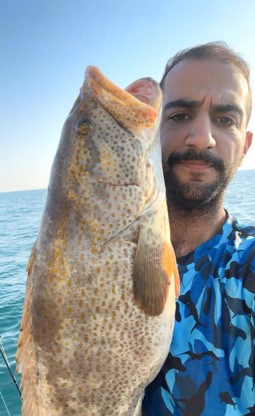
The passion for fishing and the thrill of the catch began in the days of youth and adolescence, after accompanying seasoned captains who had long experience with the open sea, gaining expertise from them and applying it in practice. His imprint was clearly evident through the photographs he shared with us.
“Bahrī” met today with Hadaq Abdulrahman Al-Filakawi, who spoke about his early fishing experiences with his father and uncle during his childhood, the fish species currently prevalent, why the Jabir Bridge has become a feeding ground for most fish species, the key secrets of catching king mackerel, when the grouper fishing season begins and where they are found, the characteristics and fishing seasons of the yellowfin seabream, the locations of blue and yellow snappers, and the season and fishing spots for the red snapper. Al-Filakawi also introduced us to the season and fishing locations for the red snapper, the best days for catching the white trevally and the fish species found there, the prime spots for catching the red mullet and his preferred bait, when the fishing season for the Spanish mackerel begins in the northern and southern areas, why certain traditional concepts of fishing are outdated, the main concerns of sea-faring communities, and the advice he offered to fellow novice anglers. Here are the details:
“I have loved the sea and fishing since I was young, and my passion for fishing grew while accompanying my father, may God prolong his life, and my uncle, may God have mercy on him. Back then, before the restrictions, we used to go to the Al-Hayshan and Al-Rushdan areas. Our primary target in the summer was the yellowfin seabream and king mackerel, while in winter we headed to Al-Dafan to target the yellowfin seabream and red snapper.”
Of course, I learned everything about the sea and fishing from the senior boat captains, including the use of the yima (baited line), trawling, and drift fishing, as well as knowledge of fish seasons and selecting the appropriate line size and yima for each specific fish, among many other things. After gaining sufficient experience, I began to rely on myself and accompanied friends on various fishing trips, with each of us benefiting from the other’s expertise.
Changes in Fish Habitats
Al-Filakawi adds: Currently, in August and early September, the nubi begins to appear in the northern Rukhsa and Dafan areas. In recent years, following the opening of the Sheikh Jaber Al-Ahmad Bridge, the habitats of the samak (a type of fish) in the Gulf of Kuwait have improved. Fishing in the Dafan area, particularly near the Jaber Bridge, has become available year-round, and a variety of fish species are found there, such as the shu’um, nubi, sabti, hamour, balool, naqour, shaym, and others.
The Ultimate Prize: Sabti
Al-Filakawi continues: For most anglers, the sabti and mizizi are the ultimate prizes due to their extreme wariness and delicious taste. However, the mizizi is more cautious and aggressive than the sabti.
Fishing is a matter of luck, and you must know the sabti’s habitat during different seasons, understand which bait attracts it in each location, and determine whether the spot requires incoming or outgoing tides. It is essential to try the location with all types of lines, whether using incoming/outgoing tides or still water. The best times to catch sabti and mizizi are from September to November, as they need to build up fat reserves before winter. During this period, they prefer rich baits such as chicken entrails, yuwaf, zuri, and salakh.
Best Seasons for Hamour
Al-Filakawi adds: The hamour lives up to its name; if it feeds, it consumes both fresh and dried bait, from the smallest to the largest. Its best season runs from April to September, and it is typically found near rock formations and reefs. To catch it, you need a line size of 100 to 200, and a reel size of 0/10 while retrieving. Preferred baits for hamour include pigeonfish species such as al-jash, al-dardaman, and al-lahlah, as well as shu’um and jam.
As for the shaym, anglers used to target it in the Dardour area starting in May, under very difficult conditions due to strong currents and depth. The best bait for it is live yimama. However, with the introduction of the jiq (jigging) and lifah techniques, it has become possible to catch it on most days of the year, whether in Dardour, near the Jaber Bridge, or in Awah.
The Ferocious Yellow Shu’um
Al-Filakawi adds: For me, the shu’um is one of the most enjoyable fish to catch. In summer, the blue shu’um is found in shallow rocky areas with depths not exceeding 10 feet, feeding on shrimp, small crabs, and small snails.
In winter, it migrates to muddy areas such as Dafan, Bar Ghadi, Madakhin Al-Sabiyah, and near Miskan Island, with shrimp being its primary bait. Catching it requires a fine line not exceeding size 40, a small sinker or local weights, and a reel. You should engage with it from the beginning of the tide; as the water rises, move closer to the edge.
The yellow shu’um is considered more ferocious than the blue variety and is found in deeper waters, feeding on shrimp, zuri, awam, and yuwaf. As for the nubi, it does not have a fixed habitat; its location depends on available food sources. Its season runs from August to April, and most of the catch occurs in the mudflats.
Awah’s Incredible Fish Diversity
Al-Filakawi continues: Most fishing spots in Awah are close to each other, but the fish diversity there is tremendous. However, those who do not understand the tides return empty-handed. Awah is abundant with yellow shu’um, shamahi, and balool. The best days to fish there are from the 9th to the 12th of the Islamic lunar month. Known spots include Awah Arid, where shamahi, shu’um, and balool are plentiful. In recent years, it has become difficult to access the 60, 90, and 25-foot reefs.
Suhail Star Marks the Season for Southern Shamahi
Al-Filakawi says: The naqour is a popular fish among people due to its abundant meat and few bones. Its preferred bait is shrimp. It was once rarely caught, but over the past three years, its population has increased significantly, making it available year-round. Its current best habitats are the northern Rukhsa, before the Nicolas Reef, and Al-Fantass.
As for the shamahi, its season in the north, from Awah to the Bridge, runs from April to early July. Most of its habitats are around reefs, and its preferred bait is large shrimp. It requires a line size of 80, 90, or 100, a long-reel rod, and a reel size of 0-8 or 0-9. Its fight is considered one of the strongest among fish species. The shamahi season in the south begins with the rising of the Suhail star at the end of August and lasts until January. It is found around Ariyaq and reefs, and jigging is the best method due to the depth and its strong pulling power.
Jigging Has Changed Fishing Concepts
Al-Filakawi adds: Jiq (jigging) and lifah have changed fishing concepts among anglers since they were introduced to us more than 10 years ago.
Jiq allows you to catch all types of fish under all conditions, as long as the fish are present. Although the costs are often high for the average person, it eliminates the need to buy different baits for every sea trip. Jiq in the north differs from jiq in the south. In the south, jiq is highly enjoyable because you cannot target a specific fish species or size, due to the diversity of fish and their varying sizes in the southern waters.
In the north, we use small jig weights ranging from 10 to 60 grams, with light tackle: reels not exceeding size 4000 and hooks no heavier than 120 grams. The best spots are the pillars of the Jabir Bridge. In the south, it is preferable to use jigs weighing no less than 80 grams, with heavy or medium-heavy action rods. The prime southern jigging locations are around Kabr Island, Umm Dirah, Qarouh rocks, and Al-Tabaanat.
Concluding his remarks, Al-Filakawi said: “One of the most frustrating issues for local fishermen is the failure to comply with collision avoidance regulations, with speedboats (tararid) speeding through fishing zones (hadhaqa). My advice to newcomers in fishing is to view it as a hobby that offers a change of scenery and relief from life’s pressures, while strictly adhering to state regulations. Avoid taking risks by heading out during weather warnings, as the sea is unpredictable, and may God protect us all.”
