"The Blue Cadet" Concludes Its Second Edition: 26 Students Undergo Practical Training in Marine Environmental Protection
&cropxunits=450&cropyunits=300&w=770)
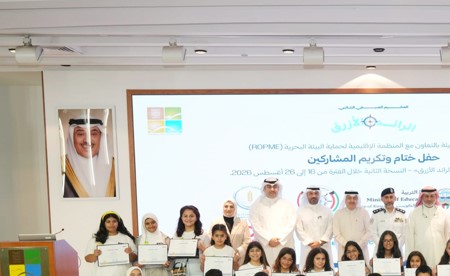
The Public Authority for Environmental Affairs (PAEA) concluded the second edition of the Blue Pioneer Environmental Summer Camp, organized in collaboration with the Regional Organization for the Protection of the Marine
Translated by Qiyas from الأنباء — Original source
The Public Authority for Environmental Affairs (PAEA) concluded the second edition of the Blue Pioneer Environmental Summer Camp, organized in collaboration with the Regional Organization for the Protection of the Marine Environment (ROPME) from the 16th to the 26th of this month, with the participation of 26 students.
Sharif Al-Khayat, Director of the Air Quality Management Department at PAEA, emphasized in a speech delivered on behalf of Acting Director General Nof Al-Bahbahani the importance of instilling the concept of sustainability among students through practical, field-based experiences rather than relying solely on theoretical knowledge. He noted the Authority’s commitment to providing participants with a comprehensive experience that combines learning, interactive activities, and field visits, enabling students to closely observe their environment, understand the challenges it faces, and recognize the national efforts undertaken to protect its resources.
He added that sustainability in the “Blue Pioneer” camp was an experience lived and practiced by students as they learned about the importance of environmental conservation, rational resource use, reducing negative practices, and enhancing the individual’s role in creating real change. Al-Khayat clarified that students are the primary focus and core objective of the camp, expressing hope that the knowledge and experiences they acquired would translate into daily behaviors whose impact would extend to their families, schools, and communities. He stressed the importance of participants becoming environmental ambassadors who understand that conservation begins with simple steps and that every individual plays a role in shaping a more sustainable future.
He praised the partnership with ROPME and its role in launching the camp by organizing its first edition and providing expertise and efforts in marine environmental protection and raising environmental awareness. He also appreciated the contributions of government and private entities in ensuring the success of the second edition, notably the General Directorate of Coast Guard, the Scientific Center affiliated with the Kuwait Foundation for the Advancement of Sciences (KFAS), Kuwait Oil Company (represented by the Ahmed Al-Jaber Oil and Gas Exhibition Administration), the Public Authority for Food and Nutrition, the Ministry of Education, Aqua Marine Company, and City Group – City Bus.
For her part, Marwa Abul, Head of the Capacity Building Unit at ROPME, stated in a similar speech that the Organization’s interest in designing and implementing the camp began last year, driven by its responsibility toward marine environmental protection and its belief that building a conscious generation is an investment in the region’s future. She explained that “Blue Pioneer” falls under Strategic Objective 3 of ROPME’s strategic directions for 2026–2030, which focuses on the “Blue Outreach” program, including the priority of “Blue Education.”
She added that the Organization follows two pathways in blue education: direct education by integrating marine concepts into the educational process, and indirect education through camps, field visits, scientific activities, and practical experiences. She noted that Kuwait was the first member state to implement the camp in its first edition during the summer of 2025 under ROPME’s supervision, while PAEA organized and implemented the second edition using its human resources and with financial support from ROPME.
She pointed out that the camp program was not limited to theoretical aspects; students learned about coral reefs, including methods for their cultivation and rehabilitation, examined marine life samples and analyzed them in laboratories, and studied issues related to marine pollution and oil spill response. The program also covered marine charts, Geographic Information Systems (GIS), and their role in understanding and monitoring the marine environment, as well as the role of the General Directorate of Coast Guard in protecting the marine environment and monitoring marine activities.
Abul emphasized that the end of the camp does not mark the end of participants’ roles; rather, each has become a “Blue Pioneer,” carrying knowledge to share with their families, schools, and friends, and applying it in their daily lives.
