Kuwait Investment Company (KIC) Investment: Supply Shortages Push Brent Near $90
A report issued by Kuwait Investment Company (KIC) regarding the performance of global oil markets in August 2026 stated that crude oil prices remained elevated above $85 per barrel, amid the continued closure of the Str
Translated by Qiyas from الأنباء — Original source
A report issued by Kuwait Investment Company (KIC) regarding the performance of global oil markets in August 2026 stated that crude oil prices remained elevated above $85 per barrel, amid the continued closure of the Strait of Hormuz and discussions about the possibility of the US government imposing stricter sanctions on Iran and its trading partners. Market conditions remained characterized by tightness rather than the usual price decline seen in late summer.
The report noted that shipping costs rose to approximately $20 million, adding a price premium borne by buyers. Persistent bottlenecks in shipping traffic through the Strait of Hormuz and the Red Sea, alongside stalled peace talks between the United States and Iran, prevented any significant drop in prices.
It mentioned that crude prices traded near the $90 per barrel mark since the beginning of August, driven by renewed attacks on oil tankers in the Strait of Hormuz and escalating rhetoric between the US and Iran. This upward trend was further bolstered by attacks targeting Emirati tankers and a Saudi oil refinery, pushing Brent crude blend prices to around $95.4 per barrel.
The report clarified that the average price of Brent crude spot contracts fell for the third consecutive month in July 2026, declining by 2.1% to $83.4 per barrel. Meanwhile, the average price of the OPEC Reference Basket dropped by 7.5% to $83.0 per barrel, compared to $85.2 in June. Kuwaiti Export Crude also fell by 11.1% to an average of $82.0 per barrel.
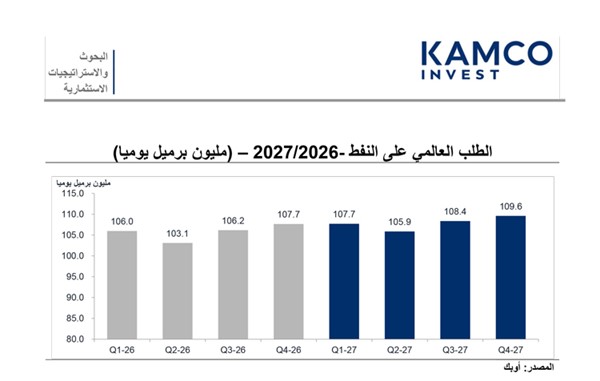
On the demand side, OPEC lowered its forecast for global oil demand growth in 2026 for the fourth consecutive month to 0.58 million barrels per day, down from its previous estimate of 0.78 million barrels per day, bringing the average global demand to 105.7 million barrels per day. In contrast, the International Energy Agency (IEA) projected a decline in global demand by 1.6 million barrels per day during 2026, a further reduction of 510,000 barrels per day from its previous estimates, due to the continued closure of the Strait of Hormuz, rising fuel prices, and their impact on consumption.
Regarding supply, IEA data showed that global oil supplies increased by 2.4 million barrels per day in July to 101.5 million barrels per day, but remained approximately 6.3 million barrels per day below the previous year’s levels, with about 8.3 million barrels per day of Gulf region production still halted. Gulf states’ production rose by 2.5 million barrels per day to 23.9 million barrels per day, while the region’s exports fell by 2.1 million barrels per day to 15 million barrels per day. The IEA lowered its forecast for third-quarter 2026 supplies by 1.7 million barrels per day and expects global supplies to decline by 4.3 million barrels per day during the year to an average of 102 million barrels per day.
According to Bloomberg data, OPEC’s average production increased by 1.16 million barrels per day in July to 19.44 million barrels per day. Iraq recorded the largest increase at 460,000 barrels per day, while Saudi Arabia and Kuwait raised their production by 390,000 and 360,000 barrels per day, respectively. Nigeria’s production, however, fell by 110,000 barrels per day to 1.56 million barrels per day.
