32.77 billion dinars spent by citizens and residents in 7 months
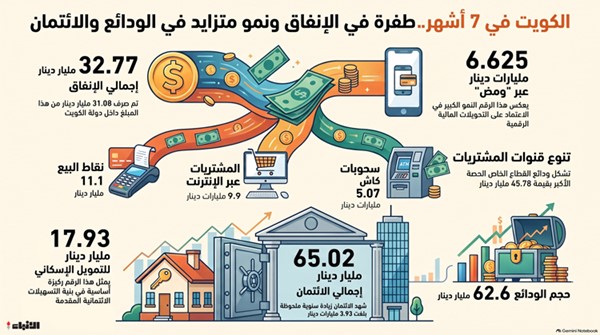
Ali Ibrahim: Official data released by the Central Bank of Kuwait revealed that total spending by citizens and residents in Kuwait reached approximately 32.77 billion dinars during the first seven months of 2026, distributed among direct purchases, cash withdrawals, online purchases via websites, as well as money transfers through the “Wamda” service.
The data showed that spending on direct purchases via point-of-sale terminals and devices amounted to approximately 11.1 billion dinars between January and the end of July 2026, reflecting continued heavy reliance on electronic payment methods for daily transactions in markets and retail stores.
It also indicated that cash spending linked to direct withdrawals from ATMs reached approximately 5.07 billion dinars during the first seven months, suggesting that a segment of consumers still relies on cash to cover part of their expenses, despite the significant expansion in the use of electronic payment methods.
Spending via websites recorded approximately 9.97 billion dinars, making it one of the most prominent components of expenditure during the period, amid the growing scope of e-commerce and the increasing reliance of citizens and residents on purchasing and paying through online platforms and websites.
Meanwhile, the value of financial transfers via the “Wamda” service reached approximately 6.625 billion dinars during the first seven months of the year, reflecting the expanding use of instant money transfer services in executing financial transactions between individuals and bank accounts.
Inside Kuwait, data showed that total spending by citizens and residents within Kuwait reached approximately 31.08 billion dinars during the first seven months of 2026, accounting for the largest share of total spending recorded during the period.
Spending within Kuwait was distributed as follows: approximately 10.3 billion dinars through direct sales terminals and points of sale, and about 4.9 billion dinars withdrawn in cash from ATMs. Additionally, approximately 9.19 billion dinars were spent on purchases via websites, while financial transfers via the “Wamda” service amounted to roughly 6.62 billion dinars.
These figures reflect the diversification of spending patterns in the local market. Spending is no longer limited to cash transactions or direct payments but is now distributed across traditional and electronic payment channels. This shift coincides with the widespread adoption of bank cards, digital banking services, and instant payment methods.
Outside Kuwait, total spending by citizens and residents abroad reached approximately 1.69 billion dinars during the first seven months of 2026. Data indicated that spending on direct purchases via sales terminals and points of sale outside Kuwait amounted to approximately 777.9 million dinars, while cash withdrawals abroad totaled about 131.1 million dinars. Furthermore, spending on online purchases abroad reached approximately 786.2 million dinars, making electronic spending one of the largest components of transactions by citizens and residents outside Kuwait.
Credit Facilities
The sectoral distribution of balances from the utilized portion of credit facilities for residents and non-residents showed an increase in the value of credit facilities by approximately 1.28 billion dinars during the first seven months of the current year, reaching 65.02 billion dinars by the end of July 2026. This represents a 2.01% growth compared to 63.74 billion dinars at the end of December 2025.
Data revealed that total credit facilities continued to rise on a year-on-year basis, recording an increase of approximately 3.93 billion dinars, or 6.4%, compared to 61.09 billion dinars at the end of July 2025. This underscores the continued growth in the volume of banking financing provided to residents and non-residents across various sectors.
The data also showed that credit facilities experienced gradual growth during the first seven months of the year, adding approximately 1.28 billion dinars to their balances compared to the end of last year. This serves as an indicator of sustained demand for financing and the expansion of credit activity within the banking sector.
Housing facilities recorded notable growth during the first seven months of the current year, rising by 3.79%, valued at 655 million dinars, to reach 17.93 billion dinars by the end of July 2026, compared to 17.27 billion dinars at the end of December 2025. On a year-on-year basis, housing facilities increased by 5.57%, valued at 947.3 million dinars, compared to 16.98 billion dinars at the end of July 2025, thereby continuing to record annual growth in their balances.
The growth in housing facilities reflects sustained demand for housing-related financing, as these constitute one of the most prominent components of long-term personal loans, meeting customers' needs for purchasing, constructing, or improving their residences. Housing facilities are long-term personal loans with a maximum duration of 15 years, provided to customers for the purpose of purchasing, renovating, or building a private residence, making them one of the most important banking financing tools linked to the housing sector.
Deposits
Data on deposits of residents and non-residents by type showed that citizens and residents have significantly increased their savings culture. The value of deposits rose by 5.8% during the first seven months of 2026, amounting to 3.47 billion dinars, to reach 62.6 billion dinars. On a year-on-year basis, deposits increased by 10.53%, valued at 5.97 billion dinars.
This rise in deposit volumes was supported by an increase in government deposits by 1.93 billion dinars, a growth of 46.3% during the first seven months of 2026. Government deposits reached 6.11 billion dinars at the end of July, compared to 4.18 billion dinars at the end of December. On a year-on-year basis, they increased by 32.9%, valued at 1.515 billion dinars, compared to 4.6 billion dinars at the end of July 2025.
Public institution deposits also supported the rise in deposit volumes in Kuwait, increasing by 9.4%, valued at 927 million dinars, during the first seven months of 2026, to reach 10.73 billion dinars by the end of July, compared to 9.8 billion dinars at the end of December 2025. On a year-on-year basis, they rose by 40.4%, valued at 3.09 billion dinars, compared to 7.64 billion dinars at the end of July 2025.
Private sector deposits increased by 1.36% during the first seven months of the current year, valued at 615.8 million dinars, to reach 45.78 billion dinars by the end of July 2026, compared to 45.16 billion dinars at the end of December. On a year-on-year basis, they increased by 3.06%, valued at 1.36 billion dinars, compared to 44.4 billion dinars at the end of July last year.
