Potato-like Moon Bites into Mars' Sun Before 'Perseverance'
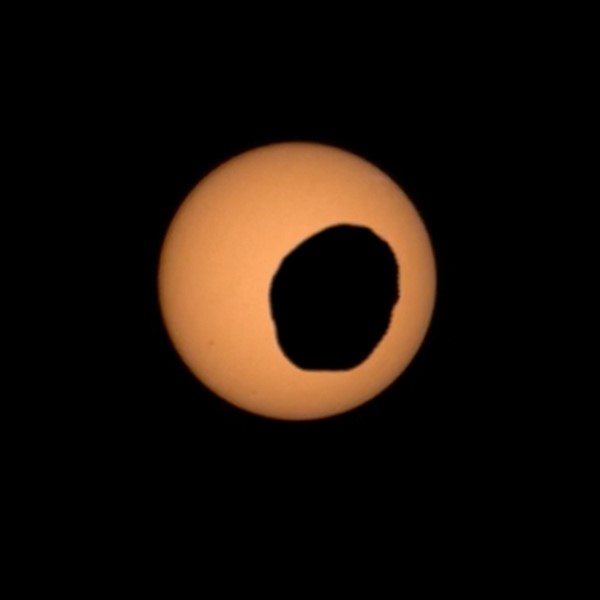
The disk of the Sun above Mars became the backdrop for a fleeting astronomical scene as Phobos, the larger of the Red Planet’s two moons, transited across it while the Perseverance rover observed from the Martian surface.
The Mastcam-Z camera documented the transit on August 12, 2026, during Sol 1948 of the rover’s mission. In the recording, Phobos appears as an irregular dark body, resembling a potato, crossing the face of the Sun without fully obscuring it.
Although the scene is popularly described as an eclipse, the more accurate term is “transit,” because the small Martian moon does not completely cover the solar disk as Earth’s Moon does during a total eclipse. NASA colorized the images to simulate what a human might see on the surface of Mars if observing the phenomenon through specialized solar-viewing glasses.
The recording’s value extends beyond its visual appeal. Since landing in Jezero Crater in February 2021, Perseverance has captured several transits of Phobos.
By comparing these recordings, scientists can refine their calculations of the moon’s orbit and monitor its changes over time.
Phobos is gradually moving closer to Mars, in contrast to Earth’s Moon, which is slowly drifting away from our planet. Estimates suggest that its distant fate may involve either approaching close enough to the Martian surface to be torn apart or disintegrating due to tidal forces, but this will not occur for an extremely long time.
