Chinese Ambassador: Number of Kuwaiti visitors to our country has doubled after visa exemption
&cropxunits=450&cropyunits=300&w=770)
Osama Diab The Chinese Cultural Center in Kuwait hosted the event “Two Palates, One Table: Tasting Chinese and Kuwaiti Tea and Sweets,” as part of the eighteenth Kuwait Cultural Summer Festival. The initiative brought to
Translated by Qiyas from الأنباء — Original source
Osama Diab
The Chinese Cultural Center in Kuwait hosted the event “Two Palates, One Table: Tasting Chinese and Kuwaiti Tea and Sweets,” as part of the eighteenth Kuwait Cultural Summer Festival. The initiative brought together the hospitality traditions of both countries, presenting tea as a bridge for communication and cultural and human rapprochement.
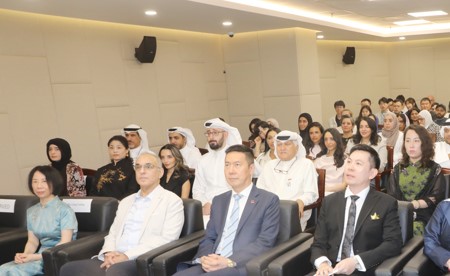
The event was organized by the Chinese Cultural Center in cooperation with the National Council for Culture, Arts and Letters, attended by the Council’s Secretary-General, Dr. Mohammed Al-Jassar, the Ambassador of the People’s Republic of China to Kuwait, Yang Xin, and the Director of the Chinese Cultural Center, Liu Jinhong, along with more than 150 attendees interested in culture, arts, media, and tea culture.
Dr. Mohammed Al-Jassar, Secretary-General of the National Council for Culture, Arts and Letters, emphasized that the Chinese tea ceremony event represents the fruit of cooperation and partnership between the Council and the Chinese side, reflecting both parties’ commitment to enhancing cultural exchange and communication between the Kuwaiti and Chinese peoples.
Speaking at the event, Al-Jassar noted that the Chinese tea ceremony goes beyond merely introducing the preparation and serving methods, opening a window onto an authentic aspect of Chinese culture, with its rituals and values passed down through generations over time.
He pointed out that presenting Kuwaiti and Arab tea ceremonies alongside the Chinese one highlighted similarities and interconnections between cultures, as well as shared human customs that unite peoples and civilizations despite differences in environments and eras.
He clarified that in many cultures, tea is not just a daily habit but a means of communication, bringing people together and bridging distances. The moment of its preparation and serving embodies shared human values, foremost among them hospitality, respect, tranquility, and dialogue—values that transcend linguistic and geographical boundaries.
In a press statement, Al-Jassar stressed the importance of cultural exchange in fostering acquaintance and understanding among peoples, viewing such events as a model of “soft diplomacy” that brings peoples closer and allows each side to learn about the other’s culture, customs, and traditions. He said that knowing the customs and cultures of peoples helps in understanding differences rather than treating them as sources of mystery or divergence. He added that the live presentation of the Chinese tea ceremony, along with an explanation of its history and significance, gives the audience a deeper understanding of the civilization in which it originated.
He further noted that the presence of specialists in Chinese culture to discuss the history of tea, its preparation methods, and its spread from China to various parts of the world, including the Arab world, transforms the event from a mere observation into a comprehensive cultural experience.
He affirmed that this type of exchange strengthens the sense that peoples, despite their differences, belong to a single world, noting that the Council strongly encourages organizing such activities that open the door to acquaintance and appreciation of different cultures.
Al-Jassar pointed out that Kuwaitis’ openness to the cultures of other peoples is an old and deeply rooted passion, linked to Kuwait’s commercial history and the travels of its people to India, East Africa, and other regions. He confirmed that this openness has continued to the present day, with travel and the discovery of new cultures becoming part of the interests of Kuwaiti society.
For his part, Ambassador Yang Xin of the People’s Republic of China to Kuwait affirmed that cultural exchange forms a bridge connecting the hearts of the peoples of the two countries, contributing to enhanced communication and understanding between them.
He noted that this year marks the 55th anniversary of diplomatic relations between Kuwait and China, pointing out that the two countries have succeeded in building fruitful cooperation in various fields over the past decades, based on mutual respect, equality, and shared benefits.
He explained that culture holds a special place in bilateral relations, noting that tea represents one of the most prominent elements of Chinese civilization, carrying a heritage spanning thousands of years, and symbolizing harmony, tolerance, and the convergence of beauty in diversity.
He added that food and sweets also represent one of the most vital means of expressing the identity of peoples and their civilizations, confirming that the event provided attendees with the opportunity to learn about the arts of tea and sweets in China and Kuwait, and to sense the shared values between the two cultures.
He praised the close cooperation between the Chinese Cultural Center and the National Council for Culture, Arts and Letters, affirming that this cooperation has contributed in recent years to enriching cultural and human exchange and strengthening the popular foundation of friendship between the two countries.
In a press statement, Yang Xin described the event as a window for introducing the profound Chinese culture and enhancing friendship between China, Kuwait, and the Arab world. He affirmed that tea in Chinese culture is not merely a beverage but a means of communication and rapprochement among peoples.
He expressed his country’s hope to expand cooperation with Kuwait in various fields, particularly cultural ones, confirming that such initiatives contribute to enhancing mutual understanding and bringing the two peoples closer.
Regarding the interest of Kuwaitis in visiting China following the implementation of the visa exemption policy, he said that the number of Kuwaitis who entered China last year doubled compared to the period before the policy was implemented.
He clarified that regional security conditions have affected air travel during the current period, so he does not have updated figures for this year. However, he expressed his expectation that the number of Kuwaitis traveling to China will continue to rise, whether for tourism, business, shopping, or study.
For his part, Liu Jinhong, Director of the Chinese Cultural Center in Kuwait, affirmed that the event represents an opportunity to enhance cultural exchange between the two countries through tea, considered one of the most prominent elements of hospitality and communication in both Chinese and Kuwaiti cultures.
He said the Center is pleased to use tea as a bridge to introduce the cultures of both countries, explaining that the Chinese people have been accustomed for thousands of years to welcoming guests with tea and building friendships around its table, which has contributed to shaping a rich and diverse tea culture.
