Marwa Al-Juaidan: "Commercial Concealment" Plays a Key Role in Combating Money Laundering
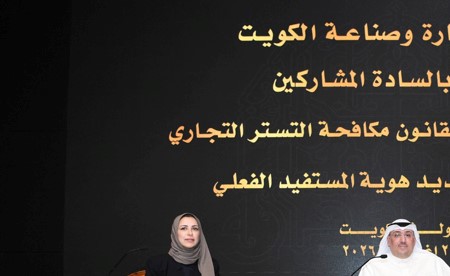&cropxunits=450&cropyunits=293&w=770)
Marwa Al-Juaidan, Acting Undersecretary of the Ministry of Commerce and Industry, affirmed that the Commercial Concealment Combating Law represents a continuation of a legislative journey, noting that the evolution of the business environment and the diversity of economic practices necessitated the establishment of a comprehensive legal framework that directly addresses cases where individuals enable others to conduct economic activities in violation of the law, use licenses, registries, and trade names as a legal cover, or circumvent legally mandated ownership proportions.
Al-Juaidan added during a seminar on the Commercial Concealment Combating Law, hosted by the Kuwait Chamber of Commerce and Industry, that the anti-concealment system is inseparable from broader national efforts to combat money laundering and terrorist financing. She explained that concealing the true individual who owns, controls, or benefits from an economic activity may open the door to misusing companies and legal entities for purposes other than their intended ones, whether to hide true ownership, launder funds, or shield actual activities from legal and regulatory oversight.
She noted that the Commercial Concealment Combating Law and the beneficial ownership system complement each other: beneficial ownership data help identify the true individual who owns or controls an entity, while the Commercial Concealment Combating Law determines whether such ownership, control, or activity is exercised in violation of the law. The law plays a crucial role in supporting the anti-money laundering framework by narrowing the scope of activities conducted outside their legal boundaries and making it more difficult to use licenses, companies, or trade names as a facade to conceal the actual operator or beneficiary of the activity.
Al-Juaidan emphasized that the positive returns of this system primarily benefit compliant merchants. She clarified that those who obtain licenses under their true identities, accurately register their data, and conduct their activities within the scope of their licenses previously faced unfair competition from entities operating outside the legal framework and not bearing the same costs. Regulating such practices ensures fairness for compliant merchants and restores competition to its proper foundation, which is based on the quality of goods and services.
She pointed out that clear ownership and control facilitate access to bank financing and enhance the ability of Kuwaiti companies to enter into regional and international partnerships that require knowledge of beneficial owners. She regarded a clear registry as an asset of the enterprise and a component of its commercial reputation, rather than an administrative burden. She stressed that the goal is for compliance to become a competitive advantage, not a cost to be borne.
It revealed that Kuwait has made tangible progress in registering beneficial owners, with the registration rate rising to over 98% among targeted entities. This achievement resulted from awareness campaigns, the development of electronic systems, and the integration of services, alongside enhanced compliance levels and a gradual shift from awareness-raising to enforcement and verification.
For his part, Deputy Managing Director of the Kuwait Chamber of Commerce and Industry, Emad Al-Zaid, stated that the Commercial Concealment Combating Law has attracted exceptional attention, both from economic and legal specialists and from citizens and residents, through studies, articles, seminars, and social media.
Al-Zaid added that this interest reflects the importance of the legislation and its direct impact on the interests of a large segment of business owners. However, it simultaneously imposes a corresponding duty on the legislator to thoroughly address all aspects, dimensions, and economic and social implications of commercial concealment.
He noted that the law was enacted in response to an urgent need driven by the widening gap, over the years, between declared ownership and the actual, stable ownership of economic projects.
He clarified that the law has brought about a shift in the approach to commercial concealment, moving from mere civil nullity to criminalization backed by decisive penalties. It also aimed to enhance the state’s capacity for supervision, financing, and debt collection.
Emad Al-Zaid observed that the law is “more restrictive than necessary” in its provisions, wording, and mechanisms, meaning its successful enforcement depends largely on the executive regulations.
He expressed reservations about the executive regulations’ ability to bear this burden, particularly since the law did not mention them nor refer to them clearly.
He also pointed out that the Chamber had hoped the law would grant participants in the phenomenon of commercial concealment, prior to its issuance, sufficient opportunity to regularize their status under clear protection from penalties. Furthermore, he expressed the Chamber’s dissatisfaction with Article Nine concerning rewards for whistleblowers.
Al-Zaid affirmed that the law fills a real and dangerous gap in regulation and sanctions, but it requires greater insight into its economic and social impacts to avoid negative consequences, particularly on the efficiency and economics of professional activities and craft services.
