Indonesian Ambassador: Our Relations with Kuwait Extend Beyond Official Cooperation to a Humanitarian Partnership
&cropxunits=450&cropyunits=300&w=770)
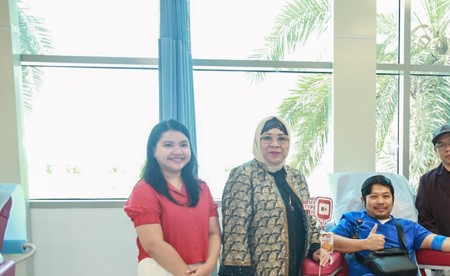
The Indonesian Embassy in Kuwait, in collaboration with the Indonesian Nurses Association in Kuwait, organized a blood donation campaign at the Salwa Al-Sabah Stem Cells and Umbilical Cord Center, with the participation
Translated by Qiyas from الأنباء — Original source
The Indonesian Embassy in Kuwait, in collaboration with the Indonesian Nurses Association in Kuwait, organized a blood donation campaign at the Salwa Al-Sabah Stem Cells and Umbilical Cord Center, with the participation of approximately 100 members of the Indonesian community, including several nurses working in Kuwait’s healthcare sector.
Indonesian Ambassador to Kuwait Lina Mariana emphasized that the campaign represents “a message of solidarity and love from Indonesia and its diaspora to Kuwait and its people,” reflecting the depth of relations between the two countries and the Indonesian community’s commitment to being an active part of Kuwaiti society.
In a statement to the press, Mariana noted that the blood donation drive is held annually in conjunction with Indonesia’s Independence Day celebrations. She pointed out that this marks the fifth campaign organized by the embassy since its arrival in Kuwait about five years ago. She highlighted that the significance of the initiative is not measured solely by the number of participants, but by the humanitarian and solidarity message it conveys.
Regarding the diplomatic dimension of the campaign, she described blood donation as a form of Indonesia’s “soft diplomacy,” explaining that the objective extends beyond providing direct medical support to expressing the solidarity of the Indonesian government and people with Kuwait and its people.
She stated that the initiative carries a clear message that “Indonesia and Kuwait stand together on every occasion and under all circumstances,” particularly in light of current regional and international conditions. She reaffirmed her country’s commitment to standing by Kuwait through initiatives that offer direct benefits to society. “This step reflects Indonesia’s dedication to translating its relations with Kuwait from the level of official cooperation into practical initiatives that impact people’s lives, underscoring that Kuwaiti-Indonesian relations are also built on human and people-to-people communication and social solidarity.”
Regarding Indonesian nursing staff, Mariana revealed that new batches of nurses have arrived in Kuwait, noting that approximately 250 new professionals recently joined the healthcare sector. She explained that the total number of Indonesian nurses in Kuwait currently approaches 500, while the Indonesian community in the country numbers around 6,000. She expressed her expectation that more Indonesian professionals will arrive in Kuwait in the coming period.
She praised the role played by Indonesian nurses in Kuwait’s healthcare sector, considering their participation in the blood donation campaign as an additional aspect of their contribution to society, alongside their professional roles. She affirmed that the campaign serves as a practical example of what resident communities in Kuwait can offer to the host society, and reflects Indonesia’s appreciation for Kuwait and its commitment to strengthening human ties between the two peoples.
She added that Kuwaiti-Indonesian relations “extend beyond political and economic frameworks into the fields of humanitarian and community work,” emphasizing that the Indonesian community, especially healthcare professionals, is keen to repay Kuwait’s kindness by serving society and participating in humanitarian initiatives.
