President Aoun returns from Italy.. Israeli phosphorus shells bombard the South
&cropxunits=450&cropyunits=320&w=770)
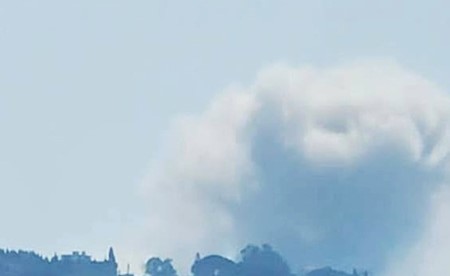
Beirut – Mansour Shaaban: The Israeli army resumed the use of phosphorus shells in its bombardment of targeted areas on the outskirts of “Doha Kafr Raman” and the vicinity of “Tallet Al-Dabasha” and “Ali Al-Taher,” and c
Translated by Qiyas from الأنباء — Original source
Beirut – Mansour Shaaban: The Israeli army resumed the use of phosphorus shells in its bombardment of targeted areas on the outskirts of “Doha Kafr Raman” and the vicinity of “Tallet Al-Dabasha” and “Ali Al-Taher,” and carried out two massive explosions in the towns of Talousa and Arnoon. It also targeted “Masira” in the Wadi Surbin area of the Bint Jbeil district, while unmanned aircraft hovered over Beirut’s southern suburbs.
This coincided with the return of President of the Republic, Major General Joseph Aoun, from Rome, where he met with Pope Leo XIV, Italian President Sergio Mattarella, and Prime Minister Giorgia Meloni. They discussed the situation in Lebanon and the region, as well as the post-phase following the end of the mandate of the United Nations Interim Force in Lebanon (UNIFIL) in the south.
Upon resuming his official duties, President Aoun received a call from the head of the “Karama Current,” MP Fayssal Karami, urging him not to be drawn into attempts to embarrass him or into voices seeking to fabricate imaginary battles. Karami stated that “Lebanon cannot tolerate a return to the policy of breaking balances or undermining the powers of the Prime Ministership or striking at civil peace.” He emphasized that political differences must remain within the framework of the Constitution, and that protecting institutions is achieved by respecting their powers, not by overstepping them.
During his attendance at an invitation from the municipal council of the mountain resort of “Baaqaa Sfarin” in the North, to participate in the opening ceremony of the beautification project for “Baaqaa Sfarin” at the foothills of the Arbaeen Mountains in northern Lebanon, Karami issued political and constitutional criticism of attempts to undermine the balances established by the Taif Agreement and to invent new customs within the Lebanese system. He pointed out that “speaking on behalf of the government in the Parliament is constitutionally the prerogative of the Prime Minister, and it is not permissible for us to have 24 opinions for 24 ministers, effectively resulting in 24 governments.”
Karami also renewed his defense of the general amnesty law, rejecting campaigns that attempted to portray it as a sectarian law or one directed against the Lebanese Army, as well as campaigns that tried to pit the Sunni community against the military institution. He called for “settling contentious files through the judiciary alone, which we believe is the correct path and means to achieve justice,” affirming that balanced development is the true entry point to strengthening Lebanon’s unity and stability.
In parallel, the “Maronite League” stated in a press release that “the movement of President Joseph Aoun toward the Vatican and other influential capitals is a national duty, because defending Lebanon requires activating all available political and diplomatic leverage.” It added that “the logic of tanks alone does not build or protect states, and history has proven that major stances can change equations, and that the voice of truth, when coupled with firm national will and effective international action, can be stronger than weapons.”
As for the “National Council of the Cedar Revolution – Lebanese Front,” it issued a statement considering that “protecting national sovereignty from any aggression, whether internal or external, is a constitutional responsibility incumbent upon the ruling political system.”
For his part, Maronite Patriarch Cardinal Bechara Al-Ra'i spoke during his reception of the new board of the Pharmacists Syndicate at his summer residence in Deir El Qamar. He highlighted “the danger of Lebanon losing its human and scientific resources, and the necessity of providing stability, peace, and job opportunities that encourage youth to remain in their homeland.” He emphasized the importance of maintaining the connection of Lebanese expatriates with their country and registering their children in Lebanon, pointing to the role played by the Maronite Church in countries of the diaspora in preserving identity, belonging, and ties with the homeland.
