Trump: Iran wants to reach an agreement, but we don't know "who we are negotiating with"
&cropxunits=450&cropyunits=300&w=770)
US President Donald Trump affirmed that Iran is eager to reach an agreement with the United States, noting that one of the most significant challenges facing negotiations with Tehran is not knowing “who we are negotiatin
Translated by Qiyas from الأنباء — Original source
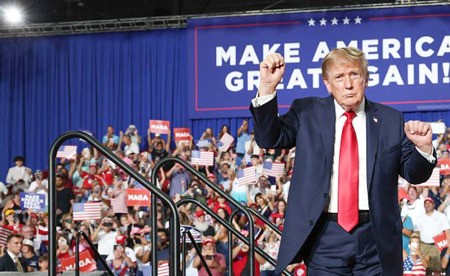
US President Donald Trump affirmed that Iran is eager to reach an agreement with the United States, noting that one of the most significant challenges facing negotiations with Tehran is not knowing “who we are negotiating with.” Speaking at a campaign rally in South Carolina, the US President said, “Iran is the only country in the world where no one wants to be president. They really want to reach an agreement,” adding that “one of my biggest problems is that I don’t know who I am negotiating with in Tehran.”
Trump reiterated his insistence that Iran will never possess a nuclear weapon, stating, “We had to go to them to eliminate their nuclear weapons program because they would have acquired a nuclear weapon. Had they possessed such a weapon, they would have used it immediately to destroy Israel and devastate the Middle East.” He again claimed that Iranians no longer have naval or air forces, radar systems, or technical equipment, and lack manufacturing capabilities, emphasizing that the United States possesses a strong military that is now stronger than ever.
Regarding the Strait of Hormuz, Trump stated, “I currently consider the Strait of Hormuz to be US territory,” noting that “once we are finished with Iran, oil prices will drop below their current levels.”
Meanwhile, US Energy Secretary Chris Wright said that the US military had secured the passage of approximately 15 million barrels of oil through the strait over seven days, confirming that oil continued to flow through the southern route of the strait.
In this context, the Axios news website quoted unnamed US officials as saying that approximately 16 million barrels of oil exited the Strait of Hormuz via the southern route last Friday, noting that about 40 oil tankers had crossed the strait through the Omani southern route two days prior.
For its part, US Central Command (CENTCOM) announced in a statement on its official X platform that US forces had rerouted 68 commercial vessels, halted three ships, and inspected two others to ensure full compliance with the sanctions imposed on Iran. The statement affirmed that US forces have been strictly enforcing a naval blockade on Iranian ports since mid-July.
On its side, the UK Maritime Trade Organization reported that the number of ships transiting the Strait of Hormuz increased by 27% during the past week, noting that 103 ships entered the strait and 89 departed during this period.
In a related development, the official Iranian news agency, IRNA, reported that Tehran had granted passage permits to several Iraqi oil tankers through the Strait of Hormuz at Baghdad’s request. It added that this occurred “despite Tehran facing the most severe military measures and extreme insecurity in the strait.”
Meanwhile, Omani Foreign Minister Badr bin Hamad Al Busaidi and his Iranian counterpart Abbas Araghchi discussed “creating suitable conditions” for resuming dialogue and negotiations, as well as developments in navigation through the Strait of Hormuz. The Omani Ministry of Foreign Affairs stated in a press release that a phone call took place between Al Busaidi and Araghchi, covering “the latest regional developments and ways to create suitable conditions for resuming dialogue and negotiations, which would contribute to bridging differences and reaching peaceful solutions to outstanding issues, taking into account the interests of all parties.” The two ministers also discussed “developments in navigation through the Strait of Hormuz,” emphasizing “the importance of continuing discussions to reach practical understandings that support the resumption of freedom of navigation, its smooth flow, and the security and stability of the region,” according to the statement.
The Sultanate of Oman is conducting negotiations with Iran regarding navigation in the Strait of Hormuz, which is one of the world’s most critical maritime passages for the transport of oil and gas.
