Peace to the Military: The Army's Presence in the South as a State Presence and Restoration of Its Prestige
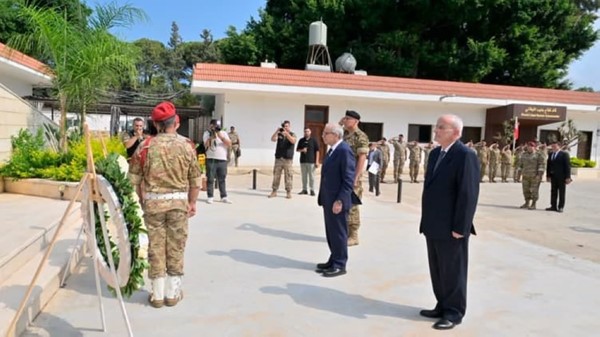
The sound of massive Israeli explosions reached the ears of Prime Minister Dr. Nawaf Salam and Minister of National Defense Major General Michel Mansour as they delivered their speeches to the command of the southern military units at the “Benot Barak” barracks in Sidon. During the visit, they witnessed firsthand the deterioration of the situation on the ground, particularly as the Israeli army carried out a massive explosion during their visit. The blast occurred in two waves in the area between the towns of Arnon and Kafr Kanna, with its echoes reverberating across various southern towns. Meanwhile, drones flew at low altitudes over Beirut’s southern suburb.
Speaking to the military personnel, Salam said, “The meaning of your presence here in the south today is not merely a military deployment; it is the presence of the state. Every site where the army is deployed is a site where the state reclaims its sovereignty, authority, and prestige. Every Lebanese flag raised above any army position is a symbol of the state’s legitimacy. We want this south, just like all of Lebanon, to be under the authority of a single state, and for Lebanese citizens to feel secure because they have an army to protect them. We want the country to enjoy stability as the state and its constitutional institutions reclaim their authority over war and peace.”
He added, “The government of reform and salvation, which I have the honor of leading, committed in its ministerial declaration to work toward establishing a state loyal to the Constitution and the Taif National Accord document we adopted. It will carry out the necessary reforms to fortify state institutions and modernize their administration. We remain committed to achieving this, as a ‘solidarity’ government as required by our country’s constitution, and as we emphasized in the very first sentence of the first paragraph of our ministerial declaration. Therefore, strengthening the role of the army is not a secondary item in our program, nor is it a technical matter; rather, it is a strategic choice at the core of our project to restore the state.”
The Prime Minister stressed that the strength of the Lebanese Army does not rest solely on its weapons, equipment, and manpower, but also on its unity. The army, he noted, is “one of the few institutions where Lebanese meet not as members of sects and regions, but as sons of a single homeland.”
He considered that the best tribute to the army’s martyrs is “to build for their children a strong state with robust institutions, a state whose authority over its territory is not contested by anyone, where no weapon stands above the army’s weapon, and where no will—domestic or foreign—rises above the will of its people, expressed through its constitutional institutions.”
He emphasized that sovereignty, “which we are reclaiming in security terms, must be consolidated in developmental, economic, and social terms.” He added that the state’s return to the south is not complete with the army’s deployment alone; the state is working to return with schools, hospitals, roads, electricity, water, administration, judiciary, job opportunities, and reconstruction.
Salam reiterated the Lebanese state’s continued work to achieve the complete withdrawal of the Israeli occupation, the release of all prisoners, and the safe and dignified return of families to their cities and villages, along with their reconstruction.
The Prime Minister listened to the demands of residents in border towns and villages, assuring them that they would not be left “to face the repercussions of security and economic conditions alone,” and pledged to address their needs and demands within the state’s and its institutions’ capacities.
For his part, Minister Mansour addressed the military personnel, saying, “Our visit to the south today is not merely a reconnaissance and inspection of conditions and needs, which we know well and strive to address and meet with all our strength, will, and capabilities. We are here today to reaffirm our firm position calling for and striving to reclaim the state’s sovereignty over all its territories.”
