Trump: We will talk to Iran when it abandons its nuclear ambitions; North Korea possesses 57 nuclear weapons and I will meet its leader
&cropxunits=450&cropyunits=300&w=770)
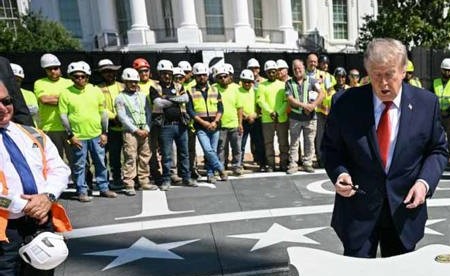
U.S. President Donald Trump stated that the United States would engage in talks with Iran once it abandons its nuclear ambitions. Adding during a tour of a new helicopter pad under construction at the White House, Trump
Translated by Qiyas from الأنباء — Original source
U.S. President Donald Trump stated that the United States would engage in talks with Iran once it abandons its nuclear ambitions. Adding during a tour of a new helicopter pad under construction at the White House, Trump said there were no negotiations with Iran at present, though he qualified this by noting, “Negotiations may resume at some point.” He reiterated that Washington has “full control” over the Strait of Hormuz, pointing out that “large quantities of oil are currently flowing through the strait.”
Meanwhile, the U.S. president said he would meet North Korean leader Kim Jong Un later this year, marking their first encounter since the start of Trump’s second term. When asked by journalists if he planned to meet Kim later in 2026, Trump replied, “Yes, I will.” Trump noted that the North Korean leader “has 57 very powerful nuclear weapons. That should never have been allowed to happen. But he has them. And I am in complete agreement with him.”
The U.S. president had previously instructed his top advisors to halt negotiations with Iran, while the North Atlantic Treaty Organization (NATO) affirmed its readiness to counter any threat following reports that Tehran was considering attacking U.S. military targets in Europe. A U.S. official told CNN that President Trump directed his negotiating team to stop talks with Tehran. According to another informed source, White House officials have recently shifted their strategy from “attacking Iran as quickly as possible” to “gradually strangling it.”
U.S. officials told the same news network that Trump’s directive to his negotiating team—which includes Vice President J.D. Vance and advisors Steve Witkoff and Jared Kushner—to refrain from entering into negotiations with Tehran came after some “positive negotiations” with the Iranian side. According to these officials, Trump remains dissatisfied with Tehran’s unwillingness to respond to his demands and wishes to wait until Iranian leaders demonstrate a renewed willingness to reach the agreement he seeks before resuming talks.
In the meantime, NATO announced its readiness to counter any threat following reports that Iran was considering attacking U.S. military targets in Europe if U.S. President Donald Trump escalated the war against Tehran. A NATO official told CNN yesterday: “Our defensive and deterrent posture is strong and effective. We are ready to counter any threat, as we did earlier this year when NATO air defenses successfully intercepted ballistic missiles launched from Iran toward Turkey on four separate occasions.”
Earlier yesterday, the Financial Times reported, citing sources close to the regime in Tehran, that Iran was considering attacking U.S. military targets in Europe if the United States escalated the war. In response, the NATO official told CNN that the military alliance “is prepared to counter any threat and will always do what is necessary to defend all allies.”
Meanwhile, Iranian Foreign Minister Abbas Araghchi said that the U.S. naval blockade on Iran’s ports has contributed to “shortages in certain areas” and rising prices within Iran. Araghchi noted in an interview published by the Iranian Ministry of Foreign Affairs that the war and U.S. sanctions have made importing goods into Iran “more difficult.”
In a related development, Kpler, a company that tracks ship movements using transponder and satellite data, reported that more than 80% of vessels transiting the Strait of Hormuz over the past two weeks took the Omani route, a UN-approved waterway opposed by Iran. CNN quoted Haimon Falekshahi, head of crude oil analysis at Kpler, as saying: “It increasingly appears that Iran has lost control of the strait, at least partially.” This situation stands in stark contrast to conditions a month ago, when Kpler recorded virtually no notable maritime traffic through the Omani route.
