Al-Anba Publishes Law Regulating the Judiciary: Permits Holding Trials, Hearing Witnesses, and Judicial Procedures via Electronic Means Under Specific Controls
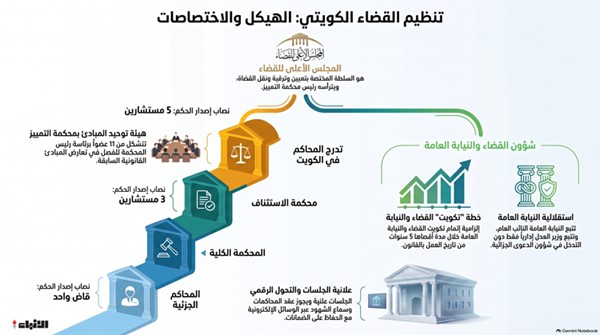
New draft law for regulating the Kuwaiti judiciary includes modern technologies and the Kuwaitization of the judiciary
Translated by Alqyas from Al-Anba — Original source
Al-Anba publishes a draft decree-law issuing a new law regulating the judiciary, which aims to reframe the legislative framework governing the judicial authority, more than three decades after the enactment of the current law. This step seeks to keep pace with developments in judicial work, enhance the efficiency of the justice system, and strengthen judicial independence.
The new law, comprising six chapters, fourteen sections, and 75 articles, includes extensive provisions on the organization of courts, their jurisdictions, and their competencies; matters concerning judges and members of the public prosecution; rules on appointment, promotion, seniority, and judicial inspection; as well as the regulation of secondment, loan, leave, courses, and training.
The law also addresses disciplinary procedures and the guarantees afforded to judges and members of the public prosecution, and establishes safeguards against dismissal. It further regulates several aspects of the public prosecution and the Court of Cassation. In line with technological advancements in judicial work, the law permits holding court sessions, hearing witnesses, and taking certain judicial measures through electronic means, in accordance with the controls set by competent authorities and ensuring the guarantees of a fair trial.
Additionally, the law includes provisions regulating the administrative and financial aspects for personnel working in courts and the public prosecution, and reorganizes certain competencies and procedures to align with the requirements of modern judicial work. The new law emphasizes the Kuwaitization of the judiciary by enabling national cadres through the gradual replacement of non-Kuwaiti judges and members of the public prosecution, according to a specified implementation mechanism with a mandatory deadline of no more than five years from the date the law enters into force. It also facilitates the promotion of Kuwaiti judges holding ranks prior to the law’s enactment.
Furthermore, the law sets a four-year term, renewable once, for senior judicial positions, requiring at least five years of prior judicial experience to assume them. It regulates the reappointment to these positions with a time constraint, and stipulates that upon expiration of the term, the incumbent returns to the judiciary according to their previous seniority rank at the time of appointment.
The following is the full text of the law:
Article 1
The provisions of the accompanying law shall apply in organizing the judiciary.
Article 2
As of the date of entry into force of the provisions of this Decree-Law, those holding the rank of Deputy Heads of the Court of Cassation and the Court of Appeal shall be promoted to the rank of Senior Advisor until the end of their service. Senior Advisors shall replace the Deputy Heads of the Court of Cassation and the Court of Appeal in exercising all powers and jurisdictions stipulated in other laws and decrees.
Those holding the rank of Senior Public Prosecutor shall be promoted to the rank of Assistant Public Prosecutor, and they may exercise the powers and jurisdictions assigned to the Senior Public Prosecutor wherever stipulated in other laws. They may also replace them in disciplinary councils, bodies, and committees of which they are members.
Article 3
As of the date of entry into force of the provisions of this Decree-Law, the President of the Court of Cassation, his Deputy, the President of the Court of Appeal, the Public Prosecutor General, the Deputy President of the Court of Appeal, and the President of the Court of First Instance shall be appointed by decree, upon proposal and nomination by the Minister of Justice, after obtaining the opinion of the Supreme Council of the Judiciary.
Incumbents holding the positions mentioned in the preceding paragraph, who were appointed before the date of entry into force of this Decree-Law, shall continue to perform their duties until the issuance of the appointment decree.
Article 4
The President of the Court of Cassation shall receive the salary prescribed for Ministers, along with all allowances, financial benefits, and other entitlements, unless the law grants him greater rights and benefits due to his position, in which case he shall receive whichever is more favorable. The Deputy President of the Court of Cassation shall receive the salary and allowances prescribed for the President of the Court of Appeal. Judges of the Court of Cassation shall receive the salary and allowances prescribed for Judges of the Court of Appeal.
Article 5
Without prejudice to the provision of Clause (2) of Article (20) of the accompanying law, the Minister of Justice, in cooperation with the Supreme Council of the Judiciary, shall issue the necessary decisions to Kuwaitize the judiciary and the Public Prosecution within a period not exceeding five years from the date of entry into force of this Decree-Law.
Non-Kuwaiti judges and members of the Public Prosecution who were contracted on secondment or in a personal capacity shall continue in their duties until the end of their secondment period or the maximum number of renewals allowed, provided that in no case shall this period exceed the five years referred to in the first paragraph of this Article.
Article 6
As an exception to the provisions of Clauses (2) and (5) of Article (20) of the accompanying law, Kuwaiti judges and members of the Public Prosecution appointed before the entry into force of this Decree-Law shall continue in their positions until the end of their service, and they may be transferred between the judiciary and the Public Prosecution.
Kuwaitis appointed to the position of “Junior Legal Researcher,” who are qualified to hold the position of Deputy Public Prosecutor, or those who applied for that position before the entry into force of this Decree-Law, are also exempted from the provisions of the clauses mentioned in the preceding paragraph.
Article 7
The Technical Office of the Court of Cassation, the Technical Office of the Public Prosecutor General, the Court of Cassation Prosecution, the two Judicial Inspection Departments overseeing the work of judges and members of the Public Prosecution, and the Kuwait Institute for Judicial and Legal Studies, established before the entry into force of this Decree-Law, shall continue to exercise their jurisdictions until they are reorganized in accordance with the provisions of the accompanying law.
Article 8
As an exception to the provisions of Article (22) of the accompanying law, obtaining a competency report is not required for the promotion of Advisors or those of equivalent rank in the Public Prosecution to the next rank, provided they held this rank before the entry into force of this Decree-Law.
Article 9
The Appeals Department for Judges and Members of the Public Prosecution at the Court of Cassation shall continue to hear and rule on appeals filed before it prior to the date of entry into force of this Decree-Law.
Article 10
The Decree-Law is repealed.
Law No. (23) of 1990, referenced above. Furthermore, any provision conflicting with the provisions of this Decree-Law is hereby repealed.
Article 11
The Prime Minister and the Ministers shall each implement this Decree-Law within their respective areas of competence. It shall be published in the Official Gazette and shall take effect from the date of its publication.
Amir of Kuwait
Mishal Al-Ahmad Al-Jaber Al-Sabah
Prime Minister
Ahmad Abdullah Al-Ahmad Al-Sabah
Minister of Justice and Advisor
Nasser Youssef Mohammed Al-Samit
Issued at the Diwan (Palace) of Seif on:
Law on the Organization of the Judiciary
Part One
Courts
Chapter One
Jurisdiction of the Courts
Article (1): Courts shall have jurisdiction to adjudicate all disputes and crimes, except those specifically exempted by law. The law shall specify the rules governing the jurisdiction of the courts.
Article (2): Courts shall not adjudicate sovereign acts.
Chapter Two
Organization and Structure of the Courts
Article (3): The courts shall consist of:
1. The Court of Cassation.
2. The Court of Appeal.
3. The Court of First Instance.
4. The Court of Petty Cases.
Article (4): The Court of Cassation shall be composed of a President, a Vice President, and a sufficient number of Senior Advisors and Advisors. It shall have chambers to hear cassation appeals in civil and commercial matters, personal status matters, criminal matters, administrative matters, and others. Each chamber shall be presided over by the President of the Court, his Vice President, or the most senior Senior Advisor. Judgments shall be issued by five of its members.
Advisors of the Court of Appeal may be seconded to work in the Court of Cassation, in accordance with the rules and regulations issued by a decision of the Supreme Council of the Judiciary.
If any chamber decides to depart from a legal principle established by previous judgments issued by it or by other chambers, it shall refer the appeal to the Body for Unification of Principles. This Body shall be composed of eleven members, being the heads of the Court’s chambers, chosen by the President of the Court of Cassation. It shall be presided over by the President of the Court or his deputy, and shall rule by majority vote on the legal principle to be followed. The appeal shall then be returned to the referring chamber for adjudication. The President of the Court shall issue regulations governing the work procedures and processes of this Body.
If two judgments are issued containing conflicting principles, the President of the Court shall, either on his own initiative or upon a proposal from the Technical Office, convene the aforementioned Body, in the absence of a specific dispute, to affirm the legal principle to be followed in subsequent appeals. The seat of the Court of Cassation shall be in Kuwait City. Its chambers may convene in any other location by a decision of the Minister of Justice, upon request from the President of the Court.
Article (5): The Court of Cassation shall have a Technical Office. Its formation and the specification of its jurisdiction shall be determined by a decision of the Supreme Council of the Judiciary for a period of one year, renewable. It shall be composed of a President at the rank of Senior Advisor and a sufficient number of members of the judicial authority, nominated by the President of the Court of Cassation.
Article (6): The Court of Cassation shall have an independent prosecution office known as the "Cassation Prosecution." It shall provide legal opinions on cassation appeals. It shall be composed of a Director and a sufficient number of members selected from among judges and members of the Public Prosecution.
The secondment of the Director and members shall be by a decision of the Supreme Council of the Judiciary, based on the nomination of the President of the Court of Cassation, and after seeking the opinion of the Attorney General regarding members from the Public Prosecution. This appointment shall be for a period of two years, renewable.
The Supreme Council of the Judiciary shall issue a regulation for the inspection of the members of this prosecution office.
Article (7): The Court of Appeal shall be composed of a President, a Vice President, and a sufficient number of Senior Advisors and Advisors. Chambers shall be formed as needed, presided over by the most senior Advisor among them. Judgments shall be issued by three Advisors.
The Court of Appeal shall be headquartered in the City of Kuwait, and its divisions may convene elsewhere by decision of the Minister of Justice, upon request of the President of the Court.
Article (8): The Full Court shall consist of a President, one or more Vice-Presidents who hold the rank of Senior Counselor, and a sufficient number of Deputy Prosecutors and judges. Its divisions shall be formed as needed, and its judgments shall be issued by three judges, except in cases where the law stipulates that the judgment be issued by a single judge.
Senior Counselors or Counselors may be assigned to preside over the divisions of the Full Court and its attached entities for a period of two years, renewable, upon request of the President of the Full Court and in accordance with the rules and regulations issued by a decision of the Supreme Council of the Judiciary.
Article (9): Partial courts shall be established in each governorate by decision of the Minister of Justice, which shall designate their headquarters and define their jurisdictional divisions.
A partial court shall consist of one or more divisions as required by the workload, and its judgments shall be issued by a single judge.
In cases of necessity, the partial court may convene anywhere within or outside the governorate by decision of the Minister of Justice, upon request of the President of the Full Court.
The General Assembly of the Full Court shall designate one or more divisions headquartered in the City of Kuwait, with jurisdiction over cases in which the Government, a public authority, or a public institution is a party.
The Minister of Justice may, by decision issued upon request of the President of the Full Court, establish partial divisions to adjudicate specific types of cases, specifying in such decision the headquarters of each division and its territorial jurisdiction.
Chapter III: General Assemblies and Temporary Committees
Article (10): The Courts of Cassation, the Court of Appeal, and the Full Court shall convene in a General Assembly, summoned by the President of the Court, to consider the following matters:
1. Organization and formation of divisions.
2. Allocation of cases among the various divisions.
3. Determination of the number of sessions and their scheduling.
4. Assignment of judges from the Full Court to work in the partial courts.
5. Organization of work during vacation periods and determination of cases to be heard therein.
6. Other matters relating to the internal affairs of the Court.
Article (11): The General Assembly of each court shall comprise all its serving judges. Its meetings shall not be valid unless more than half of its members are present. If this quorum is not met, the General Assembly may convene one hour after the scheduled time if at least one-third of the court’s judges are present. If two hours elapse thereafter without achieving this latter quorum, the General Assembly may convene regardless of the number of attending judges.
Decisions of the General Assembly shall be adopted by an absolute majority of the attending members. In the event of a tie, the vote of the President shall prevail.
Article (12): Each court shall form a committee known as the “Temporary Affairs Committee,” chaired by the President of the Court or his deputy, and comprising the two most senior members. This committee shall exercise the powers of the General Assembly in urgent matters when convening the General Assembly is not feasible.
Article (13): Decisions of the General Assembly and the Temporary Affairs Committee of each court shall be communicated to the Minister of Justice. The Minister may return to the General Assembly or the Temporary Affairs Committee any decisions he deems unacceptable for reconsideration. If they persist in their decision, he may refer the matter to the Supreme Council of the Judiciary, which shall issue a decision as it deems appropriate. Its decision shall be final.
Chapter IV: Sessions and Judgments
Article (14): Court sessions shall be public.
Court hearings, witness testimonies, and other judicial procedures may be conducted via electronic means without compromising the guarantees of a fair trial, in accordance with the rules and regulations issued by a decision of the Minister of Justice after obtaining the opinion of the Supreme Council of the Judiciary. Publicity shall be deemed satisfied if the trial procedures are conducted under these conditions.
The court may decide to make
The session shall be held in private out of respect for etiquette, preservation of public order, sanctity of families, or privacy of individuals. The pronouncement of the judgment shall take place in a public session, unless the law provides otherwise. The presiding judge shall maintain order during the session.
Article 15: Arabic is the official language of the courts. However, the court may hear the statements of parties or witnesses who do not know Arabic through an interpreter, after they have taken an oath.
Article 16: Judgments shall be issued and enforced in the name of His Highness the Amir of the State of Kuwait.
Chapter Two: The Supreme Council of the Judiciary
Article 17: The Supreme Council of the Judiciary shall be composed as follows, presided over by the President of the Court of Cassation and including the following members:
1. The Vice President of the Court of Cassation.
2. The President of the Court of Appeal.
3. The Public Prosecutor.
4. The Vice President of the Court of Appeal.
5. The President of the Court of First Instance.
6. The Undersecretary of the Ministry of Justice.
If the President of the Council is excused or prevented from attending, the Vice President of the Court of Cassation shall preside over the Council and act in his place. If neither the President nor the Vice President of the Court of Cassation is present due to an excuse or impediment, the Council may, if necessary, convene under the presidency of the President of the Court of Appeal. In the absence of the President of the Court of First Instance, the most senior of his deputies shall act in his place, and in the absence of the Public Prosecutor, the most senior of the Assistant Public Prosecutors or the Public Prosecutors acting in his place shall do so.
Article 18: The Supreme Council of the Judiciary shall have jurisdiction, upon request by the Minister of Justice, to consider all matters relating to the appointment, promotion, transfer, and secondment of judges and members of the Public Prosecution to duties other than their original positions, in the manner specified in this Law. The Council may express its opinion on matters concerning the judiciary and the Public Prosecution, and may propose measures it deems appropriate on its own initiative or upon request by the Minister of Justice.
Article 19: The Supreme Council of the Judiciary shall meet periodically, at least twice a month, upon summons by its President, or by the Vice President of the Court of Cassation in the event of the President’s absence or vacancy of the position. The summons addressed to members must be accompanied by an agenda. The Council’s meetings shall not be valid unless at least five of its members are present. All its deliberations shall be confidential. Any member may raise any issues they deem fit under the item of new business. Decisions shall be adopted by a majority of votes; in case of a tie, the vote of the presiding member shall prevail.
As an exception to the preceding paragraph, the Council may convene to discuss a specific issue upon the request of at least four of its members, and its meeting shall be valid with the presence of four members. If the Council cannot convene due to one or more vacant seats, a decree shall be issued, upon the proposal of the Minister of Justice, appointing individuals to fill the vacant seats to ensure the validity of its meetings.
The Council invites the Minister of Justice to attend its sessions on matters that the Council deems appropriate for his presence during consideration. The Minister may also attend Council meetings to present matters he deems important to bring to the Council’s attention. The Minister, or his accompanying specialists or experts, or his deputy appointed to attend, shall not have a voting right when decisions are voted upon.
The Supreme Council of Judiciary shall issue a regulation outlining the rules and procedures governing the Council’s exercise of its competencies and the location of its meetings.
The Council may request from the Ministry of Justice any information and documents it deems necessary related to the matters under consideration.
Chapter Three: Judges
Section One: Appointment, Promotion, and Seniority of Judges
Article (20): The following conditions shall apply to any person appointed to the judiciary:
1. He must be Muslim.
2. He must be a Kuwaiti national by origin.
3. He must be of full legal capacity and not have been convicted judicially or disciplinarily for an offense compromising honor or integrity, even if his reputation has been restored.
4. He must have a good conduct record and a reputable standing.
5. He must hold a law degree or an equivalent certificate recognized by the Ministry of Higher Education.
Article (21): Appointment to the position of President of the Court of Cassation shall be made among judges whose rank is no lower than First Counselor, or among members of the Public Prosecution holding an equivalent rank, provided that the appointee has previously served in the judiciary at that rank for a period of no less than five years.
Appointment to the positions of Vice President of the Court of Cassation, President of the Court of Appeal and his Vice President, and President of the Court of First Instance shall be made among judges whose rank is no lower than First Counselor, or among members of the Public Prosecution holding an equivalent rank, provided that they have previously served in the judiciary for a period of no less than five years.
Appointments to these positions shall be made by decree, upon proposal by the Minister of Justice and after obtaining the opinion of the Supreme Council of Judiciary, for a term of four years from the date of appointment. This term may be renewed once, or for the remaining period until reaching the mandatory retirement age, whichever is shorter. Upon expiration of the appointment term, the individual may return to the judiciary according to his seniority ranking prior to his appointment to the position.
The period spent in any of these positions, whether by appointment or secondment, shall be considered continuous and counted from the first date of assuming the position, even if followed by an appointment or secondment to another such position. No person who has held any of these positions may re-assume it or hold the positions stipulated in the first paragraph of Article (62) of this Law, except after four years have elapsed from the date of termination of his last tenure in any of these positions. As an exception, a person who has held any of these positions and has not completed the maximum allowable duration in that position may assume another of these positions in place of his previous one, thereby completing the remaining period of his initial tenure or its renewal.
Appointment to the position of Vice President of the Court of First Instance shall be made among judges whose rank is no lower than First Counselor, or among members of the Public Prosecution holding an equivalent rank, provided that the appointee has previously served in the judiciary for a period of no less than five years. This appointment shall be made by decree, upon proposal by the Minister of Justice and after obtaining the opinion of the Supreme Council of Judiciary, for a non-renewable term of four years, or for the remaining period until reaching the mandatory retirement age, whichever is shorter. Upon expiration of the appointment term, the individual may return to the judiciary according to his seniority ranking prior to his appointment to the position.
As for appointments or promotions to other judicial positions, they shall be made by decree, upon proposal by the Minister of Justice and with the approval of the Supreme Council of Judiciary.
Article (22): Promotions of judges and members of the Public Prosecution holding equivalent ranks shall be based on seniority and merit. In all cases, promotion shall be only to the immediately next rank.
A condition for the promotion of Counselors and members of the Public Prosecution holding equivalent ranks is that the candidate for promotion must obtain an evaluation report with a grade
Satisfactory performance must be above average, and otherwise, a candidate for promotion is required to obtain two consecutive reports in which his performance rating is not less than above average. A judge or public prosecutor may be bypassed in promotion in any of the following cases: - If a reprimand has been issued against him by the Disciplinary Council. - If a written warning has been issued against him in accordance with Articles (37) and (66) of this Law. - If he has not passed the training courses in accordance with the controls and conditions set by the Supreme Council of the Judiciary on this matter. Article (23): Seniority of judges and members of the public prosecution is determined based on the date of the decree issued appointing them to their positions, unless this decree specifies another date based on the approval of the Supreme Council of the Judiciary. If two or more judges or members of the public prosecution are appointed in a single decree, seniority among them is determined according to their order in the decree. Chapter Two: Non-removability of Judges Article (24): Judges and members of the public prosecution, except those at the rank of Deputy Public Prosecutor (C), are not subject to dismissal except in accordance with the disciplinary trial procedures stipulated in this Law. The contracts of contracted judges and members of the public prosecution may not be terminated except with the approval of the Supreme Council of the Judiciary. Senior Advisors and Advisors of the Court of Cassation and the Court of Appeal may not be transferred to the public prosecution except with their consent. Chapter Three: Duties of Judges Article (25): Judges shall take the following oath before assuming their duties: “I swear by Almighty God that I will judge among people with justice and that I will respect the laws and regulations of the country.” The oath shall be administered for the President of the Court of Cassation and his deputy, the President of the Court of Appeal and his deputy, and the President of the Total Court before His Highness the Amir, in the presence of the Minister of Justice. The oath shall be administered once for Senior Advisors, Advisors, and judges before the President of the Supreme Council of the Judiciary, in the presence of the President of the competent court. Article (26): A judge or member of the public prosecution may not be awarded medals, rosettes, ribbons, necklaces, or anything else while holding his position. It is also not permissible to combine the judicial position with engaging in trade or any work that conflicts with the dignity and independence of the judiciary. The Supreme Council of the Judiciary may decide to prevent a judge from engaging in any activity that it deems to conflict with the duties of the position and its proper performance. The Supreme Council of the Judiciary shall issue a Code of Judicial Conduct, and compliance with it is considered a duty of judges and members of the public prosecution. A judge or member of the public prosecution may be seconded to perform judicial or legal work other than his own or in addition to it, by a decision of the Minister of Justice after approval of the Supreme Council of the Judiciary. A judge or member of the public prosecution may, with his consent, be seconded or loaned to international bodies or entities within or outside the State of Kuwait for a period not exceeding four years, which is not renewable, by a decision of the Council of Ministers upon the proposal of the Minister of Justice after approval of the Supreme Council of the Judiciary. The member retains his position and seniority throughout the period of secondment, and this period shall be counted as part of years of service. He may retain his total salary. A decision by the Minister of Justice shall determine what constitutes the elements of the total salary. Article (27): A judge or member of the public prosecution may not serve as an arbitrator, even without remuneration, without the approval of the Supreme Council of the Judiciary, even if the dispute is not before the courts, unless one of the parties to the dispute is his relative or in-law up to the fourth degree. Article (28): Judges and members of the public prosecution are prohibited from the following: 1. Engaging in political work or expressing political opinions in all forms and shapes. 2. Running for candidacy in general elections. 3. Publishing anything related to their official duties on social media or otherwise. Article (29): Judges may not disclose secrets
Deliberations. Article (30): Judges related by blood or marriage up to the fourth degree shall not sit in the same judicial panel. Furthermore, the public prosecutor’s representative, the representative of any party to the case, or the defense counsel, if they are related to any of the judges hearing the case by the aforementioned kinship, shall not participate in the proceedings.
Chapter Four: Judicial Inspection
Article (31): The Judicial Inspection Administration shall be responsible for inspecting the work of counselors at the Court of Appeal, prosecutors at the Criminal Court, and their judges. It shall be composed of a head holding the rank of Senior Counselor and a sufficient number of members whose rank is not lower than that of Counselor.
Inspection of the work of public prosecutors, heads of the Public Prosecution, and their deputies shall be conducted by an administration headed by a person holding the rank of Assistant Public Prosecutor, along with a sufficient number of public prosecutors and heads of the Public Prosecution. Judges whose rank is not lower than that of Counselor may be seconded to this administration.
The Supreme Council of Justice shall issue, each year, a decision appointing the head and members of each of the aforementioned administrations. A decision by the Supreme Council of Justice shall govern the inspection system in all courts and the Public Prosecution.
Article (32): Competence assessment in inspection reports shall be determined using one of the following ratings: Competent / Above Average / Average / Below Average.
Inspection shall be conducted once for counselors at the Court of Appeal and members of the Public Prosecution holding equivalent ranks. Those who receive an “Average” rating in their competence assessment shall have the right to request a second inspection, which shall be submitted to the Supreme Council of Justice.
Inspection of prosecutors and judges at the Criminal Court, and members of the Public Prosecution holding equivalent ranks, including prosecutors at Grade “C”, shall be conducted at least once every two years.
Judges and members of the Public Prosecution must be informed of all notes or documents placed in their service files. They shall also be notified of a copy of the inspection report and shall have the right to appeal to the Supreme Council of Justice within fifteen days from the date of notification.
The Supreme Council of Justice shall rule on the appeal after reviewing the documents and, if necessary, hearing the appellant’s statements. The Council’s decision regarding competence assessment shall be final.
The Judicial Inspection Administration shall send a copy of the inspection report to the Minister of Justice and the Supreme Council of Justice immediately upon depositing the report in the personnel file.
Article (33): The Minister of Justice may refer to the Supreme Council of Justice the cases of counselors, prosecutors, and judges at the Criminal Court, and members of the Public Prosecution holding equivalent ranks, who have received two consecutive inspection reports rating them as “Below Average.”
After reviewing their cases, the Council shall decide either to refer them to retirement, terminate their contracts, or transfer them to a non-judicial position.
The Minister of Justice shall notify the judge or member of the Public Prosecution of the content of the Council’s decision referred to in the preceding paragraph immediately upon its issuance. Their jurisdiction shall cease from the date of such notification.
In the event of a decision to transfer a judge or member of the Public Prosecution to another position, they shall retain their salary in that position, even if it exceeds the maximum salary limit for the rank of the position to which they are transferred.
Article (34): The resignation of the head and members of the Supreme Council of Justice shall be considered accepted from the time it is submitted to the Minister of Justice.
The resignation of a judge or member of the Public Prosecution shall be considered accepted from the time it is submitted to the head of the court to which the judge belongs, or to the Public Prosecutor General in the case of members of the Public Prosecution.
Resignation shall not result in a reduction of pension or severance pay.
Chapter Five: On Leaves
Article (35): Without prejudice to the provisions of Articles (40) and (41) of the Civil Service System, the Supreme Council of Justice shall issue a decision establishing the system for periodic leave for judges and members of the Public Prosecution.
With the consent of the judge or member of the Public Prosecution, the periodic leave allowance may be paid in cash if work conditions so require. The Supreme Council of Justice shall establish the rules for disbursing this allowance.
The Supreme Council of Justice may authorize a judge or member of the Public Prosecution
By completing his postgraduate studies, being granted study leave, or being sent on a mission, and he may retain his full salary throughout that period. The Supreme Council of the Judiciary shall issue a decision outlining the regulations governing such matters and the components of the full salary.
Chapter Six: Disciplinary Measures
Article 36: Without prejudice to the constitutional guarantees provided for, the Minister of Justice has the right to supervise the judiciary, and the president of each court and its general assembly have the right to supervise the judges subordinate to them.
Article 37: The president of the court has the right, either on his own initiative or based on a decision of its general assembly, to admonish judges regarding any acts by them that violate their duties or the requirements of their positions, after hearing their statements. Such admonition may be oral or written; in the latter case, a copy shall be communicated to the Minister of Justice. The judge may appeal to the Supreme Council of the Judiciary against a written admonition addressed to him within fifteen days from the date of notification. The Council—or a senior advisor designated by it—may conduct an investigation into the incident that was the subject of the admonition if it deems it appropriate, and it may uphold or annul the admonition. In all cases, if the violation is repeated or persists after the admonition becomes final, disciplinary proceedings shall be initiated.
Article 38: Except in cases of flagrant offenses, no investigative measures, arrest, or filing of criminal charges against a judge or a member of the public prosecution for any crime may be taken by any authority without the permission of the Supreme Council of the Judiciary, upon request by the Attorney General. In cases of flagrant offenses, the Attorney General must, upon arresting or detaining a judge or a member of the public prosecution, refer the matter to the Supreme Council of the Judiciary within twenty-four hours for it to decide as it deems fit. In such cases, the judge or member of the public prosecution may request to be heard by the Council. The public prosecution alone holds the authority to investigate, prosecute, and take action in all crimes committed by or against a judge or a member of the public prosecution.
Article 39: The Supreme Council of the Judiciary has jurisdiction to consider the pre-trial detention of a judge or a member of the public prosecution, renew such detention, or order alternative measures, while observing the guarantees stipulated in the Code of Criminal Procedure and Courts, unless the matter is already pending before the competent criminal court, in which case that court shall have jurisdiction.
Article 40: The detention of a judge or a member of the public prosecution, pursuant to an order or judgment, shall automatically result in their suspension from performing their official duties for the duration of the detention. The Supreme Council of the Judiciary may also order the suspension of a judge or a member of the public prosecution from performing their official duties during the investigation of a crime committed by them, either on its own initiative, upon request by the Attorney General, the president of the court to which they belong, or based on a decision of its general assembly, and the Minister of Justice shall be notified thereof. Suspension shall not deprive the judge or member of the public prosecution of their salary throughout the period of suspension.
Article 41: Disciplinary action against judges of all ranks falls under the jurisdiction of a disciplinary council composed of three senior advisors from the Court of Cassation and two judges not lower in rank than those of the Court of Appeal, provided that none of them is the president or a member of the Supreme Council of the Judiciary. The council shall be presided over by its most senior member. The general assembly of each of the two courts shall annually select the senior advisors and the advisors who will serve as members of the disciplinary council, along with substitutes. The disciplinary council shall convene at the seat of the Court of Cassation, and the Chief Judicial Inspector or his designate shall represent the prosecution before it.
Article 42: Disciplinary proceedings shall be initiated by the Chief Judicial Inspector, either upon request by the Minister of Justice, the president of the court to which the judge belongs, or the Attorney General, as appropriate. Disciplinary proceedings may also be brought against a judge who has lost trust and esteem or who has lost
The necessary authority to perform his duties for reasons other than health, based on a complaint submitted for that purpose, and he shall be referred to the Disciplinary Council to consider his dismissal from service. The lawsuit shall not be filed except after a criminal or administrative investigation conducted by the Judicial Inspection or by a person designated by the Supreme Council of the Judiciary if the investigator is senior to the Head of the Judicial Inspection. The Head of the Judicial Inspection shall file the lawsuit within thirty days from the date of the request. Disciplinary proceedings against the President and members of the Supreme Council of the Judiciary from among judges shall be brought before a special judicial committee upon request by the Minister of Justice or the Supreme Council of the Judiciary. This committee shall be composed of three First Counselors selected annually by the General Assembly of the Court of Cassation, with an equal number serving as alternates in addition to their regular duties. The committee’s sessions shall be held at the premises of the Court of Cassation, and the committee may enlist the Judicial Inspection Administration to perform secretarial duties. The committee shall seriously examine the facts raised in a confidential manner; if it finds them unsubstantiated, it shall order the case file to be closed, otherwise it shall proceed with the investigation, in which case it shall possess all the powers granted to the Head of the Judicial Inspection. Article (43): Disciplinary proceedings shall be initiated by a petition containing the charges and supporting evidence, and submitted to the Disciplinary Council, which shall issue its decision to notify the judge to appear before it if it finds grounds to proceed with disciplinary trial procedures, provided that notification is issued at least one week before the scheduled date. In such cases, the Council may decide to suspend the judge from performing his official duties or place him on compulsory leave until the trial concludes, and it may review the suspension or leave decision at any time. Notification to the judge shall be effected by the President of the Court to which the judge belongs. Article (44): The Disciplinary Council may conduct any investigations it deems necessary and may designate one of its members to carry them out. Article (45): The Disciplinary Council or its designated member for investigation shall have the powers granted to courts regarding witnesses whom they deem it beneficial to hear. Article (46): Sessions of the Disciplinary Council are confidential. The Council shall render its judgment after hearing the submissions of the Judicial Inspection and the defense of the judge subject to disciplinary action. The judge has the right to appear in person before the Council and may submit his defense in writing or appoint another judge to defend him on his behalf. The Council always retains the right to require the judge’s personal appearance; if the judge fails to appear or to appoint a representative, judgment may be rendered in his absence upon verification of proper notification. Article (47): Disciplinary proceedings shall not be extinguished by the judge’s resignation. Disciplinary proceedings shall not affect criminal or civil proceedings arising from the same incident. Article (48): The judgment issued in disciplinary proceedings must include the grounds on which it is based, and these grounds shall be read aloud when the judgment is pronounced in a closed session. An appeal against the disciplinary judgment may be filed before one of the administrative chambers of the Court of Cassation specialized in matters concerning judges and members of the Public Prosecution, within sixty days from the date of the judgment if the convicted party was present at the last session of the trial. The appeal period shall commence from the date of notification of the judgment if it was issued in absentia. Except as otherwise provided, the appeal procedures set forth in Article (53) of this Law shall apply. The Ministry of Justice shall be notified of a copy of the judgment in all cases. Article (49): Disciplinary sanctions that may be imposed are reprimand and dismissal. Article (50): The President of the Court to which the judge belongs shall notify him of the judgment issued against him by the Disciplinary Council within forty-eight hours of its issuance. The judge’s jurisdiction shall cease from the date of the Disciplinary Council’s judgment of dismissal if he was present when the judgment was pronounced; otherwise, his jurisdiction shall cease from the date of notification of the judgment. Chapter Seven Appeals Against Decisions Concerning Judges’ Affairs Article (51): Without prejudice to the provisions
Article (48): One of the administrative circuits of the Court of Appeal, exclusively, shall have jurisdiction to rule on petitions submitted by judges and members of the Public Prosecution Service to annul final administrative decisions concerning any of their employment matters, provided that the petition is based on a defect in form, lack of jurisdiction, violation of laws and regulations, error in their application or interpretation, or abuse of power. It shall also have exclusive jurisdiction to rule on claims for compensation arising from such decisions, and on disputes concerning salaries, pensions, and allowances due to them or to their heirs. No person who participated in the decision that gave rise to the petition may sit to rule on such petitions.
Article (52): The petition shall be filed within sixty days from the date of publication of the contested decision in the Official Gazette, or from the date the concerned party is notified thereof or becomes certain of its existence. The petition shall be filed by submitting a petition document to the Registry of the Court of Appeal, containing details regarding the names, capacities, and addresses of the parties, the subject matter of the petition, and a sufficient statement thereof. The petitioner shall deposit, along with the petition document, copies thereof equal in number to the parties, a cover for his supporting documents, and a statement of defense. Upon depositing the petition document, the Registry shall issue the depositor a receipt certifying the date and time of deposit. The Registry must, within the following three days, notify the parties of the petition document. Each party shall have the right to respond to its contents by submitting a statement of defense, along with necessary documents, to the Court Registry within thirty days from the date of notification. Upon expiration of this period, the Registry shall set a hearing date for considering the petition within a maximum of two months, and shall notify the disputing parties of the hearing date at least one week prior to its convening, via registered letters with acknowledgment of receipt. No fees shall be levied on this petition. The petitioner shall conduct all procedures before the circuit personally, and may submit his defense in writing or appoint one of the current or former judges to do so on his behalf. The notification stipulated in this Article shall be conducted in accordance with the rules set forth in the aforementioned Civil and Commercial Procedures Law.
Article (53): Judgments issued in the lawsuits referred to in the preceding Article may be appealed before one of the administrative circuits of the Court of Cassation, exclusively, by submitting a petition document to the Registry of the Court of Cassation within sixty days from the date of the judgment’s issuance, without the requirement of a guarantee. The petition document shall include details regarding the names, capacities, and domiciles of the parties, a statement of the grounds upon which the appeal is based, and the appellant’s requests. The Public Prosecution Service at the Court of Cassation shall deposit a statement of its opinion on the grounds of the appeal within sixty days, and may endorse this opinion on the appeal file if deemed sufficient. The appellant, who is a judge or a member of the Public Prosecution Service, shall conduct all procedures before the circuit personally, and may submit his defense in writing or appoint one of the current or former judges to do so on his behalf. All other rules and provisions concerning cassation appeal procedures set forth in the aforementioned Civil and Commercial Procedures Law shall apply, except as otherwise provided.
Chapter Four
The Public Prosecution Service
Section One: Jurisdictions and Composition of the Public Prosecution Service
Article (54): The Public Prosecution Service shall exercise the powers conferred upon it by law, and shall have the right to institute and conduct criminal proceedings, without prejudice to its powers stipulated in the aforementioned Law of Criminal Procedures and Courts, or any other legal provision.
Article (55): The Public Prosecution Service shall conduct the investigation of the criminal case in accordance with the provisions of the preceding Article, and may assign judicial police officers for this investigation.
Article (56): Subject to the provisions of the two preceding Articles, judicial police officers shall, with respect to the performance of their duties, be subordinate to...
To the Public Prosecution, and they have the right of supervision over the investigative acts and evidence-gathering they carry out. Article 57: The Public Prosecution shall supervise detention centers, prisons, and other places where criminal sentences are executed. Article 58: The Public Prosecution’s duties shall be performed by the Public Prosecutor, a sufficient number of Assistant Public Prosecutors, Public Lawyers, and heads of the prosecution and their deputies. The most senior Assistant Public Prosecutor or Public Lawyer shall replace the Public Prosecutor in all his jurisdictions in the event of his absence, vacancy of his position, or the existence of an impediment. Article 59: The Public Prosecutor shall have a technical office, whose jurisdiction shall be determined by a decision of the Supreme Council of the Judiciary upon the proposal of the Public Prosecutor. This office shall consist of a head and a sufficient number of judges and members of the Public Prosecution. The appointment of office members from among the judges shall be issued by a decision of the Supreme Council of the Judiciary based on the Public Prosecutor’s nomination, for a term of two years, renewable. Article 60: The Public Prosecution is indivisible, and any of its members may act on behalf of others unless the law provides that a specific act or procedure falls within the jurisdiction of the Public Prosecutor, the Assistant Public Prosecutor, the Public Lawyer, or the head of the prosecution. Article 61: All members of the Public Prosecution are subordinate to the Public Prosecutor. The Public Prosecutor is subordinate to the Minister of Justice, except for jurisdictions related to any aspect of criminal proceedings, specifically those concerning initiating, pursuing, investigating, and handling and prosecuting such cases. Chapter Two On the appointment, promotion, and transfer of members of the Public Prosecution Article 62: Appointment to the positions of Public Prosecutor and Assistant Public Prosecutors shall be by decree, based on a proposal from the Minister of Justice, after obtaining the opinion of the Supreme Council of the Judiciary. Candidates must be judges not lower in rank than First Counselor or equivalent, or members of the Public Prosecution who have previously served in the judiciary for at least five years. Appointment to these positions shall be for a term of four years from the date of appointment to any of them, and may be renewed once or for the remaining period until reaching the mandatory retirement age, whichever is shorter. Upon expiration of the appointment term, the individual shall return to service in the judiciary according to their seniority prior to their appointment to the position. No one who has held any of these positions may rehold them or hold the positions stipulated in the first and second paragraphs of Article 21 of this Law, except after four years have elapsed from the date of the end of their last tenure in any of them. As an exception, anyone who has held any of these positions and has not completed the maximum duration of stay in them may hold one of them instead of their previous position for the remaining period of their initial tenure or its renewal. Appointment to other Public Prosecution positions and promotion to them shall be by decree, based on a proposal from the Minister of Justice, with the approval of the Supreme Council of the Judiciary, except for appointment to the rank of Deputy Prosecutor (C), which shall be issued by a decision of the Minister of Justice after obtaining the opinion of the Public Prosecutor and the approval of the Supreme Council of the Judiciary. The appointee shall be placed on probation, and may be dismissed by a decision of the Minister after obtaining the opinion of the Public Prosecutor if it is established that he is unfit to perform the duties of his position. He shall be considered confirmed upon his promotion to the higher position, and the probation period shall count toward his service tenure. All appointment conditions prescribed for judges as set forth in Article 20 of this Law shall apply to all other members of the Public Prosecution. Article 63: Members of the Public Prosecution shall take the following oath before assuming their duties: “I swear by Almighty God that I shall perform the duties of my position with honesty and integrity, and that I shall respect the laws and regulations of the country.” The oath for the Public Prosecutor shall be taken before His Highness the Amir, in the presence of the Minister of Justice. The oath for the remaining members of the Public Prosecution
The Public Prosecution is under the authority of the President of the Supreme Council of the Judiciary, in the presence of the Attorney General. Article (64): The transfer of members of the Public Prosecution to the judiciary and the transfer of judges to the Public Prosecution shall be by decree, upon the proposal of the Minister of Justice and with the approval of the Supreme Council of the Judiciary. The transfer of members of the Public Prosecution from one prosecution office to another shall be by a decision of the Attorney General. Chapter Three Disciplinary measures for members of the Public Prosecution Article (65): Without prejudice to the constitutional guarantees provided for, the Minister of Justice has the right to supervise and oversee the Public Prosecution, and the Attorney General has the right to supervise and oversee all members of the Public Prosecution. Article (66): The Attorney General may issue a verbal or written warning to a member of the Public Prosecution who fails to fulfill his official duties, after hearing his statements. The member of the Public Prosecution may appeal the written warning before the Supreme Council of the Judiciary within fifteen days from the date of notification of the warning, and the Council’s decision shall be final. Article (67): The same provisions, rules, and procedures established for the disciplinary action against judges, as set forth in Articles (41) to (50) of this Law, shall apply to the disciplinary trial of members of the Public Prosecution, except for the announcement of the disciplinary indictment and the notification of the content of the judgment issued by the Disciplinary Council, which shall be the responsibility of the Attorney General. The disciplinary action against the Attorney General shall be initiated in the same special manner prescribed for other members of the Supreme Council of the Judiciary, as stipulated in Article (42) of this Law. Chapter Five Court and Public Prosecution Staff Article (68): The Ministry of Justice shall appoint a sufficient number of staff members to work on financial, administrative, and clerical affairs in the courts and the Public Prosecution, and the Minister of Justice shall issue the necessary decisions to regulate these affairs. Subject to the relevant provisions of the Civil Service System, the heads of courts and the Attorney General, with respect to the staff members under their respective jurisdictions from the categories of general, auxiliary, and supporting functional groups, shall have the authority to impose all disciplinary sanctions except dismissal from service and demotion in rank, which shall be decided by the Minister of Justice. Except as provided above, the provisions of the aforementioned Civil Service Law and its regulations shall apply to staff members working in the courts and the Public Prosecution. Article (69): The provisions issued by decision of the Minister of Justice shall apply to the collection of court fees and fines, the preservation of deposits and trusts, and the execution of disbursement orders issued by the Public Prosecution. The Public Prosecution, when exercising its statutory authorities, is exempt from paying all fees due to state entities. Chapter Six Final Provisions Article (70): Adequate financial appropriations for the affairs of the judiciary, the Public Prosecution, and their assisting entities shall be allocated, and these appropriations shall be included among various expenditures and transfer payments in the section dedicated to the Ministry of Justice in the budget of government ministries and administrations. In derogation of the provisions of Decree-Law No. (31) of 1978 mentioned above, the Ministry of Justice, after obtaining the opinion of the Supreme Council of the Judiciary, shall submit the estimates for these appropriations to the Ministry of Finance, which prepares the draft budget. Implementation shall be in accordance with the rules agreed upon between the Minister of Finance and the Minister of Justice. The opinion of the Supreme Council of the Judiciary referred to in the preceding paragraph shall be presented in full to the National Assembly, together with the draft budget, detailed by the various allocations, in the format in which the budget of the Ministry of Justice is submitted. Article (71): The Minister of Justice shall have all the authorities of the Civil Service Diwan as stipulated in laws and regulations, with respect to the affairs of the judiciary, the Public Prosecution, and their assisting entities. Article (72): The Supreme Council of the Judiciary shall prepare a report at the beginning of October of each year, or
Whenever he deems it necessary, the report shall include deficiencies or ambiguities in the existing legislation revealed by judicial rulings and retention decisions issued by the Public Prosecution, as well as any measures he considers necessary to advance the administration of justice. The Minister of Justice shall submit this report to the Council of Ministers.
Article 73: A decree shall be issued, upon the proposal of the Minister of Justice and after obtaining the opinion of the Supreme Council of the Judiciary, to regulate the establishment of the Kuwait Institute for Judicial and Legal Studies. The decree shall specify its objectives.
Attendance at training is considered a requirement for appointment and a fundamental duty of the position. The Institute’s Board of Directors shall be composed of the Minister of Justice as Chairman, and the following members:
1. The Public Prosecutor.
2. The President of the Court of Cassation.
3. The Undersecretary of the Ministry of Justice.
4. The Dean of the Faculty of Law at Kuwait University.
5. The Director of the Institute.
6. An expert chosen by the Minister of Justice.
Article 74: By decision of the Minister of Justice, after obtaining the opinion of the Supreme Council of the Judiciary, a private club for judges and members of the Public Prosecution shall be established to engage in various cultural and social activities.
Article 75: The Minister of Justice, after obtaining the opinion of the Supreme Council of the Judiciary, shall issue the regulations governing the administrative, financial, and personnel affairs of both the Institute and the Club referred to in the preceding two articles.
Explanatory Memorandum
Decree-Law No. ( ) of 2026
Issuing the Law Regulating the Judiciary
The judiciary is a symbol of state sovereignty, a refuge for the oppressed, and a source of order. Its independence is a fundamental pillar of justice. Since the dawn of history, it has borne the trust of justice, as old as human society itself, which has always recognized its need for security and tranquility, and for resolving disputes arising among individuals. Through the judiciary, the system of governance stabilizes, security prevails, and the state flourishes. If the indispensable condition for ensuring this role is that the judiciary has its own law regulating its affairs, it is worth recalling that the first Law Regulating the Judiciary, issued by Amir’s Decree No. (19) of 1959, was entirely reviewed after approximately thirty years and subsequently repealed by Decree-Law No. (23) of 1990, which issued the Law Regulating the Judiciary. This law reorganized the judiciary to align with the prevailing circumstances at the time. However, legislative amendments to that law were continuous, aiming to prevent its provisions from becoming rigid, thus necessitating a comprehensive review to enable the judiciary to fulfill its optimal and most complete role.
In light of the comprehensive reform wave sweeping the country, which was launched by the High Speech of His Highness the Amir of Kuwait, may God protect and support him, on May 10, 2024, and which contained eloquent words stating that the justice sector is the people’s refuge for safeguarding their rights and freedoms, remaining a beacon of light, a protector of rights, and a guardian of freedoms; and that the judiciary is one of the pillars of the state, and that negative phenomena will not persist and will be reviewed according to careful, deliberate steps undertaken by trusted Kuwaiti men; and that the judiciary is capable of purifying itself through the hands of its loyal men; and since these high directives have carried the banner of reform within the judicial system, it was imperative that they influence the Law Regulating the Judiciary issued by Decree-Law No. (23) of 1990. To achieve these noble objectives, there arose a need for a new law that reorganizes the judicial framework, strengthens its weak points, and presents a more advanced profile keeping pace with developments in comparative judicial systems.
Given that the Amir’s Order was issued on May 10, 2024, and its Article (4) stipulates that laws shall be issued by decree-laws, this present decree-law has been prepared.
The decree-law comprises eleven articles. The first article stipulates that the provisions of the accompanying law shall apply to the organization of the judiciary.
Article 2 of the decree-law provides that, with effect from the date of its implementation, those holding the rank of Deputy Chief Justice of the Court of Cassation and the Court of Appeal shall be promoted to the rank of Senior Advisor, retaining the same powers and jurisdictions assigned to Deputy Chief Justices of these courts under existing laws and decrees, until the end of their service. Additionally, those holding the rank of Senior Public Prosecutor shall be promoted to the rank of Assistant Public Prosecutor, with the same powers and jurisdictions as Senior Public Prosecutors as stipulated in other laws, and shall be authorized to act in their place in disciplinary councils, bodies, and committees in which they participate.
Article 3 addresses the regulation of existing situations upon the commencement of this decree-law, taking into account the new organizational conditions for filling certain positions specified therein, the terms of appointment to these positions, and the resulting provisions that differ from previous practices. Since applying these provisions necessarily leads to the termination of the tenure of some incumbents, while other positions remain vacant, public interest necessitates the harmonization of statuses and the appointment of all incumbents according to the new organizational structure. In doing so, consideration was given to ensuring the regular convening and smooth conduct of the Supreme Council of Justice’s sessions, and to avoiding any disruption to its work that might arise from vacancies in these positions or the expiration of the terms of current officeholders.
Undoubtedly, reorganizing the appointment of administrative positions in the judiciary and defining the conditions and terms for holding them does not constitute dismissal from the judicial office, nor does it remove individuals from the judiciary or diminish the judicial status of their holders. Holding such positions is an assignment driven by the operational needs of the institution, not a personal entitlement or a permanent right to remain in them. Upon the expiration of a judge’s tenure in any such position, they shall resume their judicial duties according to their rank and seniority, as the exercise of judicial authority and adjudication of disputes is the primary function of a judge, whereas administrative posts are incidental to their career path.
To ensure continuity of operations during the period required to complete appointment procedures under the new organization, the article stipulates that incumbents appointed to these positions prior to the effective date of this decree-law shall continue to perform their duties until the issuance of the formal appointment decrees.
It also maintained that appointments are made by decree based on the nomination of the Minister of Justice and after obtaining the opinion of the Supreme Council of the Judiciary, in line with the existing law governing the judiciary, which requires seeking the Council’s opinion in this regard.
Article Four of the Emiri Decree-Law establishing the new pay scale determined that the President of the Court of Cassation shall receive the same salary as that prescribed for a Minister, along with all other allowances and financial benefits allocated to this rank, unless the law grants the President of the Court of Cassation greater rights and benefits due to his position, in which case the higher amount shall apply. The same article stipulated that the Vice President of the Court of Cassation shall receive the salary and allowances prescribed for the President of the Court of Appeal, while the counselors of the Court of Cassation shall receive the salary and allowances prescribed for counselors of the Court of Appeal.
In compliance with the High Command issued in the Amir’s speech during his visit to the Supreme Council of the Judiciary on March 16, 2025, regarding the rapid Kuwaitization of the judiciary and supporting positions, Article Five of the present Emiri Decree-Law stipulated that the Minister of Justice, in cooperation with the Supreme Council of the Judiciary, shall gradually issue the necessary decisions to Kuwaitize the judiciary and the Public Prosecution within a maximum period of five years from the date of implementation of this Decree-Law. It further provided that non-Kuwaiti judges and members of the Public Prosecution appointed on secondment or in a personal capacity shall continue in their duties until the end of their secondment period or the maximum number of renewals, provided that in no case shall this period exceed the five years mentioned in the first paragraph of this article.
Article Six exempted Kuwaiti judges and members of the Public Prosecution appointed before the implementation of its provisions, allowing them to remain in their positions until the end of their service terms, with the possibility of transfer between the judiciary and the Public Prosecution. This exemption applied to the two new conditions contained in the accompanying law, which require that those serving in the judiciary or working in the Public Prosecution must be Kuwaiti by origin and hold a law degree or an equivalent certificate recognized by the Ministry of Higher Education. This exemption also covered Kuwaitis who applied for or were appointed to the position of “Junior Legal Researcher,” which qualifies them for the role of Deputy Public Prosecutor, provided such appointments occurred before the implementation of this Decree-Law.
Article Seven of the Emiri Decree-Law stipulated that the Technical Office of the Court of Cassation, the Technical Office of the Attorney General, the Court of Cassation Prosecution, the two Judicial Inspection Departments, and the Kuwait Institute for Judicial and Legal Studies, all established before the implementation of its provisions, shall continue to exercise their competencies until they are reorganized in accordance with the provisions of the accompanying law.
Article Eight exempted counselors or members of the Public Prosecution at their rank who held such positions before the implementation of its provisions from the application of Article 22 of the accompanying law. Consequently, they are not subject to the requirement of obtaining a performance evaluation rated above average for promotion to the next rank. The rationale behind this exemption is to enhance the numerical sufficiency of members of the Courts of Appeal and Cassation, as the promotion of counselors or members of the Public Prosecution at their rank has become easier after their exemption from the requirement of a satisfactory evaluation for promotion to the next rank, thereby contributing to the Kuwaitization of the membership of these two courts.
Article Nine of the Emiri Decree-Law aimed to preserve the legal stability of requests submitted by judges and members of the Public Prosecution to the specialized chamber in the Court of Cassation before the implementation of the accompanying law. This was achieved by stipulating the continuation of this chamber’s jurisdiction to hear and rule on such requests, ensuring the smooth operation
Justice and efficiency in procedures, and to avoid the new law’s enactment causing delays in adjudicating pending cases. Article 10 repealed Legislative Decree No. (23) of 1990 referred to above, and also repealed any provision conflicting with the provisions of the present legislative decree. Article 11 obliged the Prime Minister and ministers, each within their respective competencies, to implement its provisions, and specified that it would take effect from the date of its publication in the Official Gazette.
Although the present legislative decree repealed the Law Regulating the Judiciary issued by Legislative Decree No. (23) of 1990 referred to above, the Law Regulating the Judiciary contained in the present legislative decree retained certain longstanding rules and provisions that were included in the repealed law, preserving them within its text to maintain their entrenchment since they had been in force for years, given their status as solid pillars of the Kuwaiti judiciary. Accordingly, the accompanying law aimed to achieve these objectives without undermining these pillars, thereby establishing a balance between them.
The provisions of the accompanying law consisted of 75 articles divided into six chapters. The first chapter, titled “Courts,” addressed their jurisdiction, hierarchy, organization, general assemblies, and temporary committees, as well as court sessions and the issuance of judicial rulings in Articles (1) through (16). This framework relied on the same foundational principles as the previous Law Regulating the Judiciary. However, it authorized the secondment of Court of Appeal counselors to work in the Court of Cassation, according to rules and regulations issued by a decision of the Supreme Council of the Judiciary. This measure aims to ensure that the Court of Cassation has sufficient judicial manpower and provides an effective solution to the problem of the accumulation of appeals, which had burdened litigants with years-long waits for the resolution of their appeals.
Closely related to this issue, the law adopted a new approach—distinct from previous practices—to address the matter of departing from a legal principle established by prior rulings of the Court of Cassation, or resolving conflicts between two of its rulings that contain contradictory principles. Specifically, paragraphs three and four of Article (4) stipulate that if any chamber considers departing from a legal principle established by its own prior rulings or by those of other chambers, it shall refer the appeal to the Body for Unification of Principles. This body comprises eleven members, who are heads of the Court’s chambers, selected by the President of the Court of Cassation and chaired by him or his deputy. The body decides, by majority vote, the legal principle to be followed, and then returns the appeal to the referring chamber for adjudication. The President of the Court shall issue regulations governing the body’s work and procedures. Furthermore, if two rulings are issued containing contradictory principles, the President of the Court, upon a proposal from the Technical Office, shall convene the Body for Unification of Principles, in the absence of a specific dispute, to affirm the legal principle to be followed in future appeals.
The accompanying law also sought to alleviate a significant portion of the administrative burden on the President of the Total Court, given the reality of the large number of cases brought before the first-instance courts (“partial and total”), and the resulting technical and administrative matters derived from them. Consequently, it became necessary to allow for the appointment of deputies when required. Article 8 of the accompanying law stipulated that the Total Court shall be composed of a President, one or more deputies at the rank of Senior Counselor, and a sufficient number of Deputy Prosecutors and judges. Additionally, the presidency of some of the three-judge chambers may be entrusted to Senior Counselors and Counselors for a two-year term, renewable upon the request of the President of the Total Court, thereby ensuring that the Total Court benefits from judicial expertise drawn from higher courts.
In light of public interest considerations and the changes across various fields leading to the emergence of disputes or criminal cases requiring specialized judges or specific chambers to handle them promptly,
Due to its specific nature, the final paragraph of Article 9 of the accompanying law authorized the Minister of Justice, upon the request of the President of the Supreme Court, to establish criminal courts to adjudicate specific types of cases, via a ministerial decision specifying the seat and territorial jurisdiction of each court.
Given the relentless technological and technical advancements, it became necessary to harness these developments to serve justice, saving time and effort, realizing the concept of expeditious justice, and keeping pace with the practices of courts in neighboring countries that had pioneered holding sessions via electronic means. Therefore, Article 14 of the accompanying law provided for the permissibility of holding court sessions, hearing witnesses, and conducting other judicial procedures through electronic means, without prejudice to trial guarantees, subject to regulations issued by a decision of the Minister of Justice after obtaining the opinion of the Supreme Council of the Judiciary. Publicity shall be deemed satisfied if proceedings are conducted electronically, and the pronouncement of judgment shall take place in a public session, unless the law stipulates otherwise.
Chapter Two of the accompanying law, titled “The Supreme Council of the Judiciary,” addressed its composition, competencies, and meetings in Articles 17, 18, and 19. Distinctively, the Council is composed of a President and six members. Its meetings are not valid unless at least five members are present. All its deliberations are confidential, and decisions are issued by a majority of votes; in the event of a tie, the vote of the President prevails.
Where a specific matter required submission to the Supreme Council of the Judiciary and could not tolerate delay, or where exigent circumstances necessitated it, the second paragraph of Article 19 of the accompanying law permitted, as an exception to the procedures specified for convening the Council by its President or the Vice President of the Court of Cassation in the absence of the President or if the position is vacant, and as an exception to the quorum requirement of at least five members, the convening of the Council to discuss a specific matter upon the request of at least four of its members, with the meeting being valid if four members are present.
The third paragraph of Article 19 addressed a legislative remedy for the scenario where the Supreme Council of the Judiciary cannot convene due to one or more vacant seats among its members. This situation could paralyze the Council’s work and halt the exercise of its competencies, given the requirement for a minimum quorum that cannot be met with ongoing vacancies. To prevent such paralysis, the provision authorized the issuance of a decree appointing replacements for the vacant seats, upon the proposal of the Minister of Justice, in a manner limited solely to completing the legal quorum necessary for the Council to convene.
Chapter Three of the accompanying law, titled “Judges,” is divided into seven chapters. The first chapter addressed their appointment, promotion, and seniority in Articles 20, 21, 22, and 23. Since the judiciary is a general authority and one of the state’s powers, Article 20 of the accompanying law stipulated that those assuming judicial office must be Kuwaiti nationals by origin, consistent with the constitutional requirements for members of the National Assembly and ministers. The law also adopted justified strictness in filling these positions by adding the phrase “even if his reputation has been restored” to clause (3) of that article. Furthermore, appointment to these positions became restricted to holders of a law degree or its equivalent recognized by the Ministry of Higher Education, thereby excluding holders of a Sharia degree from appointment.
Article 21 of the accompanying law provided a robust regulatory framework for the conditions of appointment to senior judicial positions. It stipulated that the position of President of the Court of Cassation must be filled by judges holding the rank of First Counselor or higher, or by members of the Public Prosecution holding an equivalent rank, provided that they have previously
Working in the judiciary at this rank for a period of no less than five years, given that it is the highest position in the judicial hierarchy and entails presiding over the Supreme Judicial Council, necessitates specific and extensive judicial experience at this particular rank. The article also included provisions regarding appointments to the positions of Deputy President of the Court of Cassation, President of the Court of Appeal, his Deputy, and President of the Court of First Instance. It stipulated that holders of these positions must be judges or public prosecutors of at least the rank of Senior Counsel, provided they have previously served in the judiciary for no less than five years.
Since entrenching the principle of orderly rotation for senior judicial positions requires limiting the terms of office in a manner that ensures equal opportunity among members of the judicial branch, this article stipulated that appointments to the aforementioned judicial positions shall be for a term of four years, renewable once, or for the remaining period until reaching the mandatory retirement age, whichever is shorter. Upon expiration of the appointment term, the individual shall return to judicial service according to their seniority ranking prior to appointment to any of these positions, without such return being considered dismissal or removal. This is based on the judicial tradition, upheld across generations, which holds that the most cherished place for a judge is the bench. Furthermore, non-renewal of a judge’s appointment to other roles does not constitute dismissal or removal, as long as the judge continues to exercise their jurisdiction in hearing cases, issuing judgments, and administering justice among people.
To achieve this objective, the article’s text unified the time limit for assuming senior judicial positions. It also stipulated that the period spent in any of these positions, whether by appointment or secondment, shall be considered continuous and counted from the first assumption of such a position, even if followed by an appointment or secondment to another such position. To ensure regular rotation within a controlled timeframe, actual turnover in these positions, and an opportunity for other qualified competencies, the same article provided that no one who has held any of these positions may hold any of them or the positions specified in the first paragraph of Article (62) until four years have elapsed from the date of the end of their last tenure in any of these positions. As an exception, a person holding any of these positions who has not completed the maximum duration of stay in that position may assume another of these positions in place of their previous one, thereby completing the remaining duration of their initial tenure or its renewal.
In the same context, the accompanying law dedicated a special provision to the position of Deputy President of the Court of First Instance, considering that it does not form part of the membership of the Supreme Judicial Council. Appointment to this position is made from among judges or public prosecutors of at least the rank of Senior Counsel, provided they have previously served in the judiciary for no less than five years. The appointment is issued by decree upon the proposal of the Minister of Justice and after obtaining the opinion of the Supreme Judicial Council, for a term of four years that is not renewable, or for the remaining period until reaching the mandatory retirement age, whichever is shorter. Upon expiration of the appointment term, the individual may return to judicial service according to their seniority ranking prior to appointment to the position.
The accompanying law also considered the conditions for the promotion of judges and members of the public prosecution in the same capacity. Article (22) thereof stipulated that promotions are based on seniority, merit, and achieving a “above average” rating in performance reports on their work. Promotion is only to the immediately next rank. For Counsels and public prosecutors of equivalent rank, a single performance report is required; in all other cases, the candidate must obtain two consecutive performance reports. This article outlined the circumstances under which a judge or public prosecutor may be bypassed in promotion and specified
Article (23) Judicial seniority and that of members of the Public Prosecution are determined according to the date of the decree appointing them to their positions, unless the decree specifies another date based on the approval of the Supreme Council of the Judiciary. If two or more individuals are appointed by a single decree, seniority is determined by their order of mention therein.
Chapter Two addresses the non-dismissibility of judges and members of the Public Prosecution, embodying the provision of Article (163) of the Constitution, which stipulates that the law shall guarantee judicial independence and specify the conditions under which they are not subject to dismissal. Accordingly, Article (24) provides that judges and members of the Public Prosecution, except those holding the rank of Third Assistant Public Prosecutor, are not subject to dismissal except through the disciplinary trial procedures set forth in this Law. The contracts of judges and members of the Public Prosecution engaged on a contractual basis may not be terminated without the approval of the Supreme Council of the Judiciary. Furthermore, individuals holding the ranks of Senior Advisor and Advisor among the members of the Court of Cassation and the Court of Appeal may not be transferred to the Public Prosecution without their consent. The exception of Third Assistant Public Prosecutors from the protection against dismissal outside disciplinary channels is justified by their recent appointment, which warrants placing them under probation before such guarantees apply to them.
Chapter Three covers the duties of judges under Articles (25), (26), (27), (28), (29), and (30). It stipulates that they must take an oath before assuming their duties, using the wording specified in Article (25). The Law does not merely enumerate prohibitions that judges or members of the Public Prosecution must avoid; rather, Article (26) explicitly obligates them to adhere to the “Judicial Code of Conduct.” Given their sufficient expertise, they are permitted to be seconded to perform judicial or legal duties other than or in addition to their primary work, by a decision of the Minister of Justice following the approval of the Supreme Council of the Judiciary.
Chapter Four, titled “Judicial Inspection,” reflects the continuity of the accompanying Law in maintaining the concept of a Judicial Inspection Administration, as was the case under the previous Law. Articles (31), (32), (33), and (34) address the Judicial Inspection Administration and its competencies, which include inspecting the work of advisors of the Court of Appeal, prosecutors of the Court of First Instance, and their judges. It also mandates the Judicial Inspection Administration to oversee the work of public prosecutors, heads of the Public Prosecution, and their deputies in fulfilling their assigned roles, while specifying the positions comprising these two administrations. Undoubtedly, the existence of such inspection will reveal deficiencies in their work. The Law also adopts a new approach, differing from the previous Law, by allowing a second inspection for advisors of the Court of Appeal and members of the Public Prosecution of equivalent rank who received a “satisfactory” rating, upon a request submitted to the Supreme Council of the Judiciary. The Law also addresses the consequences of an individual under inspection receiving two consecutive “satisfactory” reports. It stipulates that the resignation of the head and members of the Supreme Council of the Judiciary becomes effective from the time it is submitted to the Minister of Justice, and the resignation of a judge or member of the Public Prosecution becomes effective from the time it is submitted to the head of the court to which the judge belongs, or to the Public Prosecutor for members of the Public Prosecution, without any reduction in pension or severance pay.
Chapter Five regulates leave under Article (35). In order to encourage judges and members of the Public Prosecution to complete their academic studies, the Law takes this aspect into account, permitting the Supreme Council of the Judiciary to grant judges and members of the Public Prosecution authorization to pursue postgraduate studies, take academic leave, or be sent on a mission, with the possibility of retaining
At the comprehensive level throughout that period, a decision must be issued by the Supreme Council of the Judiciary regarding the regulations governing this matter and what constitutes elements of the comprehensive salary. Chapter Six was dedicated to the subject of disciplinary matters. Article 36 began by establishing the general principle of the Minister of Justice’s oversight over the judiciary, without prejudice to the constitutional guarantees ensuring the independence of the judicial authority, and with the oversight of each court president and its general assembly over the judges subordinate to them. Its provisions, from Articles 37 to 50, specifically regulated the disciplinary procedures for judges and members of the public prosecution, warned judges against conduct violating their duties, outlined the procedures to be taken against them in cases other than flagrant offenses, and assigned the Supreme Council of the Judiciary the jurisdiction to consider the pre-trial detention of a judge or a member of the public prosecution and its consequences. It also addressed the disciplinary action against judges of all ranks before the Disciplinary Council, the circumstances under which disciplinary proceedings are initiated by the Head of Judicial Inspection and the associated procedures, the sessions of the Disciplinary Council, and stipulated that the disciplinary penalties that may be imposed are reprimand and dismissal.
Furthermore, Article 42 of the accompanying law specified the manner in which disciplinary proceedings are brought against judges and the circumstances necessitating such actions, including: a judge losing trust and respect, or the competence required to perform his duties due to any behavior that undermines such competence, such as moral or professional misconduct, repeated non-malicious complaints against him, or violation of the judicial code of conduct, and other acts that diminish his dignity and prestige.
Pursuant to the aforementioned Article 42, a special judicial committee was established. Disciplinary proceedings against the president and members of the Supreme Council of the Judiciary from among the judges may only be initiated by this committee, upon request from the Minister of Justice or the Supreme Council of the Judiciary. The committee is composed of three First Counselors, selected annually by the General Assembly of the Court of Cassation, with an equal number serving as alternates, in addition to their regular duties. The committee’s sessions are held at the premises of the Court of Cassation, and the committee may enlist the Judicial Inspection Administration to perform secretarial duties.
Article 48 established a new procedural guarantee, allowing an appeal against the judgment issued in disciplinary proceedings before the Administrative Chamber of the Court of Cassation specialized in matters concerning judges and members of the public prosecution, within a specified period not exceeding sixty days from the date of the judgment’s issuance or its notification, if issued in absentia, according to the procedures outlined in the article. Previously, the former law insulated judgments from appeal by any means. This amendment aimed to reinforce the principle of legality and judicial oversight, and to guarantee the right to litigation for those referred to disciplinary trials, especially in light of the absence of considerations justifying the closure of the appeal process for such judgments, which, given their nature and seriousness, should be subject to judicial review like other disciplinary disputes heard before bodies that include a judicial element in their composition.
Chapter Seven, titled “Appeals Against Decisions Concerning Judges’ Affairs,” regulated the procedures, time limits, and competent authority for adjudicating such appeals through Articles 51, 52, and 53. The law followed a different approach from the previous legislation, assigning jurisdiction over requests submitted by judges and members of the public prosecution to annul final administrative decisions concerning any of their professional affairs to one of the Administrative Chambers of the Court of Appeal. Appeals against its judgments are heard before one of the Administrative Chambers of the Court of Cassation.
Part Four of the law, titled “The Public Prosecution,” addressed its jurisdiction, composition, appointment, promotion, transfer, and disciplinary measures for its members, through Articles 54 to 67. The most prominent provisions in this part included what was stipulated
Article (62) of the law establishes a similar framework regarding the appointment of the Public Prosecutor and Assistant Public Prosecutors within the Public Prosecution, specifically concerning the requirement of judicial experience, the fixed duration of appointment, and the restrictions on reappointment to the positions specified in that article. This represents the consolidation of the same principles underlying Article (21) of the accompanying law, which reinforces the principle of regulated rotation for senior judicial positions, unifies the maximum time limit for holding such positions, and provides opportunities for other qualified professionals. Additionally, the law introduces a deviation from the previous legislation regarding the initiation of disciplinary proceedings against the Public Prosecutor; pursuant to Article (67), such proceedings are now initiated through the same special procedure applied to other members of the Supreme Council of the Judiciary, as stipulated in Article (42), whereas under the previous law, they were initiated by the Minister of Justice.
Chapter Five of the law regulates the status of personnel working in the courts and the Public Prosecution. Articles (68) and (69) address the appointment of staff to handle financial, administrative, and clerical affairs in the courts and the Public Prosecution, as well as the authorities of court presidents over them. They also cover the collection of judicial fees and fines, the safeguarding of deposits and trusts, and the execution of disbursement orders issued by the Public Prosecution. Furthermore, the law introduces a provision exempting the Public Prosecution, when exercising its legally mandated competencies, from paying all fees due to state entities, thereby enabling it to perform its judicial functions without procedural or financial obstacles.
Chapter Six of the accompanying law addresses the final provisions in Articles (70) through (75). These articles regulate the financial appropriations allocated for judicial affairs, the Public Prosecution, and supporting entities, and mandate their inclusion under expenditures and payments in the section dedicated to the Ministry of Justice within the budget of government ministries and administrations. The law grants the Minister of Justice all authorities of the Civil Service Bureau as stipulated in laws and regulations, specifically concerning judicial affairs, the Public Prosecution, and their supporting entities. The law also highlights the role of the Supreme Council of the Judiciary in identifying ambiguities or deficiencies in existing legislation and proposing necessary measures to advance the administration of justice.
Article (73) of the law regulates the Kuwait Institute for Judicial and Legal Studies, specifies its composition, and stipulates that participation in training is a requirement for appointment and a fundamental duty of the position. Articles (74) and (75) maintain the concept of establishing a club for judges and members of the Public Prosecution to engage in cultural and social activities. The law leaves to the Minister of Justice the authority to issue regulations governing the administrative, financial, and personnel affairs of both the Institute and the Club, following the opinion of the Supreme Council of the Judiciary.
Draft Decree-Law No. ( ) of 2026
Replacing the table attached to Decree-Law No. (126) of 2018 concerning the minimum periods required for retention in the ranks of judges and members of the Public Prosecution.
After reviewing the Constitution,
And Decree-Law No. ( ) of 2026 issuing the Law Regulating the Judiciary,
And Decree No. (126) of 2018 amending the table attached to Decree No. (41) of 2009 concerning the minimum periods required for retention in the ranks of judges and members of the Public Prosecution,
And based on the proposal submitted by the Minister of Justice,
We have decreed as follows:
After approval by the Council of Ministers:
Article One
The table of minimum periods required for retention in the ranks of judges and members of the Public Prosecution attached to this Decree-Law is hereby replaced by the table attached to Decree-Law No. (126) of 2018, without prejudice to the salaries, allowances, and increments allocated for each rank.
Article Two
The Ministers are each responsible, within their respective jurisdictions, for implementing this Decree-Law.
The decree shall be published in the Official Gazette and shall take effect from the date of its publication.
Emir of Kuwait: Mishal Al-Ahmad Al-Jaber Al-Sabah
Prime Minister: Ahmad Abdullah Al-Ahmad Al-Sabah
Minister of Justice: Counselor Nasser Youssef Muhammad Al-Samit
Issued at the Bayt Al-Saif Palace on: [Date]
