Aoun: Lebanon's top priority is to extend UNIFIL's mandate, and we are committed to fully implementing the framework agreement
&cropxunits=450&cropyunits=272&w=770)
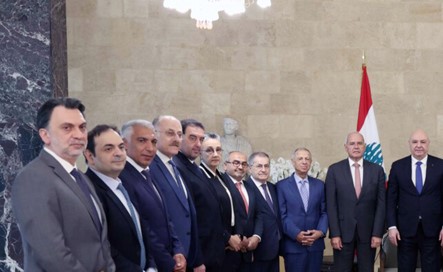
Beirut – Mansour Shaaban: President of the Republic, General Joseph Aoun, affirmed during his meeting with the “Task Force for Lebanon” delegation that “Lebanon is committed to fully implementing the Framework Agreement
Translated by Qiyas from الأنباء — Original source
Beirut – Mansour Shaaban: President of the Republic, General Joseph Aoun, affirmed during his meeting with the “Task Force for Lebanon” delegation that “Lebanon is committed to fully implementing the Framework Agreement and relies on the United States to carry it out,” noting that Washington is “serious, committed, and supportive” of this effort. He stressed that “Israel will not be able to achieve its goals through the mere use of military force, destruction, and killing of innocents.”
President Aoun pointed out that “service ministries are now present in villages and towns where the Lebanese Army has deployed, providing services to residents.” He highlighted efforts to “enact laws to combat corruption, complete reforms, implement e-government, and activate the judiciary.”
While Israel continued its illegal military operations in the south—conducting shelling, airstrikes, destruction, clearing operations, and displacing residents—President Aoun received at Baabda Palace a delegation comprising 20 members of parliament, led by MP Melhem Khalaf. The delegation presented him with a parliamentary petition signed by 86 MPs, representing more than two-thirds of the Parliament, calling for the retention of the international peacekeeping forces (UNIFIL) stationed in the south.
President Aoun welcomed the MPs’ initiative, emphasizing “the importance of UNIFIL’s presence in the south for various humanitarian, social, economic, and security reasons, as well as for providing a sense of reassurance to the population in the south, which helps stabilize them in their villages and towns.” He expressed hope that “this move, stemming from the Lebanese parliamentary initiative, will achieve the desired outcome.”
He clarified that “Lebanon’s first option is to extend the mandate of UNIFIL forces. If that is not possible, the second option is to have forces with the required legal framework, ensuring that the south is not left without an international presence under the UN flag.” He noted that “there is currently no decision on this matter.”
He added that “Israel opposes the presence of UNIFIL forces and has been pressuring in this direction for about a year, whereas we call for their continued presence. The core idea is that we want to create a breakthrough, either by extending UNIFIL’s mandate or by deploying substitute forces, and we are working to prevent any vacuum.” He stressed that “such an issue must be pushed forward now, rather than waiting until the last moment to discuss it.”
At the Sarrat al-Sumoud (Government Palace) in central Beirut, Prime Minister Dr. Nawaf Salam received the parliamentary delegation, reiterating that “the official Lebanese position insists on the need for an international force in the south to carry out three essential tasks: monitoring and reporting, coordination, and liaison.” He added, “I personally informed UN Secretary-General Antonio Guterres, during his visit to Beirut and through subsequent communications, of Lebanon’s clear position on this matter. He expressed understanding of the need to continue the presence of an international force in the south to succeed UNIFIL.”
In this context, former President of the Republic, General Michel Suleiman, stated that “after all these years and all the tragedies for which Lebanese have paid the price, the time has come for everyone to realize that there is no solution except through the state and its legitimate institutions, foremost among them the Lebanese Army, which will continue to implement the decisions of the political authority, thereby safeguarding Lebanon’s sovereignty, protecting its unity, and serving the interests of all Lebanese.” He continued, “Experience has proven that Lebanon’s protection can only be ensured by a single national army, a single sovereign decision, and a state that alone holds the authority over war and peace.”
Meanwhile, Army Commander, General Rodolphe Hayek, and US General Joseph Clerfaut, head of the Special Military Coordination Group for Lebanon, discussed developments in the south and security arrangements related to the “Framework Agreement,” as well as the difficulties faced by the Lebanese Army in carrying out its missions, foremost among them the continued attacks and clearing and destruction operations by the Israeli occupation. During the meeting held at General Hayek’s office, both sides emphasized “the importance of supporting the Lebanese Army amid the missions it is carrying out in the south and various other regions of Lebanon.”
