A Fine of $59.8 Trillion Per Gram: What Do You Know About the Most Expensive Material on Earth?
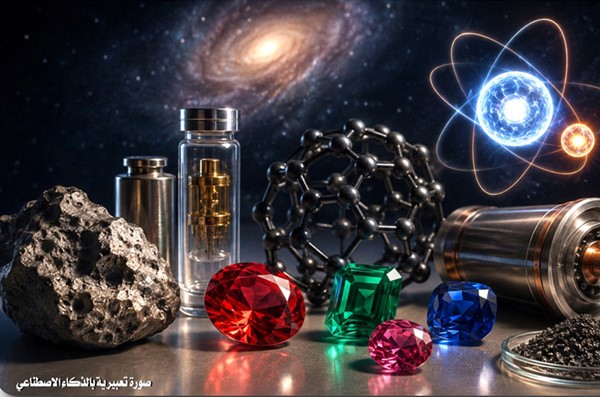
Scientific and space developments have revealed rare materials whose value far exceeds that of gold, platinum, and gemstones, with prices for some reaching millions of dollars per gram. Antimatter tops the list, valued at approximately $59.8 trillion per gram.
These extraordinary prices are linked to the scarcity of these materials and the difficulty of producing or extracting them, as well as their importance in nuclear energy, medicine, advanced technology, and space exploration. Some of these materials represent scientific bets on future technologies.
Below is a list of the most expensive known materials on Earth:
Antimatter: $59.8 trillion per gram, the most valuable globally, produced only in particle accelerators in minuscule quantities.
Nitrogen-containing fullerenes: $134 million per gram, potentially used in the future to develop ultra-miniature atomic clocks and navigation systems.
Californium-252: $25.6 million per gram, with global production not exceeding one gram annually, used in nuclear, industrial, and medical applications.
Bennu asteroid samples: $9.6 million per gram, with 121 grams returned by the OSIRIS-REx mission, characterized by their content of carbon, water-bearing minerals, and organic compounds.
Red diamond: $4.7 million per gram, with fewer than 30 known stones worldwide.
Emerald, ruby, and sapphire: $483,000 per gram, with their value determined by rarity, color, clarity, cut quality, and weight.
Helium-3: $96,000 per gram, with its value potentially rising to $3 million in the future, amid interest in its possible use as fuel for nuclear fusion reactors.
