Ministry of Health Classifies Surgical Procedures as Major and Minor to Link Them to Overtime Allowance Disbursement Mechanism
AbdulKarim Al-Abdullah: The Undersecretary of the Ministry of Health, Dr. Salman Khalifa Al-Sabah, issued Administrative Decision No. 6247 of 2026, concerning the adoption of a comprehensive and specific classification f
Translated by Qiyas from الأنباء — Original source
AbdulKarim Al-Abdullah: The Undersecretary of the Ministry of Health, Dr. Salman Khalifa Al-Sabah, issued Administrative Decision No. 6247 of 2026, concerning the adoption of a comprehensive and specific classification for major and intermediate surgical procedures across various medical and surgical specialties, and linking this classification to the mechanism for disbursing overtime allowances. This step aims to unify the standards adopted among technical departments and organize the mechanism for calculating and classifying surgeries at the level of the Ministry’s facilities.
The decision, which Al-Anba newspaper publishes, is based on the provisions of the Civil Service Law and its amendments, Law No. 70 of 2020 concerning the practice of the medical profession and its auxiliary professions, patients’ rights, and health facilities, as well as Ministerial Decision No. 360 of 2024. It also takes into account what was presented by the Assistant Undersecretary for Technical Affairs regarding the letters from the technical department councils on the classification of intermediate and major surgeries, and the requirements of work interest and the organization of overtime allowance disbursements.
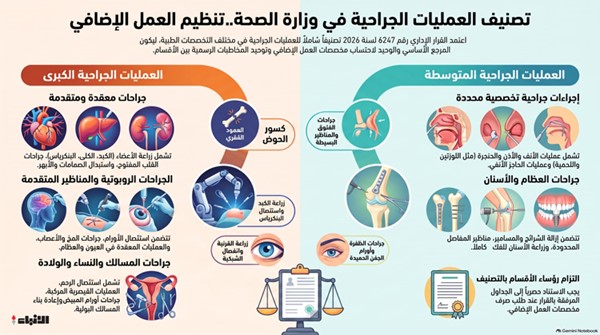
The decision stipulates the classification of major and intermediate procedures according to detailed tables attached to it, which serve as the authoritative reference in this regard. The decision established an extensive list of procedures classified as “major surgical operations,” including general surgery and specialized surgeries, among them heart, thoracic, and vascular surgeries. These include aortic dissection and aneurysm repair, heart valve replacement and repair, coronary artery surgeries and bypass procedures, along with several complex procedures combining coronary artery, valve, and aortic surgeries.
The classification also covered a wide spectrum of general surgery, including colon and rectal surgeries, partial bowel resections, gallbladder and bile duct surgeries, pancreatic and liver surgeries, stomach and obesity surgeries, thyroidectomy, breast surgeries, hernia repairs, laparoscopic and robotic surgeries, in addition to liver transplants and other advanced surgical procedures.
The list of major surgeries extended to neurosurgery, plastic surgery, urology, vascular surgery, and organ transplantation. The decision included kidney transplants from living and deceased donors, pancreas transplants, simultaneous pancreas-kidney transplants, as well as nephrectomies, prostatectomies, cystectomies, urinary tract reconstruction, and other major surgeries. The tables demonstrate the breadth of the classification, encompassing dozens of procedures within each specialty rather than just general titles.
In obstetrics and gynecology, the decision adopted a wide range of procedures as major surgeries, including various types of hysterectomies, cesarean sections accompanied by additional procedures, ovarian tumor surgeries, ectopic pregnancy surgeries, advanced tear repairs, pelvic floor and fistula surgeries, in addition to a large number of gynecological laparoscopies and open surgeries.
The decision also specified major procedures in ophthalmology, including corneal transplants, retinal detachment surgeries, orbital eye surgeries, eye tumor surgeries, eye lens implants, and some strabismus and glaucoma surgeries. In otorhinolaryngology (ENT), the surgeries included ear and sinus procedures, gland excisions, some head and neck surgeries, robotic transoral surgeries, and tracheostomies.
In orthopedic surgery, the classification was detailed according to the nature and complexity of the procedure. It included open and complex fracture surgeries, long bone fracture fixation, pelvic injuries, multiple fractures, repair of accompanying blood vessels, nerves, and tendons associated with fractures, reconstructive surgeries, and complex surgical revisions, among other procedures requiring a high level of surgical intervention.
The decision was not limited to major surgeries; it also established a separate, detailed classification for “intermediate surgeries,” covering the same specialties, thereby enabling a clear distinction between the two surgery categories when calculating overtime allowances. Intermediate procedures included gynecological and obstetric interventions such as certain hysteroscopies, removal of some polyps, cervical cerclage, manual removal of the placenta, oocyte retrieval, selected fallopian tube surgeries, repair of lacerations, and other related procedures.
The intermediate classification for ophthalmology included procedures such as pterygium surgery, excision of certain benign eyelid tumors, and other specified interventions. In otolaryngology, it covered septoplasty, tonsillectomy, adenoidectomy, insertion of ear ventilation tubes, removal of foreign bodies, selected sinus surgeries, and excision of neck masses. In orthopedic surgery, the decision classified a range of procedures as intermediate, distributed across bone injuries, removal of plates and screws, arthroscopy of the knee, shoulder, and elbow, hand, wrist, foot, and ankle surgeries, pediatric bone procedures, as well as certain soft-tissue surgeries, biopsies, and limited interventions.
The intermediate classification also encompassed dental and maxillofacial surgeries, including procedures related to full-mouth rehabilitation, bone grafting, full-arch dental implants, selected facial and jaw injuries, jaw surgeries, temporomandibular joint procedures, and soft-tissue reconstruction, among others, as specified in the decision’s annexed schedules.
Article Two of the decision emphasized that heads of technical departments must adhere in their official correspondence to the surgery classification outlined in the decision, whether for major or intermediate procedures, in accordance with the attached schedules. This means that official communications regarding surgery classification must be based on the approved lists and must not deviate from them.
Article Three stipulated that the decision be communicated to all relevant parties for implementation and that it take effect from the date of its issuance, thereby establishing the new classification as the official regulatory reference for technical departments within the Ministry of Health when handling major and intermediate surgeries and their associated overtime allowances.
