When Artificial Intelligence Becomes the Human Voice in Theater!
&cropxunits=338&cropyunits=450&w=600)
The question no longer posed today is: Can artificial intelligence write? It has proven its ability to produce texts rapidly, organize ideas, suggest phrasings, and simulate various linguistic patterns and styles. But the more important, and perhaps more urgent, question concerns what happens to the literary text when this technology enters the core of the creative process: Where does humanity remain when the machine participates in crafting the text?
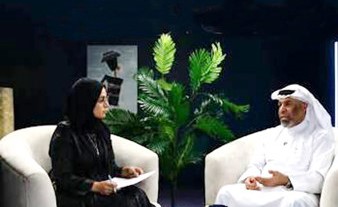
This question was central to the discussion by researcher and playwright Dr. Abbas Al-Qassab, within the podcast “The Relationship Between Literary Text and Artificial Intelligence,” moderated by poet Nadia Al-Malaa, and organized by the Bahraini Playwrights Union. Al-Qassab explored the relationship forming between the writer and artificial intelligence, and the questions it raises regarding the nature, specificity, and presence of human experience within the literary text. Al-Qassab does not approach artificial intelligence from a position of outright rejection or treat it as an adversary to creativity. Rather, he focuses on how writers employ this tool and the limits of its presence in the creative process. At its core, a literary text is not merely well-ordered words; it is the product of experience, consciousness, culture, memory, and engagement with life. A writer does not write only from what they know, but also from what they have lived, witnessed, and been affected by. It is the distance between human experience and language that grants the text its specificity, enabling it to reach and influence the reader.
From this perspective emerges one of the fundamental challenges in employing artificial intelligence in writing. Unconscious or uncritical use may produce texts that appear technically complete and linguistically coherent, yet lack the human element that gives the text its identity and uniqueness. Artificial intelligence can process material provided by humans, reshape it, develop it, and suggest various pathways. However, the starting point remains fundamentally human: ideas, questions, experience, and the desire to express are what give the creative process its direction. Here lies the importance of the writer’s continued presence in the text—not merely as a user of a technological tool, but as the bearer of a vision, experience, and distinct voice.
Perhaps the greatest danger does not lie in the writer’s use of artificial intelligence, but in allowing it to become a substitute for their unique voice. When texts become similar, language converges, and phrasing becomes more polished than the experience behind it, the text may lose part of its identity, even if it appears technically flawless.
In this context, the value of what can be termed “human imperfection” comes to the fore. Literature is not created by technical perfection alone. Humans err, hesitate, contradict themselves, suffer, and reconsider their ideas. These details, which may appear as weaknesses on the surface, can transform in literary works into elements that confer authenticity, beauty, and specificity. A text that is technically ideal is not necessarily one that conveys genuine emotion, nor does polished language necessarily imply a profound experience behind it. Through this lens, the relationship between literary text and artificial intelligence extends beyond the introduction of a new technology into the world of writing; it is a debate about the future of creativity, and about the boundaries that must remain clear between the tool and the experiencer, between the ability to produce words and the ability to imbue those words with meaning.
Ultimately, the problem may not be that machines write, but rather that humans lose the reason that drives them to write. The issue is not that machines write; the issue is when we forget why we write.
