"Kabar" a Safe Haven for Tern Breeding
&cropxunits=450&cropyunits=301&w=770)
Darine Al-Alawi
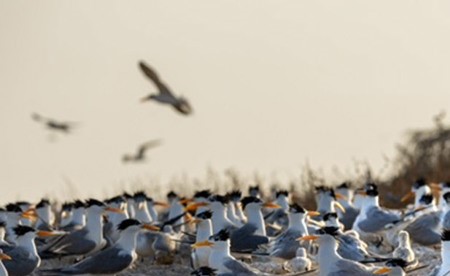
The lens of environmental and wildlife photographer Qasim Al-Baoui captured a scene during a field visit to Kubbar Island, where chicks of the Greater Crested Tern were seen. The island serves as a breeding habitat for these birds during the summer months of June and August. The chicks were observed alongside their mothers, a sight that underscores the importance of Kuwait’s islands as natural sites for breeding and nurturing new generations of this marine bird species.
In this context, Al-Baoui told Al-Anbaa that observing the Greater Crested Tern during the breeding season holds special significance. The presence of chicks alongside adult birds provides a clear indicator that the site is being used for breeding, allowing observers to track key stages in the life cycle and behavior of this bird within the Kuwaiti environment.
He added that the Greater Crested Tern, scientifically known as *Thalasseus bergii* and referred to in English as the “Greater Crested Tern,” is a distinctive marine bird in the Gulf. It is a species that can be spotted in Kuwait, particularly during warmer months, with limited numbers present year-round. It also breeds locally in suitable locations. Al-Baoui explained that quiet islands and coastal areas represent vital habitats for this bird, offering relatively open and safe sites for laying eggs and raising chicks. Therefore, monitoring breeding colonies in these areas does more than just record the bird’s presence; it helps in understanding the state of the coastal environment and its suitability for sustaining the bird’s life cycle.
Distinctive Features
He pointed out that the Greater Crested Tern is one of the largest tern species. It can be identified by several distinctive features, most notably its long, strong yellow or greenish-yellow bill, and a white head topped with a prominent black crest, especially during the breeding season. Other characteristics include a gray back and wings, white underparts, and black legs. The adult bird measures between 43 and 53 cm in length, with a wingspan reaching approximately 100–130 cm, making it a relatively large marine bird.
Regarding field observations, he noted that the presence of chicks was the most striking aspect of the monitoring process. Chicks of the Greater Crested Tern differ significantly from adults; they are covered in downy, mottled plumage that is grayish-brown and do not initially display the distinctive appearance of adult birds. As they grow, their feathers gradually change. Seeing an adult bird near a chick is of great importance to observers, as it documents the parental care stage and confirms that “the site is not merely a stopover area for birds, but can serve as a location for breeding and raising chicks.”
He noted that the Greater Crested Tern is a social bird that typically breeds in colonies comprising large numbers of individuals. Breeding sites may be shared with other tern species. Their nests are very simple, often consisting of a shallow depression or scrape in the ground, so they may not appear as traditional nests to the untrained eye.
Primary Food Source
He clarified that the Greater Crested Tern relies primarily on fish. It is a skilled hunter, soaring above the sea surface before diving toward the water to catch its prey with its bill. It may then return to the breeding site to feed the chick. “When we observe an adult returning from the sea with a fish to feed its chick, we are witnessing a complete picture of the relationship between the island and the sea. The island provides the breeding site, while the sea provides the food. Any disruption to either link can impact breeding success.”
Protecting Breeding Sites
He mentioned that the presence of the Greater Crested Tern in Kuwait, particularly its success in breeding and raising chicks, makes the conservation of its sites environmentally important, even though the species is classified globally as Least Concern.
He emphasized that approaching nesting sites during the breeding season must be extremely limited, as the goal of environmental monitoring is to observe and document bird behavior without causing disturbance. Therefore, one should avoid approaching nests, touching eggs or chicks, or disturbing colonies with boats, vehicles, or human gatherings.
