How did Europe save its airports from running out of jet fuel?
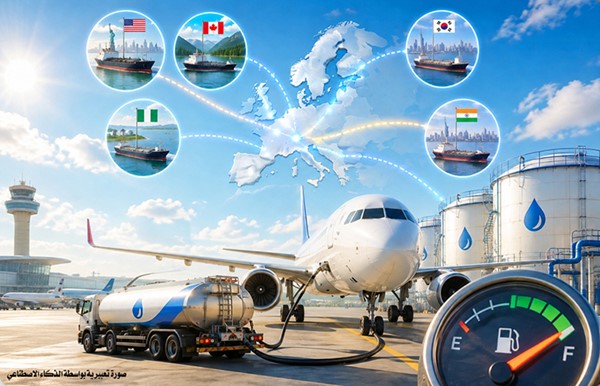
Europe has managed to avert a scenario of jet fuel shortages and widespread flight cancellations, despite supply disruptions through the Strait of Hormuz, by leveraging rapid diversification of import sources and increased refinery output. However, this came at a high cost, reflected in elevated prices and impacts on airlines.
Before the crisis, the Middle East supplied approximately 75% of Europe’s jet fuel imports, amounting to around 375,000 barrels per day. The continent consumes roughly 1.6 million barrels per day, while local production does not exceed 1.1 million barrels, underscoring its structural dependence on imports.
With shipments disrupted, Europe increased its imports from the United States, Canada, Nigeria, India, and South Korea, while simultaneously boosting output from European refineries. Meanwhile, U.S. refinery production surpassed 2 million barrels per day for the first time on a four-week moving average basis.
According to data from Oil Price, the U.S. Energy Information Administration, the International Energy Agency, and the International Air Transport Association (IATA), these measures succeeded in preventing a widespread physical fuel shortage but shifted the crisis to prices. Jet fuel prices rose to approximately $149 per barrel on August 4, up from $90 at the beginning of 2026, representing a 65% increase.
Risks remain, as European stockpiles fell to around 38 million barrels in early June, covering less than a month of demand, leaving the market more vulnerable to any new disruptions.
