President Aoun briefed on Rome meeting deliberations... Israeli military operations continue in the south
&cropxunits=450&cropyunits=349&w=770)
Beirut – Mansour Shaaban In the final phase of the military operations in the south, Israeli forces penetrated the western outskirts of the town of Ma’ al-Jabal, burning several “khayam” (temporary shelter) homes. A majo
Translated by Qiyas from الأنباء — Original source
Beirut – Mansour Shaaban
In the final phase of the military operations in the south, Israeli forces penetrated the western outskirts of the town of Ma’ al-Jabal, burning several “khayam” (temporary shelter) homes. A major explosion was carried out between the towns of Kafr Tabbait and Arnoon in the Nabatieh district, while in the town of Zoutar al-Sharqi, unmanned aerial vehicles covered the entire south, reaching as far as the capital, Beirut, and its adjacent southern suburb.
Residents of Mansouri town held a protest rally under the slogan “Mansouri is not occupied,” in front of the Lebanese Army center in the Ammarieh area, near the town south of Sidon. They demanded the right to return to their homes and livelihoods, insisting that their town is not within the so-called “yellow line.” MP Ali Kharis, a member of the “Development and Liberation” bloc led by Speaker of the Parliament Nabih Berri, participated in the rally. Kharis stated, “Mansouri town is not occupied. We had hoped that the Rome meeting would lead to an agreement and withdrawal from a number of villages, only to be surprised that the enemy is attempting to infiltrate other villages.”
Meanwhile, President of the Republic General Joseph Aoun briefed the head of the Lebanese negotiating delegation, former Ambassador Simon Karam, on the deliberations of the meetings held last week in Rome between Lebanese, American, and Israeli delegations, and provided him with his directives for the next phase.
In parallel, Minister of Foreign Affairs and Emigrants Youssef Raji held a telephone conversation with Egyptian Foreign Minister Dr. Badr Abdelatty, during which they reviewed developments in the ongoing negotiation track between Lebanon and Israel. Minister Raji emphasized “Lebanon’s commitment to completing the negotiation process in a manner that safeguards national sovereignty and preserves Lebanese rights.”
Shortly thereafter, in a political and familial meeting, former President of the Republic General Michel Suleiman received at his residence in Amchit the president of the Lebanese Kataeb Party, MP Samy Gemayel, and his wife. The meeting underscored the importance of supporting the negotiation track to restore state sovereignty over all Lebanese territories, strengthen state institutions, and pave the way for economic recovery and reconstruction. It was further emphasized that “this cannot be achieved without clear steps beginning with the state’s monopoly on weapons, the consolidation of the ceasefire, and Israel’s withdrawal from all occupied Lebanese towns and lands in the south, followed by a meeting of frankness and reconciliation according to Gemayel’s initiative, leading to Lebanon’s commitment to a clear policy of neutrality regarding axis conflicts, thereby protecting it from their repercussions and returning national decision-making to legitimate state institutions.”
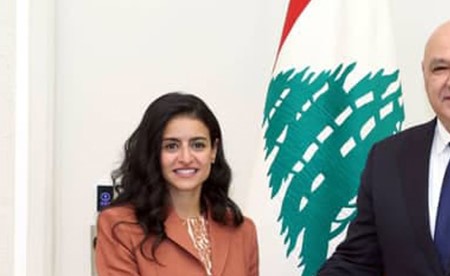
Economically, Speakers of the Parliament Nabih Berri and of the Council of Ministers Nawaf Salam met with Dalia Khalifa, Director of the Middle East Department at the World Bank, accompanied by Enrique Blanco Armas, World Bank Country Manager for Lebanon. They discussed ways to align the Bank’s current and future project portfolio with government priorities across various sectors, particularly energy, water, and social protection. The role of the World Bank in reconstructing war-damaged areas was also discussed, including damage assessment, infrastructure rehabilitation, and coordination of donor efforts.
In a related development, President Joseph Aoun assured Sheikhah Nasser Al-Nuaimi, Secretary-General of the UN World Tourism Organization, that “Lebanon remains, despite the difficult circumstances it has endured, a focal point for Arab and foreign tourists due to its unique characteristics. The Lebanese state is working to develop the tourism sector, akin to other sectors that form the pillars of its economy.”
For his part, Prime Minister Nawaf Salam, during a meeting with heads of economic bodies Muhammad Shqair and Khalil Al-Arab, president of the Lebanese-Syrian Business Council, stressed “the importance of activating the role of the Lebanese-Syrian Business Council and transforming it into a framework to develop trade exchanges, encourage joint investments, facilitate the movement of Lebanese exports and transit through Syria, and enhance cooperation in the transport and energy sectors, thereby opening new opportunities for the private sector and positively impacting the economies of both countries.”
