Coordination between the Ministry of Higher Education and the Ministry of Education to operate model schools
&cropxunits=450&cropyunits=253&w=770)
Alaa Khalifa: University sources reported that the model schools in the Sabah Al-Salem University City have recently been handed over to the university and are ready for use, with ongoing communications and meetings betw
Translated by Qiyas from الأنباء — Original source
Alaa Khalifa: University sources reported that the model schools in the Sabah Al-Salem University City have recently been handed over to the university and are ready for use, with ongoing communications and meetings between officials from the Ministry of Higher Education and the Ministry of Education on the matter.
Sources told “Al-Anbaa” that the model schools in Kuwait serve as a pioneering center for work at Kuwait University, representing a distinctive and innovative academic addition driven by a forward-looking vision aligned with modern global developments in education. These schools are distinguished by their modern, multi-functional facilities and advanced educational and technological capabilities designed to meet contemporary learning needs. They are also notable for their location within the campus of Sabah Al-Salem University City.
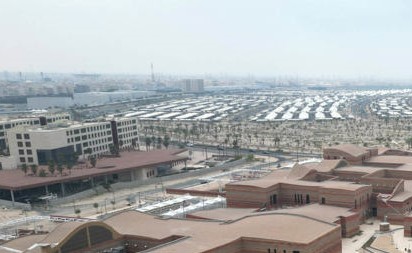
The sources noted that the model schools are situated in the eastern part of Sabah Al-Salem University City, adjacent to the female students’ residential building, with separate entrances, parking areas, and dedicated external spaces for the project. The model school complex comprises seven separate buildings on the ground and first floors, connected via a service basement. It covers educational stages from kindergarten to grade twelve, including a nursery. The nursery building is separate on the ground floor, while the kindergarten building is connected to the ground floor of the girls’ primary school building. Similarly, the girls’ intermediate school building is connected to the girls’ secondary school building on the ground floor.
The sources indicated that the built-up area of the model schools is approximately 54,000 square meters. The nursery operates as a semi-independent building with a capacity of 148 children, while the remaining stages combined accommodate 888 students across kindergarten through grade twelve.
The sources clarified that these schools focus on delivering advanced educational programs and systems to enhance student performance, improve academic achievement, and develop curricula and teaching methods in collaboration with the College of Education at Kuwait University. The schools also aim to provide an attractive and stimulating environment that fosters creativity and critical thinking, preparing students for lifelong learning. Additionally, they offer a practical field for training College of Education students and conducting applied educational research.
Sources stated that the university proposed, upon the operationalization of these schools, taking into account the limited spatial capacity of administrative offices compared to schools under the Ministry of Education. The university suggested that the model schools be managed by one principal and one deputy principal, along with a supporting administrative staff commensurate with the office space capacity and the schools’ enrollment capacity.
The university also proposed establishing a mechanism to attract highly qualified teaching staff, enabling them to teach across multiple educational stages based on their expertise. It further recommended studying the allocation of additional financial incentives for teaching staff.
Finally, sources indicated that the university proposed that the administrative, educational, and financial oversight of the model schools fall under the operating entities, while their maintenance works should be included in the budget of the Construction and Maintenance Administration at Kuwait University.
