The Southern Front: An "Open Square" on the Lines of Fire and Negotiations
&cropxunits=450&cropyunits=253&w=600)
Beirut – Mansour Shaaban The southern front remains an open arena for the lines of fire and negotiations, whose seventh round concluded with talk of positives and proposals for experimental zones, while the Israeli army
Translated by Qiyas from الأنباء — Original source
Beirut – Mansour Shaaban
The southern front remains an open arena for the lines of fire and negotiations, whose seventh round concluded with talk of positives and proposals for experimental zones, while the Israeli army continues its attacks. Meanwhile, reports indicated that Lebanon and Israel agreed on a shortlist of countries that can send forces to verify the disarmament of Hezbollah under the “Framework Agreement” reached between the two sides with US mediation.
On the ground, Israeli forces penetrated the northern outskirts of the town of Ma’ al-Qalaa, with shelling targeting a house and coinciding with patrols using machine guns. A similar penetration occurred toward the village of Zoutar al-Gharbi, where a new earth berm was erected, constituting a new violation of the “Experimental Zone Agreement.”
Artillery shelling continued at the outskirts of Nabatieh, while Israeli warplanes flew at low altitudes over the airspace of the central and western sectors. Israeli artillery heavily bombarded the area around the town of Mansouriya, hitting several homes.
For its part, the Lebanese Ministry of Health announced in a statement that the cumulative total of casualties from continuous Israeli attacks since March 2 until August 7 reached 4,335 killed and 12,273 injured.
In a security context, Minister of Interior and Municipalities Ahmad al-Hajjar, after chairing a meeting of the Sub-Committee of the Security Council for the North Lebanon and Akkar governorates, stated that “the next phase will see an enhancement of measures and further readiness and preparedness.”
Responding to a question about anticipated economic and investment projects in northern Lebanon, al-Hajjar replied that “ensuring security and stability constitutes the foundation for any investment or developmental process,” noting that “the government is making great efforts to enhance stability in various Lebanese regions, alongside addressing major national challenges, foremost among them the continued Israeli occupation of parts of southern Lebanon... The government is working to expedite the Israeli withdrawal and ensure the deployment of the Lebanese army and the return of displaced persons to their towns and villages.”
Minister al-Hajjar emphasized that “efforts and communications with the Republic of Iraq are ongoing to enhance bilateral cooperation in the energy sector, whether in securing oil or in projects related to restarting oil infrastructure.”
He added: “We will spare no effort as a government to develop the north and improve the economic situation, not only in Tripoli and Akkar, but throughout Lebanon.”
The minister stressed that “priority remains for field operations,” stating: “The most important thing above all is actual, serious, and continuous measures. Security is not merely conducting a security campaign for a few days and then stopping; it is a daily and permanent endeavor.”
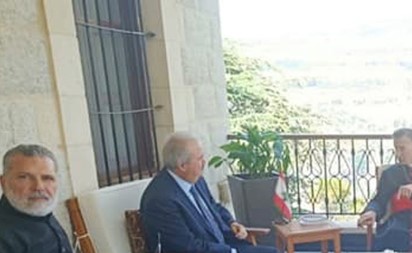
Regarding the government’s decision to stagger the retroactive effect of public sector salaries, Finance Minister Yassin Jaber, in a statement after meeting Maronite Patriarch Bechara al-Raï in Deir al-Qamar, said that “the increases will be paid at their specified times without delay,” clarifying that “the challenge lies in the mechanism for disbursing the retroactive amount established since March 1.”
He explained that “monetary pressures and injecting $420 million at once could harm the Lebanese lira and the state’s monetary stability level.”
The Finance Minister noted that he had emphasized during his meeting with Maronite Patriarch Bechara al-Raï “the continuation of government efforts on both the domestic and international fronts, particularly regarding cooperation with the Republic of Iraq on the oil file, and communication with the IMF and the World Bank to rehabilitate the banking sector.”
