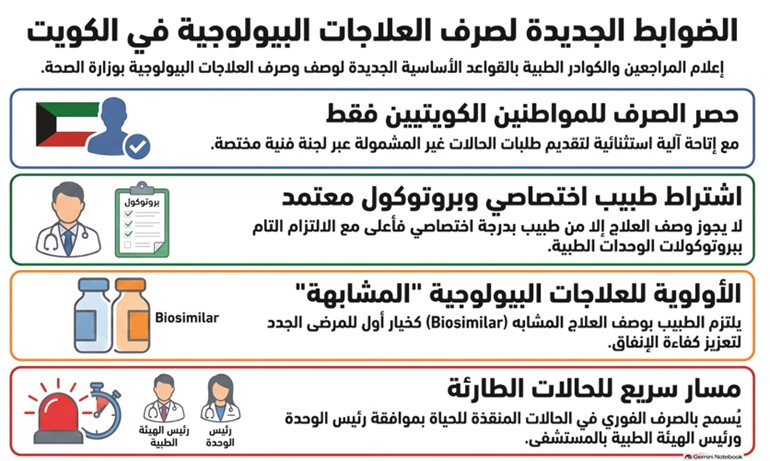
Biological treatments dispensed exclusively to Kuwaiti nationals, with exceptions for cases not meeting eligibility criteria
Abdul Karim Al-Abdullah: Minister of Health Dr. Ahmed Al-Awadi has approved a mechanism for the prescription, dispensing, and follow-up of biological treatments at the Ministry of Health. According to the mechanism, publ
Translated by Qiyas from الأنباء — Original source
Abdul Karim Al-Abdullah: Minister of Health Dr. Ahmed Al-Awadi has approved a mechanism for the prescription, dispensing, and follow-up of biological treatments at the Ministry of Health. According to the mechanism, published by Al-Anbaa, the provisions of the decision apply to all hospitals, specialized centers, and primary healthcare centers affiliated with the Ministry of Health. It is noted that there are 231 biological treatments included in the decision regulating the dispensing of biological treatments at the Ministry of Health, and forms for requesting the availability of biological treatments have also been approved.
**Kuwaiti Citizens Only**
The mechanism for dispensing biological treatments listed in the annex to this decision is restricted to Kuwaiti patients. It permits cases not covered by this article to submit a request for a biological treatment in accordance with the mechanism stipulated in Article Four of this decision.
The mechanism includes the following controls for prescribing and dispensing biological treatments:
1. Before prescribing any biological treatment, strict adherence to therapeutic protocols prepared by specialized medical units under the supervision of specialized medical councils and approved according to the administrative hierarchy is mandatory.
2. Biological treatments may only be prescribed by a specialist physician or higher, from the medical specialty relevant to the patient’s condition. No request or prescription for a biological treatment for the purposes of this decision will be accepted unless issued by a physician meeting these conditions.
3. Biological treatments are to be prescribed only for locally approved indications.
4. Biological treatments may not be prescribed for non-approved indications unless approval is obtained from the Technical Committee responsible for studying requests for use of drugs for non-approved indications, which falls under the General Administration of Supervision and Pharmaceutical Affairs.
5. Biological treatments must be prescribed by their trade name accompanied by the international non-proprietary name.
6. Biological treatments are to be used according to the approved therapeutic sequence for each disease. Their use should follow the exhaustion or unsuitability of traditional treatment options, where determined by the approved protocol. Initiation of biological treatment at an early stage is permitted if the approved therapeutic protocol so stipulates, based on the severity of the condition, its clinical characteristics, or defined risk factors.
7. Biological treatments are to be prescribed according to the approved initiation criteria for each medical condition.
8. Renewal or continuation of biological treatment is linked to achieving a documented clinical response according to the criteria for treatment continuation and the periodic evaluation schedule specified in the approved therapeutic protocol. Failure to achieve a proven therapeutic response is considered a reason for discontinuing treatment and adopting alternative therapeutic measures.
9. The treating physician is obligated to prescribe biosimilar treatment as a first therapeutic option for patients who have not previously received approved biological treatment, unless there are clinical justifications necessitating the use of the reference biological treatment. Such justifications must be documented in the patient’s medical file.
10. Clinically stable patients may be switched from reference biological treatment to an approved and available biosimilar at the Ministry of Health, according to an approved switching protocol that includes:
* Criteria for selecting eligible patients for switching.
* Clinical and laboratory follow-up plan after switching.
* Indicators for evaluating response.
* Mechanism for handling non-response or the appearance of side effects.
11. In medical cases requiring intervention by a team of multiple medical specialties to monitor the patient’s condition, the treating physician must coordinate in advance with relevant medical specialties before initiating biological treatment and when switching between types, to ensure the quality of the therapeutic decision, prevent medical duplication or conflict, and guide unjustified spending.
12. Advanced biological-origin treatments may not be prescribed or administered except in hospitals or specialized centers approved by the Ministry, which possess the necessary clinical expertise, technical facilities, and operational infrastructure to handle the nature of the treatment, its risks, and its implementation and follow-up requirements. This includes, where necessary, capabilities for cell or sample collection, coordination with manufacturing centers, therapeutic preparation, drug administration, patient hospitalization, critical care, or management of acute or delayed complications.
13. No advanced biological-origin treatment, including genetic, cellular, genetically modified cellular, or chimeric antigen receptor T-cell (CAR-T) therapies, may be initiated without obtaining informed consent signed by the patient, their legal guardian, or legal representative, according to the forms and procedures approved by the Ministry.
14. The hospital or specialized center approved to apply advanced biological-origin treatments is obligated to implement a precise tracking system for these treatments to ensure clear linkage between the patient and the therapeutic product used throughout all stages of treatment, according to the nature of each product. This tracking system must include, as a minimum where applicable:
* Documentation of patient data.
* Scientific and trade name of the treatment.
* Batch number or product identifier.
* Cell or sample collection data (collection center, manufacturing center, or manufacturer).
* Shipping, receipt, and storage data.
* Date of treatment administration.
* The treating physician, and the hospital or specialized center where the treatment was applied.
**Tracking Data**
15. The Pharmacy Department, in coordination with the therapeutic team, is responsible for verifying the completeness of tracking data before dispensing advanced biological-origin treatment. It may not be dispensed or applied if verification of the product’s identity or its match with the specified patient is impossible, where the treatment is designated for a specific patient.
16. When dispensing the medical prescription from the pharmacy, any automatic substitution between biological treatments is prohibited, whether between reference and biosimilar biological treatments or among biosimilar biological treatments, except by decision of the treating physician and according to the approved switching protocol. Biological treatments are not considered a category of drugs eligible for automatic substitution.
17. Pharmacy departments are obligated not to dispense biological treatments except in accordance with prior approvals and approved restrictions, where required.
18. Physicians, pharmacists, and nursing staff, each within their scope of practice, are obligated to provide appropriate patient education to the patient, their legal guardian, or legal representative upon initiation of biological treatment, upon switching to a biosimilar, or when using any advanced biological-origin treatment. This education must include clear and simplified information regarding:
* The nature of the treatment and available alternatives.
* Justifications for choosing the treatment or switching to it.
* Expected therapeutic benefits.
* Treatment safety and expected risks.
* Method of use or administration and requirements related to preparation or application.
* Follow-up plan, including long-term follow-up requirements if dictated by the nature of the treatment.
The provision of this education must be documented in the patient’s medical file.
**Reporting**
19. Physicians, pharmacists, and nursing staff are obligated to report any adverse drug interactions associated with the use of biological treatments in accordance with the systems and standards approved in the Kuwaiti Pharmacovigilance Guideline, via the electronic form available on the Ministry of Health website (WWW.MOH.GOV.KW) under the electronic services tool of the Pharmaceutical and Food Control. Care must be taken to accurately mention the trade name of the biological treatment and the batch number, given the complex characteristics of biological treatments.
20. The hospital or specialized center approved to apply advanced biological-origin treatments is obligated to establish a record to document treatment data, clinical outcomes, and short- and long-term safety indicators. This includes, according to the nature of the treatment and where applicable:
* Response indicators.
* Duration of response.
* Loss of response.
* Serious or unexpected side effects.
* Delayed complications.
* Hospitalization or death cases, if any.
* Reasons for discontinuing or not completing the treatment.
**Cases Not Covered**
The mechanism states that cases not covered by the decision may, if their medical condition necessitates the use of one of the biological treatments listed in the annex, submit a request for a biological treatment according to the following mechanism:
The treating physician fills out the approved “Request for Dispensing Biological Treatment” form, stating the medical justifications and reasons accurately, and attaches all reports, tests, and supporting documents for the request. The physician then submits it to the head of the relevant unit in the hospital or specialized center. The head of the relevant unit reviews the request, verifies the therapeutic need, and ensures the case meets the criteria, requirements, and conditions for initiating and continuing biological treatment approved in the therapeutic protocols. The request is then referred to the head of the Pharmacy Department in the hospital or specialized center.
The Pharmacy Department reviews the request from a pharmaceutical perspective, including verifying the availability of the biosimilar, calculating dosages, and ensuring the completeness of reports, tests, and supporting documents. The request is then sent to the General Administration of Drugs and Medical Equipment.
The General Administration of Drugs and Medical Equipment, through the entity responsible for health technology assessment and in coordination with relevant entities as needed, studies the request from clinical and economic perspectives. It then submits it, accompanied by recommendations and all supporting reports, tests, and documents, to the Permanent Technical Committee for Drug Evaluation and Classification to make an appropriate decision. If the request is approved, the duration of therapeutic approval, dispensing controls, follow-up, and renewal are determined. A copy of the approved form is sent to:
* The Pharmacy Department of the concerned hospital or specialized center to take dispensing procedures in accordance with applicable systems and regulations, in coordination with the department and the treating physician.
* The Medical Warehouses Administration to take necessary measures regarding quantity estimation, provision, and distribution.
* The Office of the Minister of Health.
**Emergency Cases**
The mechanism indicated that in emergency or life-saving cases:
1. Specialized medical department councils, each within their specialty, are responsible, within three months of the issuance of this decision, for preparing a list of emergency medical cases requiring biological treatment, where delaying treatment poses a serious risk to the patient’s life or health. This list is approved by the Undersecretary of the Ministry and reviewed annually or as needed.
2. Biological treatment may be dispensed in approved emergency cases listed in the aforementioned item, upon request by the treating physician and with prior joint approval from the head of the relevant medical unit and the head of the medical staff at the hospital or specialized center.
3. The treating physician is obligated, on the first working day following the emergency dispensing, to complete the biological treatment dispensing request form, attach the medical report, tests, and supporting documents, and submit them to the head of the relevant unit, the head of the department, and the head of the medical staff to document the emergency dispensing decision and complete the necessary approvals.
4. The approved request, accompanied by reports, tests, and supporting documents, is submitted to the Permanent Technical Committee for Drug Evaluation and Classification to review the case and issue an appropriate decision regarding the continuation, modification, or discontinuation of the treatment. Emergency dispensing does not constitute permanent or automatic approval for continuing the treatment.
**Follow-up, Evaluation, and Reporting**
The mechanism emphasized that Health Technology Assessment Monitoring, under the General Administration of Drugs and Medical Equipment and in coordination with the Permanent Technical Committee for Drug Evaluation and Classification and relevant entities, will monitor the use of biological treatments at the Ministry of Health as follows:
* Reviewing data on the prescription and dispensing of biological treatments to monitor indicators of irrational or non-compliant drug use with approved protocols and propose necessary corrective measures. Coordination will be maintained with usage review committees established in hospitals and specialized centers to review the use of specific biological treatments and verify compliance with controls for their prescription and dispensing. Review results will be submitted to Health Technology Assessment Monitoring for analysis and issuance of appropriate recommendations.
* Conducting clinical and economic evaluations for high-cost biological treatments and proposing phased switching programs to biosimilars, if clinical suitability and economic viability are proven. Results will be shared with relevant entities to support spending efficiency, governance of purchasing and contracting decisions, and rational use of resources.
* Reviewing data from records or approved forms for advanced biological-origin treatments, including clinical outcomes and short- and long-term safety indicators, to evaluate results and compliance with approved protocols. Necessary recommendations regarding their continued use, restriction, or re-evaluation will be submitted, while maintaining patient data confidentiality.
The mechanism noted that Health Technology Assessment Monitoring will prepare an annual report, in coordination with relevant entities, submitted to the Undersecretary of the Ministry and then to the Minister of Health, containing the following:
* Total reference biological treatments, biosimilar biological treatments, and advanced biological-origin treatments available at the Ministry, their annual costs, and distribution across medical specialties.
* Number of requests for biological treatment, number of approved and rejected requests, and their financial costs.
* Proportions of biosimilar biological treatment use and annual financial savings achieved.
* Results of biological treatment usage reviews in hospitals and recommendations based on them.
* Opportunities for achieving spending efficiency on biological treatments based on the results of clinical and economic evaluations, accompanied by comments and proposals from relevant entities, to pave the way for translating them into decisions and policies.
The mechanism obligated the Kuwait Center for Pharmacovigilance, under the General Administration of Supervision and Pharmaceutical Affairs, to implement a proactive national program to monitor the safety of new biological treatments, biosimilar biological treatments, and advanced biological-origin treatments. The aim is early detection of any local or global signals regarding safety, lack of efficacy, or loss of response, analysis of these signals, and sharing results with entities responsible for evaluating, classifying, purchasing, and dispensing drugs at the Ministry to link them with decisions on continuation or restriction. The Pharmaceutical Inspection and Licensing Administration, under the General Administration of Supervision and Pharmaceutical Affairs, is also obligated to audit the dispensing of biological treatments in compliance with the controls and mechanisms approved in this decision.
