Our Ambassador to the United Kingdom: Supporting youth in educational and cultural initiatives to enhance their leadership skills
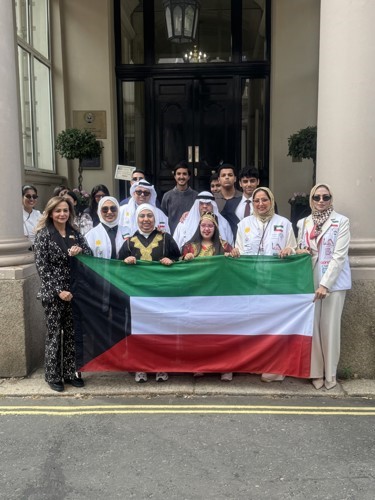
Our Ambassador to the United Kingdom, Badr Al-Munikh, received a Kuwaiti delegation of persons with disabilities, led by Meshal Al-Kilab, a member of the Capital Governorate Council, as part of their participation in the summer program of the Gulf Academy for Leadership and Innovation (GALI), held in the United Kingdom from August 4 to 10.
Ambassador Al-Munikh welcomed the Kuwaiti delegation at the embassy premises, praising the participants’ enthusiasm, ambition, and commitment. He reaffirmed the commitment to supporting Kuwaiti youth in educational and cultural initiatives that broaden their horizons and strengthen their leadership skills, noting that these efforts contribute to preparing a promising generation that will lead the country’s future development and reflect Kuwait’s ongoing investment in cultivating future leaders.
He expressed his appreciation to the Capital Governorate for its support of Kuwaiti youth and to the delegation’s chairperson, Meshal Al-Kilab, for her dedicated leadership and commitment to providing meaningful educational and leadership opportunities for Kuwaiti youth. He commended their efforts in promoting the values of inclusion, empowerment, and equal opportunity, particularly for students with disabilities, ensuring that all young people have access to learning and leadership opportunities.
He also praised the summer mentoring and guidance program offered by the Gulf Academy for Leadership and Innovation, which brings together outstanding youth from various Gulf Cooperation Council (GCC) countries. He emphasized that such initiatives play a vital role in preparing the next generation of leaders by enhancing leadership, innovation, creativity, dialogue, and mutual understanding among civilizations.
For her part, Al-Kilab commended Ambassador Al-Munikh’s efforts to facilitate the delegation’s mission in the United Kingdom. She stressed that the delegation, which included students with disabilities, did not merely participate in the summer program but also took on leadership and supervisory roles over their peers without disabilities, “thereby conveying authentic messages embodied in inclusion, empowerment, and inspiration.” The program involves 100 promising participants from across the GCC countries, offering opportunities for direct interaction with leaders and experts, as well as participation in interactive dialogues, workshops, and field visits.
