Despite the Regional War, Kuwait Visitors Injected 287 Million Dinars into the Local Economy
Despite the exceptional geopolitical conditions the region has witnessed since the outbreak of the US-Israeli-Iranian war on February 28, 2026, the Kuwaiti economy continued to attract spending executed by holders of for
Translated by Qiyas from الأنباء — Original source
Despite the exceptional geopolitical conditions the region has witnessed since the outbreak of the US-Israeli-Iranian war on February 28, 2026, the Kuwaiti economy continued to attract spending executed by holders of foreign bank cards. This serves as an indicator reflecting the continuity of commercial activity, visitors’ confidence in the local economic environment, and the ability of Kuwaiti markets to maintain healthy levels of purchasing activity during one of the most sensitive periods at the regional level.
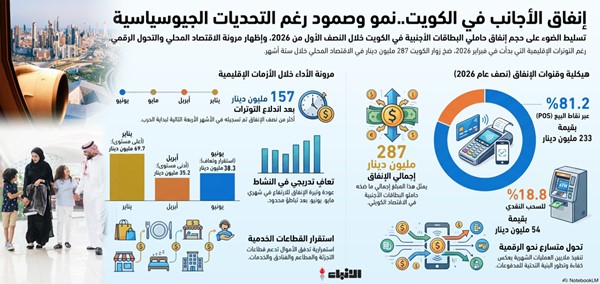
Data from the Central Bank of Kuwait shows that total spending executed by foreign bank cards within Kuwait reached approximately 287 million dinars during the first half of 2026. This was distributed between 233 million dinars via point-of-sale (POS) terminals and 54 million dinars through cash withdrawals. These figures confirm the continued inflow of foreign spending into the local market throughout the first six months of the year, including the months immediately following the outbreak of the war.
These numbers are based on foreign card transactions executed within Kuwait, which constitute one of the most prominent official indicators for measuring spending by non-residents and foreign cardholders in the country. The data reveals that 81.2% of total spending was directed toward purchases via POS terminals, compared to only 18.8% for cash withdrawals. This reflects the rapid shift toward electronic payment methods and visitors’ primary reliance on bank cards to settle the cost of their purchases in Kuwaiti markets, rather than relying on cash. This trend also highlights the development and widespread adoption of the digital payment infrastructure across various commercial and service activities.
On a monthly basis, spending by foreign cardholders peaked in January at approximately 69.7 million dinars, before declining to 60.2 million dinars in February, then to 39.5 million dinars in March, and 35.2 million dinars in April. It rose again to approximately 44.1 million dinars in May, before stabilizing at around 38.3 million dinars in June. This pattern indicates that while the pace of spending slowed with the onset of regional tensions, it remained uninterrupted, showing signs of gradual recovery during the last two months of the first half of the year.
An analysis of the data suggests that the four months following the outbreak of the war accounted for approximately 157 million dinars of the total spending, representing more than half of the spending recorded during the first half of the year. This reinforces the hypothesis that military developments in the region did not halt spending activity within the Kuwaiti market but rather had a limited impact on its pace, before markets regained part of their activity.
The data also shows the continuity of purchasing activity through the execution of millions of electronic transactions. The number of purchases executed via foreign cards reached 2.5 million in January, 1.9 million in February, 1.34 million in March, 1.29 million in April, 1.7 million in May, and 1.48 million in June. This confirms that the use of foreign cards remained a daily presence across various commercial activities and was not limited to seasonal or exceptional purchases.
The data further highlights that the spending structure remained stable throughout the months of the first half of the year. POS payments maintained the largest share of total spending in all months, reflecting continued consumer and visitor confidence in Kuwait’s electronic payment system. It also underscores the banking sector’s success in providing high-efficiency digital payment services, even during periods marked by regional disruptions.
These indicators reflect the Kuwaiti economy’s ability to maintain a stable commercial and service environment during a period characterized by heightened geopolitical risks. Central Bank data showed no interruption in the flow of spending executed by foreign cards; rather, purchasing and cash withdrawal activities continued regularly throughout the first half of the year. This supports the continuity of activity in retail, restaurant, hotel, and various service sectors.
These results also confirm that the local market retained its attractiveness as a destination for spending and consumption, despite regional challenges. This was facilitated by the stability of the banking sector, the efficiency of electronic payment systems, and the normal operation of markets and service sectors. This was reflected in the continued flow of hundreds of millions of dinars through foreign cards during the first six months of the year.
