Starting August 12: Three rare celestial phenomena coincide
&cropxunits=450&cropyunits=300&w=600)
The sky on August 12 will witness a rare alignment of three major celestial phenomena occurring within a short timeframe: a total solar eclipse, the peak of the Perseid meteor shower, and a planetary parade, according to the British newspaper Daily Mail. During this astronomical alignment, residents of specific regions on Earth will be able to observe a rare total solar eclipse, as the Moon passes between the Earth and the Sun, completely obscuring the Sun’s disk for a brief period. The path of totality will be visible in western Iceland, Greenland, northern Spain, and parts of Portugal. In the United States, the eclipse will appear partial, with varying degrees of coverage reaching approximately 9% in New York, while reaching about 53% in the Canadian city of St. John’s. Iceland and Spain are considered among the best locations to observe the eclipse, particularly Spain, due to the broadness of the eclipse path and mild weather conditions in August.
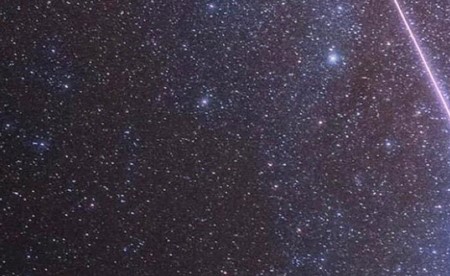
The Perseid meteor shower will reach its peak on the night of August 12, extending until dawn on August 13, with the potential to see up to 100 meteors per hour, provided the sky is dark and clear. The presence of a new moon that night will be an ideal factor for observation, as it will not cause light pollution that could hinder the visibility of meteors. The shower will continue until August 24, but the best viewing period will be from 11 p.m. until dawn.
The third phenomenon will be the planetary parade, also known as the “planetary display,” which is an apparent alignment of several planets from the solar system along a single line or arc in the night sky. During this event, Jupiter, Mercury, Mars, Saturn, Uranus, and Neptune will appear aligned in a wide arc across the sky. Mars and Saturn can be seen with the naked eye, while observing Mercury and Jupiter requires greater concentration due to their low appearance near the eastern horizon. Uranus requires binoculars for observation, whereas Neptune needs a telescope. For optimal viewing of the planetary parade in the Northern Hemisphere, it is recommended to look at the sky approximately 30 to 60 minutes before sunrise, ensuring clear weather and an unobstructed horizon.
