Minister of Health Approves Job Description, Requirements, and Controls for Licensing the Midwifery Profession
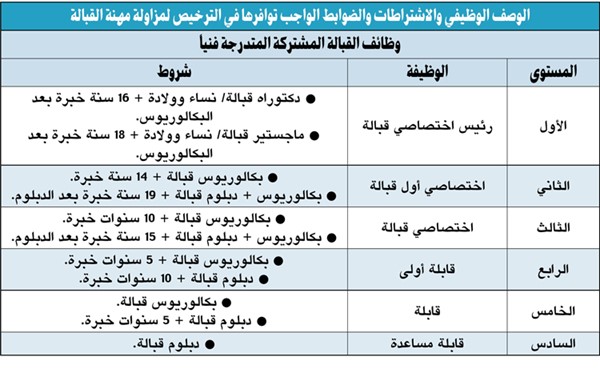
AbdulKarim Al-Abdullah Health Minister Dr. Ahmed Al-Awadi has approved the job description, requirements, and regulations necessary for licensing the midwifery profession. The document includes six job titles: “Assistant
Translated by Qiyas from الأنباء — Original source
AbdulKarim Al-Abdullah
Health Minister Dr. Ahmed Al-Awadi has approved the job description, requirements, and regulations necessary for licensing the midwifery profession. The document includes six job titles: “Assistant Midwife,” “Midwife,” “Senior Midwife,” “Midwifery Specialist,” “Senior Midwifery Specialist,” and “Chief Midwifery Specialist.”
**Assistant Midwife**
The job description and licensing requirements for the midwifery profession, published by “Al-Anbaa,” stipulate that the job title of “Assistant Midwife” requires the holder to possess a “Diploma in Midwifery.” The organizational reporting structure falls under technical and administrative supervision, with direct supervision by a “Head Nurse” or “Head Midwife” or their superiors.
Regarding the main duties and responsibilities of the “Assistant Midwife”:
**During Pregnancy**
1. Conduct necessary laboratory tests as per physician instructions.
2. Collect and document comprehensive health history.
3. Perform a comprehensive assessment of the pregnant woman, including fetal position, heart rate, and activity.
4. Perform fetal monitoring (NST) and uterine contraction monitoring (CTG) when necessary, and present results to the physician.
5. Provide education and counseling regarding diet, exercise, newborn care, vaccinations, and follow-up, under the supervision of a physician.
6. Provide health education on breastfeeding and its importance, and prepare the pregnant woman for it.
**During Labor**
1. Verify the mother’s identity according to patient identification policy and apply an identification bracelet according to established policy.
2. Ensure informed written consent is obtained from the concerned party, according to approved policy.
3. Review prenatal records to identify any specific instructions or previous risk factors during pregnancy.
4. Assess uterine contractions, monitor labor progress, and perform vaginal examinations in emergency situations where no doctor is present. Use the labor monitoring form to record the following:
* Maternal vital signs.
* Intensity, frequency, and duration of uterine contractions.
* Cervical dilation, effacement, fetal position, and descent in emergency situations where no doctor is present.
* Onset of labor, rupture of membranes (bag of waters), and documentation of amniotic fluid color.
5. Identify abnormal labor conditions, such as changes in fetal heart rate, degree of fatigue, etc., initiate necessary interventions, and notify the physician immediately.
6. Provide health and psychological support to the woman and her family.
7. Provide non-pharmacological comfort measures during labor.
8. Assist the midwife or physician in performing a normal delivery.
9. Promote skin-to-skin contact between mother and newborn to stimulate early breastfeeding initiation.
10. Examine the placenta and membranes to ensure completeness and check for any abnormalities.
11. Assess uterine position after delivery.
12. Perform uterine massage to promote postpartum contractions.
13. Estimate blood loss during labor, initiate appropriate treatment, and notify the physician in case of postpartum hemorrhage.
14. Examine the perineal area for any first- or second-degree injuries and notify the physician.
15. Administer all medications prescribed by the physician according to established policy.
**Newborns**
1. Suction fluids from the nose and mouth to maintain the airway.
2. Stimulate breathing by gently massaging the baby.
3. Ensure the baby is crying and breathing well; perform resuscitation if necessary and refer to a neonatologist if required.
4. Assess the baby’s condition at the first and fifth minutes using the APGAR scale (Appearance, Pulse, Grimace, Activity, and Respiration).
5. Clamp, tie, and cut the umbilical cord using sterile instruments.
6. Examine the umbilical cord and determine the number of blood vessels present.
7. Apply an identification bracelet to the newborn according to established policy.
8. Collaborate with the neonatologist to perform a rapid physical examination to verify the absence of congenital anomalies or birth injuries.
9. Measure the baby’s weight, length, and head circumference.
10. Administer intramuscular Vitamin K to prevent bleeding, according to established policy.
11. Initiate breastfeeding within the first hour of birth.
**Postpartum Care**
**Mother**
1. Monitor and document vital signs.
2. Perform physical assessments using the BUBBLE-HE method.
3. Educate the mother on postpartum exercises and adequate nutrition.
4. Care for episiotomy wounds using the REEDA scale.
5. Care for cesarean section incisions.
6. Emphasize the importance of breastfeeding, including positioning, milk expression, and storage.
7. Provide a comprehensive discharge plan to ensure the mother and family receive appropriate information about the postpartum period and follow-up care.
8. Administer medications prescribed by the physician.
**Newborns**
9. Perform a comprehensive physical examination, identify any abnormal signs, and refer to a neonatologist if necessary.
10. Provide newborn care, such as bathing, umbilical cord care, etc.
11. Educate parents on warning signs in newborns and advise on when to seek emergency care.
12. Administer the Hepatitis B vaccine according to the protocol within 24 hours.
**Midwife**
The job description and licensing requirements for the midwifery profession include the job title “Midwife.” The scientific qualifications required are a “Bachelor’s Degree in Midwifery” or a “Diploma in Midwifery” with five years of experience. The organizational relationships for this title involve technical and administrative supervision, with direct supervision by a “Head Nurse” or “Head Midwife” or their superiors.
The main duties and responsibilities of the “Midwife” title are as follows:
**During Pregnancy**
Perform the duties and responsibilities of the lower job level, in addition to the following:
1. Educate pregnant women on relaxation techniques and non-pharmacological methods for managing pain during labor.
2. Identify high-risk pregnancy conditions, such as gestational diabetes, miscarriage, preeclampsia, etc., and notify the physician.
**During Labor**
Perform the duties and responsibilities of the lower job level, in addition to the following:
1. Perform urinary catheterization or enemas as needed.
2. Perform an episiotomy if necessary.
3. Conduct normal deliveries.
**Newborns**
Perform the duties and responsibilities of the lower job level.
**Postpartum Care**
**Mother**
Perform the duties and responsibilities of the lower job level, in addition to the following:
1. Request and perform necessary laboratory tests.
**Newborns**
Perform the duties and responsibilities of the lower job level.
**Other Duties and Responsibilities**
* Participate in data collection for use in scientific research.
**Senior Midwife**
The job description and licensing requirements for the midwifery profession indicate the title “Senior Midwife.” The scientific qualifications required are a “Bachelor’s Degree in Midwifery” with five years of experience, or a “Diploma in Midwifery” with ten years of experience. The organizational relationships for the “Senior Midwife” title involve assuming technical and administrative supervision, with direct supervision by a “Head Nurse” or “Head Midwife” or their superiors.
The main duties and responsibilities of the “Senior Midwife” title include:
**During Pregnancy / During Labor / Newborns / Postpartum Care:**
Perform the duties and responsibilities of the lower job level.
**Other Duties and Responsibilities**
1. Assume supervisory roles according to the hierarchical progression of leadership positions.
2. Participate in meetings and committees when assigned.
**Midwifery Specialist**
The job description and licensing requirements for the midwifery profession note the title “Midwifery Specialist.” The scientific qualifications required are a “Bachelor’s Degree in Midwifery” with ten years of experience, or a “Bachelor’s Degree” with a “Diploma in Midwifery” and fifteen years of experience after the diploma. The organizational relationships for this title involve technical and administrative supervision, with direct supervision by a “Head Nurse” or “Head Midwife” or their superiors.
The main duties and responsibilities of the “Midwifery Specialist” title include:
**Pre-pregnancy Period**
1. Provide counseling and care to women and families before pregnancy.
2. Collect and document the woman’s health history (medical, surgical, obstetric and gynecological, family, etc.).
3. Assess nutritional status and provide necessary guidance.
4. Review immunization status and guide towards obtaining necessary vaccinations.
5. Conduct health education and awareness sessions on reproductive health and family planning.
**During Pregnancy / During Labor / Newborns / Postpartum Care:**
Perform the duties and responsibilities of the lower job level.
**Other Duties and Responsibilities**
Perform the duties and responsibilities of the lower job level, in addition to:
* Participate in preparing research and studies specific to the midwifery profession.
**Senior Midwifery Specialist**
The job description and licensing requirements for the midwifery profession for the title “Senior Midwifery Specialist” stipulate that the scientific qualifications are a “Bachelor’s Degree in Midwifery” with one year of experience, or a “Bachelor’s Degree” with a “Diploma in Midwifery” and nineteen years of experience after the diploma. The organizational relationships for this title involve technical and administrative supervision, with direct supervision by a “Head Nurse” or “Head Midwife” or their superiors.
The main duties and responsibilities of the “Senior Midwifery Specialist” title are as follows:
**Pre-pregnancy Period / During Pregnancy / During Labor / Newborns / Postpartum Care:**
* Perform the duties and responsibilities of the lower job level.
**Other Duties and Responsibilities:**
* Perform the duties and responsibilities of the lower job level, in addition to:
* Prepare research and studies specific to the midwifery profession.
**Chief Midwifery Specialist**
The job description and licensing requirements for the midwifery profession include the title “Chief Midwifery Specialist.” The scientific qualifications required for this title are:
* A PhD in Midwifery or Obstetrics and Gynecology, with 16 years of experience after the Bachelor’s degree.
* A Master’s degree in Midwifery or Obstetrics and Gynecology, with 18 years of experience after the Bachelor’s degree.
The organizational relationships involve technical and administrative supervision, with direct supervision by a “Head Nurse” or “Head Midwife” or their superiors.
The main duties and responsibilities of the “Chief Midwifery Specialist” title are as follows:
**Pre-pregnancy Period / During Pregnancy / During Labor / Newborns / Postpartum Care:**
* Perform the duties and responsibilities of the lower job level.
**Other Duties and Responsibilities:**
* Perform the duties and responsibilities of the lower job level, in addition to:
* Participate in developing the executive plan based on the strategic plan, preparing policies, and monitoring their implementation, according to guidelines for quality management and accreditation.
