Banks redraw the credit map: housing, real estate, and industrial loans account for 74% of new financing
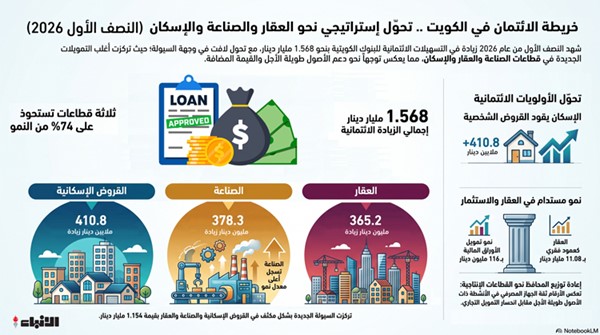
Ahmed Gharbilaym: The growth in credit facilities provided by local banks during the first half of 2026 is not merely a routine increase in financing volume, but rather reveals a clear shift in the credit landscape within the Kuwaiti economy. While bank credit portfolios rose by approximately 1.568 billion dinars over just six months, this increase was not evenly distributed across various sectors. Instead, it concentrated notably in three main areas: housing loans, industry, and real estate, which together accounted for nearly three-quarters of new loans, indicating a distinct change in financing priorities within the banking sector.
Data from the Central Bank of Kuwait shows that the total outstanding balance of credit facilities utilized by residents increased from 53.18 billion dinars at the end of December 2025 to 54.75 billion dinars by the end of June 2026. This represents an increase of 1.568 billion dinars, or a growth rate of 2.95%.
The map of new financing during the first half of 2026 reveals an unprecedented concentration of credit growth in three key sectors: housing loans, industry, and real estate. Collectively, these sectors absorbed 1.154 billion dinars, equivalent to 73.63% of the total increase of 1.5677 billion dinars. Housing loans took the lead with an addition of 410.8 million dinars, followed by industry with an increase of 378.3 million dinars, and real estate with an increase of 365.2 million dinars. This means that approximately three out of every four dinars added to bank credit portfolios during the first half of the year flowed into these three sectors.
However, a detailed reading of the data reveals that the most important message lies not in the volume of the increase, but in the direction of these funds. Banks have redistributed their credit portfolios in a manner that reflects a shift in financing priorities, granting preference to sectors linked to production, investment, and long-term assets, while financing for certain commercial and consumer activities has receded.
**Industry: The Surprise of the First Half**
If the real estate sector has traditionally dominated the credit landscape in recent years, the industrial sector was the undisputed surprise of the first half of 2026. The sector not only achieved positive growth but also recorded the highest growth rate among all major economic sectors. Credit facilities granted to industry rose from 2.13 billion dinars at the end of December to 2.5 billion dinars by the end of June, achieving an increase of 378.3 million dinars over six months, with a growth rate reaching 17.8%.
These figures reflect a clear expansion in financing directed toward the industrial sector, whether for funding new production lines, operational expansions, or industrial investments, making it the largest beneficiary of the credit redistribution during this period. Notably, the value of the increase achieved by the industrial sector was the largest among productive sectors, reflecting greater confidence from the banking system in this activity compared to others.
**Real Estate: The Bet Continues**
Despite industry leading in terms of growth rate, the real estate sector remained one of the main pillars of bank credit portfolios. Real estate credit facilities increased from 10.72 billion dinars at the end of December to 11.08 billion dinars by the end of June, an increase of 365.2 million dinars, representing a growth rate of 3.4%. This means that real estate alone accounted for approximately 23% of the total credit increase during the first half of the year, confirming its continued status as one of the most attractive sectors for bank financing. Furthermore, real estate financing exceeding 11 billion dinars reflects sustained demand for financing related to real estate and investment projects, as well as financing directed to real estate development companies.
**Personal Facilities: The Largest Component**
Although attention has focused on industry and real estate, personal facilities remain the largest component of bank credit portfolios. Their balance increased from 20.02 billion dinars to 20.34 billion dinars, an increase of 318.6 million dinars, with a growth rate of 1.6%, accounting for approximately 37% of total credit facilities in Kuwait.
However, details within this sector reveal a very different picture when examining its internal components. The increase was not the result of a rise in all types of personal loans but was driven almost entirely by housing loans. Housing loans rose from 17.27 billion dinars to 17.68 billion dinars, an increase of 410.8 million dinars, with a growth rate of 2.4%, remaining the main driver of personal financing growth.
In contrast, consumer loans declined from 2.077 billion dinars to 2.041 billion dinars, a decrease of 36 million dinars, or 1.7%. Loans for private and model housing also fell from 198.2 million dinars to 174.9 million dinars, a drop of 23.3 million dinars, or 11.8%. The "other personal loans" category recorded a decline from 475.6 million dinars to 442.6 million dinars, a loss of 33 million dinars, or 6.9%. These figures indicate that housing loans have practically become the sole driver of personal facility growth, while other components experienced declines or stagnation.
**Investment in Shares Continues to Rise**
Financing dedicated to purchasing securities continued to grow during the first half of the year. The total for this item increased from 4.792 billion dinars to 4.908 billion dinars, an increase of 116 million dinars, with a growth rate of 2.4%. This growth resulted from an increase in financing provided to companies and institutions from 3.11 billion dinars to 3.13 billion dinars, as well as an increase in financing directed to individuals from 1.68 billion dinars to 1.76 billion dinars, reflecting continued investment activity in the securities market.
**Construction: Quiet Growth**
The construction sector maintained its growth trajectory but at a more subdued pace. Credit facilities increased from 2.6831 billion dinars to 2.7856 billion dinars, an increase of 102.5 million dinars, with a growth rate of 3.8%, reflecting continued financing directed toward contracting and infrastructure projects.
**Financial Institutions: Notable Expansion**
Non-bank financial institutions, which include investment, financing, insurance, and exchange companies, recorded strong growth. Facilities increased from 1.6733 billion dinars to 1.8167 billion dinars, an increase of 143.4 million dinars, with a growth rate of 8.6%.
**Services and Oil: Continuous Growth**
Facilities directed to the other services sector also rose from 4.1268 billion dinars to 4.3005 billion dinars, an increase of 173.7 million dinars, with a growth rate of 4.2%, remaining the third-largest borrowing sector from banks. The crude oil and gas sector recorded good growth, with facilities increasing from 2.0568 billion dinars to 2.2094 billion dinars, an increase of 152.6 million dinars, or 7.4%, reflecting continued financing for projects and services related to the oil sector. Meanwhile, the public services sector achieved the highest relative growth rate of 85.6%, with facilities rising from 115.6 million dinars to 214.5 million dinars, an increase of 98.9 million dinars.
**What Do the Numbers Say?**
Data from the Central Bank reveals that local banks did not merely increase financing during the first half of 2026; they clearly reordered their lending priorities. Financing shifted more toward productive and investment sectors, primarily industry and real estate, with sustained momentum in housing loans.
These shifts indicate that credit growth is no longer based solely on quantitative expansion but has become more selective in distributing financing. This reflects the banking system’s orientation toward supporting economic activities with long-term assets and added value, while maintaining the quality and diversification of credit portfolios amid local and regional economic changes.
