Madbouly: The state was keen not to issue any conclusions or announce the causes of the Damietta incident before the completion of the inspection work
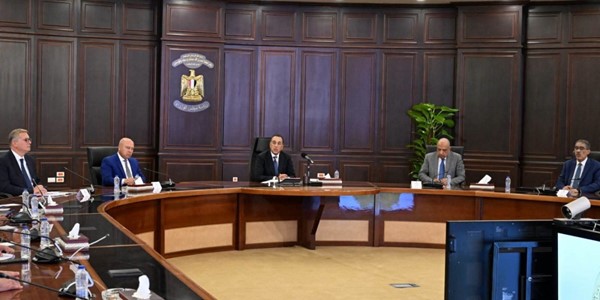
Cairo — Ahmed Saber Dr. Mustafa Madbouly, Prime Minister, held his weekly press conference following a cabinet meeting at the government headquarters in the New Alamein City. The conference was attended by Field Marshal
Translated by Qiyas from الأنباء — Original source
Cairo — Ahmed Saber
Dr. Mustafa Madbouly, Prime Minister, held his weekly press conference following a cabinet meeting at the government headquarters in the New Alamein City. The conference was attended by Field Marshal Kamel al-Wazir, Minister of Transport; Mahmoud Esamat, Minister of Electricity and Renewable Energy; Karim Badawi, Minister of Petroleum and Mineral Resources; and Diaa Rashwan, Minister of State for Media.
The Prime Minister emphasized the government’s full awareness of public and media expectations to learn the details of the incident that occurred at the Port of Damietta. He clarified that he would provide a comprehensive explanation of the state’s actions in response to the situation, noting that as soon as the incident was announced, the state immediately began implementing numerous measures and procedures, the specifics of which were not known to journalists or citizens.
Madbouly stated that the full scope and detailed dimensions of the state’s efforts and movements to address the situation would be outlined. He stressed that upon the announcement of the incident, the state and its relevant agencies were mobilized for immediate intervention and the enforcement of a package of urgent executive measures. These operational pathways may not have been known to many citizens or media outlets.
He stressed that the fundamental and pivotal pillar up to this point has been presenting a comprehensive model of crisis management, involving all state agencies in coordinated cooperation. He addressed the discourse and questions circulating on various social media platforms regarding the state’s readiness and capacity to handle emergencies and crises, particularly in light of previous state statements about its ability to manage crises and questions about the handling of this specific incident.
The Prime Minister reviewed the overall measures taken to clarify the dimensions of the situation. He noted that at approximately 2:15 PM on Wednesday, they were informed by the Minister of Petroleum and Mineral Resources of a fire breaking out on two ships at the Port of Damietta.
Dr. Madbouly pointed out that one of these ships, as is well known, belongs to the group of regasification vessels contracted by the state and secured to meet national energy needs. He explained that this vessel was docked inside the port, with another vessel known as a "storage ship" moored nearby at a close distance. He noted that the state had previously decided to retain a storage ship as a full cargo ready for immediate use around the clock, with the option to transfer it from Damietta to Sokhna to pump its contents into the national grid according to actual needs, rather than leaving these cargoes in territorial waters or abroad on other ships, as they were purchased to ensure local presence.
The Prime Minister continued, emphasizing that these two ships include the regasification vessel, which functions as a complete industrial facility receiving liquefied natural gas (LNG) shipments to convert them back to their gaseous state in preparation for pumping into the grid. He noted that this facility is classified as a highly dangerous plant due to the high-pressure pumping of gas. He warned that, God forbid, if an incident had occurred without proper crisis management, the consequences would have been catastrophic. An explosion on this ship would not have been limited to a fire on board; its effects would have extended to destroying port facilities and surrounding areas.
He indicated that when the drone attack occurred on the two ships, the truth and most important fact were that the first ship, the storage or depot ship, was not affected, and praise be to God. Immediate action was taken to address some limited consequences that appeared, which were fully contained. He affirmed that this ship is 100% intact, while some negative effects were limited to the regasification ship.
He added that as soon as the fire broke out, he was immediately informed by the Minister of Petroleum and Mineral Resources. Immediate communication was established with Field Marshal Kamel al-Wazir, Minister of Transport, and all state security and sovereign agencies to ensure joint and direct handling of the matter.
The Prime Minister stated that the state treated the incident from the first moment as a fire on board the ship, as reported. He noted that all state agencies moved immediately based on this assessment, recognizing the potential scale of repercussions had the fire gotten out of control.
He clarified that upon receiving the report, a working group comprising the Ministers of Transport and Petroleum and Mineral Resources was formed. The team began field operations on the ground immediately. Initially, the two connected ships were separated via a series of transport lines and pipes, preventing the fire’s effects from spreading between them. The storage ship was handled quickly, the situation was brought under control, and it was cleared and moved completely away from the dock and the other ship.
He noted that, as part of precautionary measures, the crews on the regasification ship were evacuated immediately upon the announcement of the fire, as this was a necessary security measure, especially given the ship contained large quantities of LNG measured in tons.
The Prime Minister stated that the actions taken by the Egyptian crews during the incident represented a national epic and an exemplary model. He explained that orders were given to deploy four Egyptian tugs equipped with their technical crews, which managed to tow the ship away to a distance exceeding three and a half kilometers into the waters, far from the dock, in anticipation of any developments resulting from the fire, particularly given the possibility of an explosion that could have affected the entire port.
He affirmed that work at the Port of Damietta continued normally throughout the incident response period. The port witnessed the entry and exit of approximately 15 ships carrying various types of goods, commodities, and foodstuffs, reflecting the efficiency of crisis management and the lack of impact on port navigation.
The Prime Minister expressed gratitude and appreciation to all Egyptian crews involved in managing the crisis, affirming that they made exceptional efforts for approximately 12 continuous hours, from 4:00 PM until 4:00 AM. Firefighting operations continued continuously, with work teams rotating to ensure sustained efficiency. He explained that the nature of the fire was highly complex due to its connection to LNG under high pressure within transport lines and tanks, requiring handling of the gas source itself, not just the visible flames.
He clarified that, in parallel with firefighting efforts, relevant authorities were conducting a comprehensive assessment of all circumstances to determine the true causes. He affirmed that the state was keen not to issue any conclusions or announce the causes of the incident before the completion of inspection and evaluation work.
He added that the Armed Forces, the Ministry of Interior, and security and sovereign agencies began analysis and inspection work from the first moment, relying on various data, images, and technical assessments, to precisely determine the true cause of the fire before announcing it to the public with full transparency and confidence.
He noted that technical work was being conducted at the highest level simultaneously to handle the incident. He emphasized that the most important aspect was the work done by the Armed Forces and the Ministry of Interior to contain the fire and use various methods and techniques to overcome it, alongside traditional firefighting methods. This included the use of chemical agents, aircraft to control the flames, and the use of remote-controlled drones ("drones") to document developments in controlling the situation after the ship was towed to the open sea. He added that in the early hours of the morning, the handling of the fire on the ship was successfully completed, and the threat of a major explosion, God forbid, which could have had many negative repercussions, had ended.
In this context, the Prime Minister thanked everyone involved in these efforts and firefighting operations within this integrated system, which continued from the first moment of the fire for more than 14 continuous hours. He praised their swift response, noting that any negligence or delay, God forbid, could have led to a real disaster affecting the port, its ships, and many vital facilities in its vicinity. He highlighted that the steps taken in this regard were carried out with extreme caution and focus to prevent any danger to the port and surrounding facilities.
He pointed out that the crisis was managed from the first moment, minute by minute, and hour by hour. Although they were not physically present at the site, it was managed in real-time as if they were there. He noted the immediate transfer of Field Engineer Kamel al-Wazir, Minister of Transport, and Engineer Karim Badawi, Minister of Petroleum and Mineral Resources, to the Port of Damietta, where they began handling the incident from there, while maintaining continuous communication and coordination with various state security and sovereign agencies to handle the situation from both security and criminal aspects.
He noted that in parallel with the firefighting and crisis containment axis, a security axis was worked on, alongside the beginning of movement on the logistical track. The Ministers of Petroleum and Electricity took charge of securing strategic alternatives to ensure the stability of the energy system, which relies on gas either from local production, through shipments provided via regasification ships, or through existing pipeline networks.
The Prime Minister explained that the process was calculated with precision, as the ship involved in the incident contributes a major part to feeding the energy system that operates power generation stations and meets the state’s natural gas needs. He noted that with the ship taken out of service, the emergency plan was immediately implemented, relying on the alternative system and diversifying supply sources. Without these alternatives, it would not have been possible to guarantee the absence of any crisis or interruptions. He continued that through alternatives prepared by the state in advance, and by diversifying energy mix sources and alternatives, the alternative system of fuel oil and diesel stations was immediately activated until conditions returned to normal.
In this regard, Madbouly reassured citizens that the energy system was not affected, affirming that there were no repercussions on its sustainability. This is especially true as the Egyptian state is capable and possesses the necessary strategic alternatives. He explained that despite being in the summer season, with unprecedented temperature rises and other large needs, the system was not affected, praise be to God. The state continues its efforts. He noted that the current work axis with the Ministers of Petroleum and Electricity, in cooperation with the Central Bank and the Ministry of Finance, aims to secure financial and logistical needs and strategic alternatives until the repair of the damaged ship is completed.
He continued that the approach adopted by the state was primarily based on activating an integrated national crisis management system, which enabled state institutions, praise be to God, to contain the situation and emerge with the least possible damage. He considered the success of efforts in preventing the escalation of repercussions as a sign of divine favor and grace.
He noted the public’s attention to the damaged ship incident, pointing out that executive measures and technical repair work had immediately begun to assess the time required for full rehabilitation. He explained that until the operational efficiency of that ship is restored, the state had previously secured strategic alternatives through another ship contracted and prepared in the Port of Aqaba, in coordination and cooperation with our brothers in the Hashemite Kingdom of Jordan at the Port of Aqaba, designated for emergency cases. He continued that immediate communication was established with the Jordanian Minister of Energy to activate the operation of this ship and integrate it into the state’s energy supply system to ensure the sustainability of its flows.
The Prime Minister concluded his remarks by highlighting the strenuous efforts that continued for 12 or 14 continuous hours, which perhaps many were not fully aware of in terms of their path and behind-the-scenes details, as the state’s focus was entirely on confronting the fire, which could have resulted in severe repercussions for the Port of Damietta and its vital infrastructure, especially given the presence of one of the strategic economic facilities in that area. He affirmed the state’s success, praise be to God, in handling and containing this situation.
He noted the formation of a security working group tasked with precisely determining the causes of the incident. All details were reached and verified beyond any doubt at around 2:00 or 3:00 AM, following the ascent of specialized technical teams onto the ship to inspect the effects of the drone and its remnants. Security agencies are currently analyzing and studying these remnants to precisely determine their origin.
He affirmed that up to this moment, as the attendees followed, no entity has officially claimed responsibility for this incident. While there are speculations and opinions on the matter, the state does not rely on speculation or unverified propositions. Instead, it takes its measures, verifies, and evaluates situations based on tangible facts to ensure complete confirmation.
In the same context, he noted that the state managed this situation professionally, particularly regarding crisis handling mechanisms and limiting its repercussions. He added that the security working group is currently studying the incident to determine its source and assess the situation, to determine the formulation of the Egyptian state’s reactions in the coming period.
The Prime Minister concluded his remarks, stating that there are many details unknown to many, but the most important aspect is the great epic written by the heroic youth of Egypt, some of whom risked their lives, as it was possible, God forbid, that if the situation had gotten out of control and with that speed, the ship could have deviated during the towing process.
