Spanish Prime Minister accuses 'Mafias' of human trafficking of being behind the influx of thousands of migrants to 'Ceuta'
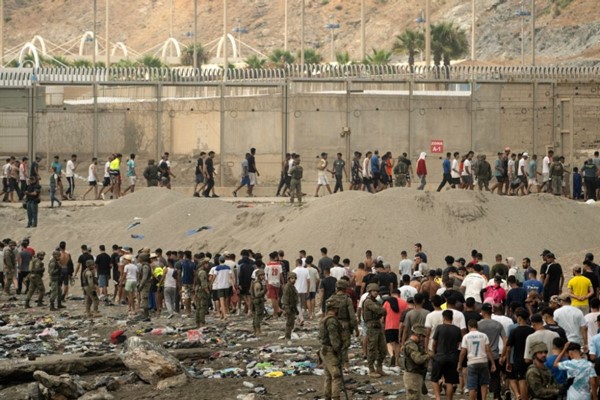
Spanish Prime Minister Pedro Sánchez on Friday described the mass influx of migrants into the city of Ceuta as an “attack and a violation of Spain’s territorial integrity,” pledging to use “all state resources” to protec
Translated by Qiyas from الأنباء — Original source
Spanish Prime Minister Pedro Sánchez on Friday described the mass influx of migrants into the city of Ceuta as an “attack and a violation of Spain’s territorial integrity,” pledging to use “all state resources” to protect the city and expedite the return of those who had entered irregularly.
Sánchez made these remarks during a visit to Ceuta to assess the developing crisis, noting that security measures at the border would be strengthened. He affirmed that Spain stands with the Spanish city, which also forms part of the European Union’s external border.
He highlighted “fruitful cooperation with countries of origin and transit,” emphasizing coordination with Moroccan authorities and continuous dialogue with Rabat to return migrants “as quickly as possible.”
Sánchez blamed human smuggling networks for the crisis, accusing them of “deceiving many young people” and pushing them to undertake dangerous journeys.
Accordingly, Sánchez announced on Thursday the deployment of floating barriers (“buoys”) at the maritime border between the Spanish enclave and Morocco to create a “physical barrier” that would curb crossing attempts and enable authorities to implement “immediate returns” of migrants who breach it, refusing them entry.
Sánchez’s comments came as the death toll of individuals who drowned while attempting to swim to Ceuta rose to 34, with rescue forces continuing search operations for missing persons in waters near the border.
Initial estimates by security forces indicate that approximately 60,000 migrants entered Ceuta irregularly in recent hours, marking the largest migration crisis the city has faced since 2021. This surge prompted the government to deploy military units to support police and Civil Guard forces.
For its part, the European Union announced its readiness to provide additional support to Spain, including through the European Border and Coast Guard Agency (Frontex).
On July 8, Spain’s Supreme Court ruled that “immediate returns” cannot be applied to migrants who reach Spanish beaches by swimming, as they do not cross a physical border barrier. Instead, they must be subjected to legal procedures, including the opening of an administrative file for each individual, the right to legal counsel, and the opportunity to seek asylum.
This ruling does not prohibit “returns” entirely but requires authorities to follow procedures outlined in the Aliens Act and provide legal guarantees to migrants before returning them to their countries of origin.
The Spanish Prime Minister linked the migrant surge to a misleading interpretation of the court ruling, which he said was promoted by human trafficking “mafias.”
Sánchez stated, “Through our discussions with Moroccan authorities, it has become clear that human trafficking mafias promoted an interpretation of a ruling by the Spanish Supreme Court that serves their own interests.” He explained that the interpretation, which claims that “individuals who arrived in Spain by sea cannot be returned to the border,” spread rapidly in recent hours.
The Spanish Ministry of the Interior reported that the number of returnees from Ceuta to Morocco on Friday reached approximately 25,000.
Meanwhile, Moroccan police arrested around 30 young men in the city of Fnideq in northern Morocco, according to Agence France-Presse (AFP), following clashes near the border with the Spanish enclave of Ceuta.
Security forces used tear gas and water cannons to disperse a crowd of thousands, mostly young men, who had gathered in recent days in an attempt to cross the border, during which they pelted security forces with stones.
Despite the clashes, hundreds of individuals seeking to cross into the Spanish enclave continued to head to the area, scaling steep cliffs overlooking the border crossing point.
On Thursday evening, young men set fire to police patrols, taxis, and buses, as observed by AFP.
For his part, Belgian Foreign Minister Maxime Prévot confirmed that Belgium is closely monitoring the situation in Spanish Ceuta, noting that “the pressure on a member state located on the EU’s external border is a European issue, not solely a Spanish one.”
He emphasized that protecting Europe’s external borders is a priority for the Belgian government, asserting that border control, taking a firmer stance against irregular migrants, and dismantling the operational model of human smugglers are not incompatible with a humanitarian approach but are essential conditions for it.
