27.9 billion dinars spent by citizens and residents in the first half
Ali Ibrahim: Latest data released by the Central Bank of Kuwait (CBK) showed continued strength in consumer spending in Kuwait during the first half of 2026, despite geopolitical developments and events in the region dur
Translated by Qiyas from الأنباء — Original source
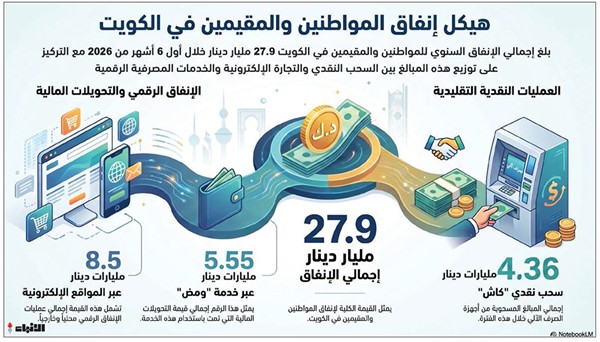
Ali Ibrahim: Latest data released by the Central Bank of Kuwait (CBK) showed continued strength in consumer spending in Kuwait during the first half of 2026, despite geopolitical developments and events in the region during the period. Total spending by citizens and residents across various payment channels reached approximately KD 27.92 billion, a figure reflecting the robustness of economic activity, sustained consumer confidence, and the growing reliance on electronic payment channels.
Direct purchases via point-of-sale (POS) terminals, both within Kuwait and abroad, accounted for the largest share of total spending, reaching KD 9.46 billion, or about 33.9% of total spending in the first six months of the year. This highlights continued commercial activity and consumption across various sectors, as well as the expanding use of bank cards in daily transactions.
Online spending ranked second, totaling KD 8.53 billion, representing approximately 30.6% of total spending. This confirms that e-commerce is solidifying its position as one of the leading spending channels in Kuwait, supported by increased adoption of digital services and the diversity of local and global electronic platforms.
Instant transfers via the “Wamda” service recorded significant growth, reaching KD 5.55 billion in the first half of the year, equivalent to about 19.9% of total spending. This reflects the rising use of instant payment and transfer solutions among individuals and businesses, as well as growing confidence in the digital infrastructure of the banking sector.
Conversely, cash withdrawals via ATMs amounted to approximately KD 4.36 billion, accounting for roughly 15.6% of total spending. This indicates a continued relative decline in reliance on cash compared to electronic payment methods, amid the ongoing shift toward a less cash-dependent society.
These indicators suggest that consumer activity in Kuwait maintained its momentum during the first half of 2026, despite the uncertainty surrounding regional geopolitical events. Consumers continued to spend at strong levels, while digital channels continued to increase their share of total payments. This reflects the resilience of the Kuwaiti economy, the efficiency of its electronic payment infrastructure, and the banking sector’s ability to provide diverse and secure payment solutions that meet the needs of individuals and businesses under various circumstances.
Total credit facilities granted to residents and non-residents rose by 1.86%, or KD 1.187 billion, during the first half of 2026, reaching KD 64.9 billion by the end of June, compared to KD 63.74 billion at the end of December 2025. This reflects sustained credit activity in the banking sector and banks’ continued financing of various economic sectors.
Housing loans recorded notable growth during the first six months of the year, rising by 2.37%, or KD 410.8 million, to reach KD 17.68 billion by the end of June 2026, compared to KD 17.27 billion at the end of December 2025. These loans are long-term personal facilities with a maximum tenure of 15 years, granted for the purpose of purchasing, building, or renovating private housing, reflecting sustained demand for housing finance.
In contrast, consumer loans declined by 1.7% during the same period, a decrease of KD 36 million, to reach KD 2.04 billion by the end of June, compared to KD 2.07 billion at the end of December. These loans are defined as medium-term personal facilities with a maximum tenure of five years, designated for financing personal and consumption needs. This trend may indicate that a segment of customers is moving toward rationalizing consumer borrowing or preferring long-term financing.
Total deposits from residents and non-residents increased by 5.29%, or KD 3.135 billion, during the first half of 2026, reaching KD 62.29 billion by the end of June, compared to KD 59.15 billion at the end of December 2025. This reflects the continued strength of the deposit base in the banking sector.
The increase was driven by a 41.29% rise, or KD 1.726 billion, in government deposits, reaching KD 5.9 billion by the end of June, compared to KD 4.18 billion at the end of December 2025. Public institution deposits also rose by 9.4%, or KD 923.2 million, to reach KD 10.73 billion, compared to KD 9.8 billion at the end of last year. The private sector also continued to strengthen its deposits at banks, increasing by 1.07%, or KD 485 million, to reach KD 45.6 billion by the end of June 2026, compared to KD 45.16 billion at the end of December 2025.
Data showed that private sector deposits in Kuwaiti dinars rose by 0.76%, or KD 299.4 million, to reach KD 39.34 billion by the end of June, compared to KD 39.05 billion at the end of December. Meanwhile, private sector deposits in foreign currencies increased by 3.03%, or KD 185.6 million, to reach KD 6.3 billion, compared to KD 6.11 billion at the end of 2025.
These indicators reflect the continued strength of the Kuwaiti banking system, supported by deposit growth outpacing credit facility growth. This enhances banks’ liquidity levels and provides greater scope to continue financing various economic activities in the coming period.
