Aoun: Committed to implementing the Framework Formula, but we fear the impact of Israeli practices on its effectiveness
&cropxunits=450&cropyunits=300&w=770)
Caution remains the dominant mood in southern Lebanon, as the Israeli army continues to bomb targeted sites and shatter residential neighborhoods, including the town of Maroun al-Ras yesterday, not to mention the flight
Translated by Qiyas from الأنباء — Original source
Caution remains the dominant mood in southern Lebanon, as the Israeli army continues to bomb targeted sites and shatter residential neighborhoods, including the town of Maroun al-Ras yesterday, not to mention the flight of drones as far as Beirut and its suburbs, a situation that has generated “sustained concern” among President Joseph Aoun, Speaker of the Parliament Nabih Berri, Prime Minister Nawaf Salam, and local residents.
The latest development is Israeli Prime Minister Benjamin Netanyahu’s trip to Washington to meet U.S. President Donald Trump. Anticipating the visit, Netanyahu stated he would discuss “all the issues at hand” and emphasized that the goal of his trip is “to preserve Israel’s security and expand the circle of peace around it.”
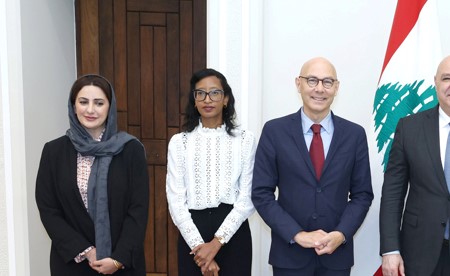
In this context, President Aoun, during his meeting with the UN High Commissioner for Human Rights, Volker Türk, stated that “Israel’s continued destruction of homes and leveling of villages in the areas it occupies in the south constitutes a direct violation of human rights and a blatant breach of international laws and norms, necessitating international action to halt it and prevent it from continuing the destructive plan it previously pursued in Gaza.”
President Aoun stressed that Lebanon, which signed the “Framework Agreement” following negotiations in Washington, “is committed to implementing it, but fears, on the other hand, that Israeli practices may undermine its effectiveness, especially since Lebanon will not accept the continued violation of its provisions and the disregard of international support calling for their respect.”
Türk conveyed to President Aoun the Commission’s interest in the situation in Lebanon and its monitoring of the rapid developments, particularly the continuous Israeli attacks since March 2, with a view to preparing a detailed report on human rights violations, while reaffirming continued international support for Lebanon and the provision of necessary aid.
For his part, Prime Minister Salam, during a cabinet meeting at the Saray in central Beirut, affirmed that the government is always ready to take advantage of all available options at any time to achieve economic recovery goals, leveraging all regional and international support available for the recovery path and state-building.
Referencing his call with Syrian Foreign Minister Asaad al-Shibani immediately after his return from Iraq, Salam emphasized “the importance of strengthening regional connectivity for mutual benefit for all.” He outlined the connection of Lebanon to the Basra-Tripoli pipeline, citing shared benefits and Lebanon’s significant storage capacity, along with plans to establish a new refinery, as stated by Minister of Information Paul Maroun.
Regarding the south, State Minister for Administrative Development Dr. Fadi Makki led a high-level diplomatic and development delegation, including Dutch Ambassador Frank Molan, Spanish Ambassador Miguel de la Cueva, Brazilian Ambassador Felipe Goulart, and Mexican Ambassador Francisco Romero, along with Alejandro Vitadine, head of the European Bank for Reconstruction and Development (EBRD) office in Lebanon, Gilaneh Al-Misiry, representative of UN Women in Lebanon, and several heads of non-governmental organizations, on a tour of Sidon. They inspected the damage and witnessed the destruction, and also visited the old quarters of Sidon.
During the tour, Makki said: “The ambassadors are witnesses to reality. The presence of the ambassadors with us today is essential, because the best way to understand what is happening is to see it on the ground. What they see of destruction and the effects of Israeli attacks is the reality that the people of the south live with daily. We want them to convey this image to their countries and to the international community as it is.”
During the tour, Dutch Ambassador Molan and Spanish Ambassador de la Cueva spoke, affirming “their countries’ support for Lebanon,” and said: “We came to visit the south and Sidon to assess the damage, and Sidon is a historic city whose cultural and historical heritage must be preserved. We hope for the end of the war and the return of peace to Lebanon and its south, because peace is the most effective message for peoples.”
