Minister of Education: Over 75% completion rate of the 2025-2027 Education Reform Plan as of July
&cropxunits=450&cropyunits=300&w=770)
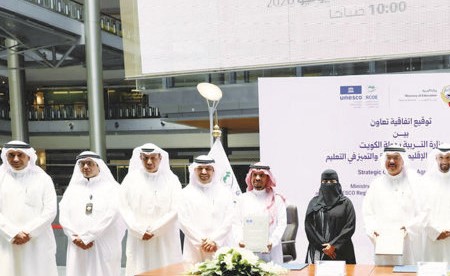
Alaa Khalifa: Education Minister Eng. Sayed Jalal Al-Tabtabaee emphasized the importance of the joint cooperation agreement between the Ministry and UNESCO’s Regional Centre for Quality and Excellence in Education, in al
Translated by Qiyas from الأنباء — Original source
Alaa Khalifa: Education Minister Eng. Sayed Jalal Al-Tabtabaee emphasized the importance of the joint cooperation agreement between the Ministry and UNESCO’s Regional Centre for Quality and Excellence in Education, in alignment with Kuwait Vision 2035, which places human development and the enhancement of human capital at the core of its priorities.
In a press statement during his attendance at the signing of the cooperation agreement between the Ministry and the Centre, Al-Tabtabaee stated that this initiative also stems from the conviction that education serves as the foundation for building society, enhancing competitiveness, and achieving sustainable development. He noted that the education development process enjoys the support and attention of the wise political leadership, which consistently affirms that investing in Kuwaiti human resources is the most crucial investment. This commitment drives the Ministry to continue its work, accelerate the pace of reform, and translate these directions into programs and development projects with tangible impacts on the educational field.
He clarified that the Ministry has made significant strides across several development pathways, including updating curricula according to international standards, developing measurement and assessment tools, expanding educational services, advancing digital transformation, strengthening training programs and capacity-building for educational staff, and reviewing the legislation and policies governing educational work. He added that these achievements represent the beginning of a broader path that requires sustained effort, swift implementation, and continuous evaluation of results. He pointed out the Ministry’s keenness to benefit from regional and international experiences, expand cooperation with educational and research institutions to contribute to policy development, knowledge transfer, and national capacity building, and utilize data and studies to support educational decision-making.
He explained that the Ministry’s joining of the supervisory committee for the Regional Assessment of Student Achievement in Arab Countries project last January exemplifies the level of cooperation with the UNESCO Regional Centre for Quality and Excellence in Education. It reflects Kuwait’s confidence in its standing to support regional educational initiatives and paves the way for a broader launch toward a deeper and wider institutional partnership, culminating in the agreement. He stated that the Ministry views the agreement as a starting point for an effective strategic partnership that translates into executive projects and development initiatives responding to its priorities, based on clear action plans, measurable performance indicators, and continuous monitoring and evaluation mechanisms. This ensures the achievement of sustainable results that contribute to elevating the quality of education and enhancing the efficiency of the educational system.
He noted that the Ministry possesses competencies and expertise that warrant pride, alongside a genuine will to develop education and benefit from every serious cooperation that adds value to the educational system. This approach simultaneously preserves national identity, societal values, and students’ needs. He expressed his sincere gratitude and appreciation to the UNESCO Regional Centre for Quality and Excellence in Education, represented by its Director General, Dr. Abdulrahman Al-Mudairis, for their constructive cooperation and commitment to strengthening joint efforts with the Ministry.
He affirmed that the Ministry is proceeding with the development of its educational system in accordance with the Education Reform Plan for the period 2025–2027, which is based on phased implementation, performance measurement, and continuous monitoring. He indicated that the plan’s completion rate exceeded 75% as of July this year, reflecting tangible progress in achieving its targets according to the approved timeline. This underscores the Ministry’s commitment to advancing development programs through an institutional methodology focused on performance measurement, continuous improvement, and enhancing the quality of educational outcomes.
He added that the Ministry will continue to strengthen its partnerships with specialized educational institutions and organizations in line with Kuwait Vision 2035, translating the directives of the wise political leadership toward building a modern educational system capable of preparing generations equipped with knowledge, skills, and values, and contributing to sustainable development and shaping the nation’s future.
For his part, Al-Mudairis affirmed that the signing of the agreement comes at a time when educational transformations are accelerating globally due to technology and artificial intelligence, highlighting the need to strengthen effective strategic partnerships to ensure the sustainability of educational excellence.
He noted that the agreement embodies a shared vision and a firm commitment to enhancing the quality and excellence of education as a foundation for building sustainable knowledge-based societies capable of preparing for the future. It also represents the culmination of the Ministry of Education’s efforts and initiatives to expand its partnerships and leverage global expertise to develop its educational system.
