"Al-Ayareen": A Heavyweight Comedy
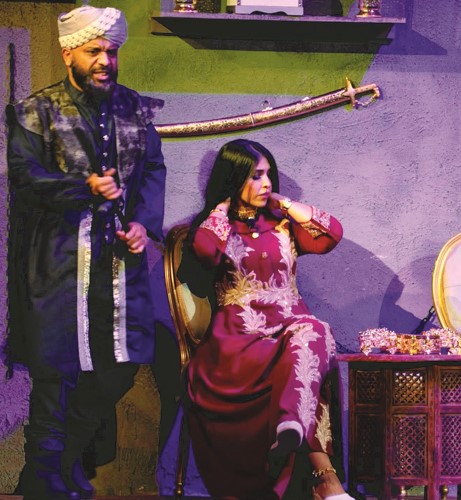
Bashar Jasim Al-Kandari Among the plays that resonated well with discerning audiences is “Al-Ayareen” (The Rogues), currently staged at the East Association Theater (the theater of the late Sheikh Duaij Al-Khalifa Al-Sabah). The play is written by the veteran Badr Al-Muharriq, with dramaturgy by Fatima Al-Musallam, set design by Jasim Kharibit, and features a cast including Mubarak Al-Mane, Sultan Al-Faraj, Noura Al-Amiri, Mohammad Ashour, Zainab Bahman, Nasar Al-Nassar, Abdulmohsen Al-Qaffas, Abdullah Al-Rumayyan, Nasser Al-Doub, and is directed by Yousef Al-Baghl, with costumes by Dr. Absam Al-Humaidi.
The play’s script is dense and weighty, which director Yousef Al-Baghl handled intelligently, especially given his experience directing numerous academic theater productions. Overall, the play’s atmosphere aligns with academic theater infused with comedy. The set design by Jasim Al-Kharibit employed a moving circular platform in the center of the stage, used to change scenes and sets, as well as on the sides of the stage, giving the production vitality and separating scenes from one another. He also incorporated ropes throughout the set design. The play opened with marionette art, a popular theatrical form relying on puppets suspended in the theater space.
The plot revolves around a group of characters who rely on cunning to achieve their personal interests. These individuals are known more for deceit and trickery than for strength, embodying the proverb, “Whoever has a trick should use it,” to gain material or social advantage. However, the events turn against them, and the truths are revealed in a comedic manner.
The play is light, delivered in our Kuwaiti dialect, and tells the story of a group of people who rely on shrewdness, wordplay, and evasion: the governor, the sultan, the vendors, the madman, and the wives of the rogues—all pursuing their interests through deceit.
All the artists participating in the play were the highlights of the performance, with their roles roughly equal in size. Regarding distinction and surprise, particularly in the dose of comedy, the credit went to Nasser Al-Doub, Nasar Al-Nassar, and Noura Al-Amiri. Nasar Al-Nassar, in particular, delivered two or three roles accompanied by puppets, entertaining the audience with his portrayal of the madman. Noura proved herself through comedy, while Al-Doub is a versatile artist. Mubarak Al-Mane and Sultan Al-Faraj are stars with their own unique styles in comedic improvisation. Additionally, Abdullah Al-Rumayyan and Zainab Bahman formed a delightful comedic duo. Al-Rumayyan demonstrated that his presence in any production is an asset to the performance, just as Zainab Bahman, who possesses comedic talent and strong character embodiment, did. Abdulmohsen Al-Qaffas, whom we are accustomed to seeing in dramatic roles, tried hard to bring joy and jokes to his characters, but his problem was that he was too easily amused by his colleagues, often unable to hold back his laughter on stage. Mohammad Ashour is a comedic star and one of the most important figures in the world of comedy, having proven himself in multiple plays. However, his continued reliance on the same “character” and in most of his works has kept him in the same mold, specifically his speech pattern (the “Maksar” accent). Ashour should present more diverse characters and avoid repetition.
Overall, the work is “heavy” and academic-comedic. We can say “Al-Ayareen is a heavy-comedy production.” Bravo.
