Kuwaiti banks solidify their regional standing with assets exceeding $449.60 billion
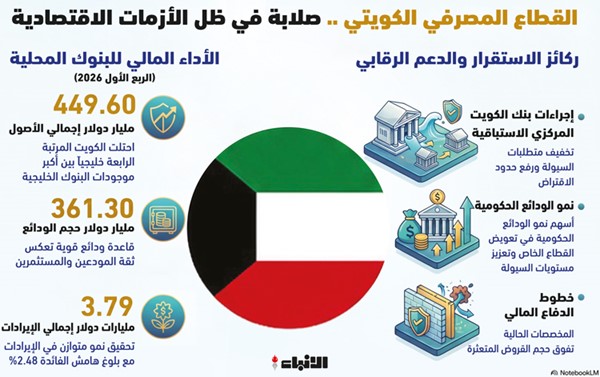
Despite the geopolitical tensions witnessed in the region with the outbreak of the US-Israeli-Iranian war, and the accompanying fears regarding their impact on the region’s economies and financial markets, the Kuwaiti ba
Translated by Qiyas from الأنباء — Original source
Despite the geopolitical tensions witnessed in the region with the outbreak of the US-Israeli-Iranian war, and the accompanying fears regarding their impact on the region’s economies and financial markets, the Kuwaiti banking sector has demonstrated exceptional resilience and a high capacity to withstand shocks. It has maintained the stability of its financial indicators and continued business growth, without recording any fundamental disruptions in liquidity, funding, or asset quality levels. This reflects the strength of its financial positions and the efficiency of the regulatory framework led by the Central Bank of Kuwait.
The ability of Kuwaiti banks to contain the crisis’s repercussions did not stop there; they continued to strengthen their position among the largest Gulf banks, benefiting from high capitalization levels, a strong deposit base, and high asset quality, alongside proactive precautionary measures taken by the Central Bank of Kuwait to enhance financial stability. This bolstered the confidence of depositors and investors and cemented the banking system’s ability to continue financing economic activity even during the most turbulent periods.
Financial data for the first quarter of 2026 confirms this resilience. Total assets of Kuwaiti banks reached $449.60 billion by the end of March, placing them fourth among the largest banking sectors in the Gulf Cooperation Council (GCC) countries, after the United Arab Emirates, Saudi Arabia, and Qatar. Customer deposits amounted to $361.30 billion, while net loans reached $289.40 billion. The net interest margin stood at 2.48 percent, and banks recorded total revenues of $3.79 billion during the first quarter of the year.
These indicators reflect the continued balanced growth of the Kuwaiti banking sector despite the exceptional circumstances the region has experienced. They also confirm the success of regulatory and precautionary policies in maintaining high levels of liquidity and financial stability, and enhancing banks’ capacity to face any potential credit or funding pressures. At the same time, Kuwait, along with the United Arab Emirates, ranked among the fastest-growing GCC countries in government and quasi-government deposits during the early months of 2026. This helped offset the slowdown in private sector deposit growth, enhanced liquidity levels within the banking system, and increased banks’ ability to continue financing various economic sectors.
The Central Bank of Kuwait played a pivotal role in enhancing the banking sector’s resilience by implementing a series of precautionary measures, including easing liquidity requirements, raising lending limits, and releasing part of the capital conservation buffer. These measures provided banks with greater room for refinancing and absorbing any potential credit pressures, within a framework of preventive actions aimed at enhancing confidence and financial stability, rather than as a response to a banking crisis.
In the regional context, reports issued by rating agencies and international financial institutions confirmed that Gulf banks successfully navigated the repercussions of regional tensions accompanying the war. They benefited from strong funding, high capitalization levels, available liquidity, and continued government support, which limited their exposure to short-term credit risks and cemented their ability to continue growing despite the uncertainty in the region. Reports from S&P Global, Fitch Ratings, and MEED magazine indicated that the Gulf banking sector entered the period of regional tensions in 2026 on strong financial foundations, including high levels of liquidity and capitalization, and a stable deposit base. This enabled it to contain the war’s repercussions without recording significant disruptions in the banking system or a noticeable decline in credit activity.
The reports confirmed that Gulf banks benefited from strong local funding and continuous government support, which limited their exposure to short-term risks. Meanwhile, Gulf banking systems maintained high levels of financial stability compared to many other markets that were more affected by geopolitical volatility.
Data for the first quarter of 2026 showed the continued strength of funding sources for Gulf banks. Local deposits rose by 16.9 percent year-on-year, offsetting the decline in interbank funding and reflecting continued customer and institutional confidence in the Gulf banking sector despite the exceptional circumstances in the region. MEED noted that government and quasi-government deposits recorded strong growth, particularly in Kuwait and the UAE, which compensated for the slowdown in private sector deposit growth in both countries. Additionally, April saw an acceleration in government deposit inflows due to proactive measures taken by GCC governments to protect banking systems and enhance liquidity levels.
For its part, Fitch highlighted that funding and liquidity represent one of the strongest points of the Gulf banking sector. It noted that government deposits typically account for between 20 and 30 percent of total banking sector deposits. These deposits are characterized by stability and long-term horizons, providing banks with a strong funding base even during periods of economic and geopolitical volatility.
The agency added that Gulf banks’ reliance on public sector and government deposits was a key factor in stabilizing funding sources and reducing potential risks. It emphasized that the withdrawals observed to a limited extent at the beginning of the war did not last long, with most funds returning to banks within a few weeks, a clear indicator of continued investor and depositor confidence in the safety of Gulf banking systems.
Agency data showed continued growth in credit extended to the private sector in GCC countries during the first quarter of 2026, with an annual growth rate of 8 percent by the end of March. This reflects continued credit activity and banks’ confidence in financing the economy, despite the uncertainty imposed by geopolitical developments. The report noted that provisions set aside by banks to cover expected credit losses exceed the volume of current non-performing loans, forming the first line of defense in protecting asset quality. High capitalization levels represent the second line of defense, giving banks additional capacity to face potential losses without affecting their financial stability.
It was clarified that the limited impact of the war on Gulf banks, compared to other economic sectors, is due to the fact that GCC economies and their banking systems have shown high levels of resilience over the past three years, while many global economies faced inflationary pressures and economic growth slowdowns.
Despite these positive indicators, the agency stressed that Gulf banks do not view the current situation as the end of risks. Instead, they continue to prepare for the possibility that some sectors may face pressures during the second half of 2026, with expectations of varying degrees of economic activity slowdown across GCC countries.
**Gulf Banking Sector Assets Reach $4.01 Trillion**
Total assets of banks in GCC countries rose to a record level of $4.013 trillion by the end of the first quarter of 2026, compared to $3.912 trillion in the fourth quarter of 2025, achieving a quarterly increase of $101 billion, equivalent to growth of 2.58 percent.
On a year-on-year basis, total assets increased by approximately $409 billion compared to $3.604 trillion in the first quarter of 2025, equivalent to growth of 11.35 percent.
Gulf banking assets also recorded a cumulative increase of $772 billion, equivalent to growth of 23.82 percent, compared to the first quarter of 2024, when they stood at $3.241 trillion.
