Successful treatment of bile duct obstruction in a Kuwaiti national with a rare congenital anatomical variation
&cropxunits=450&cropyunits=300&w=770)
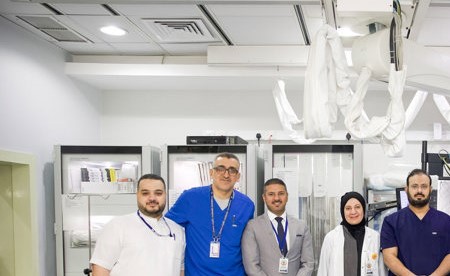
In a landmark medical achievement reflecting the continuous advancement of specialized, high-precision services at the Ministry of Health, a medical team at Al Adan Hospital, led by Dr. Youssef Al-Tawalla, Senior Specialist in Gastrointestinal and Liver Diseases and Advanced Therapeutic Endoscopy, successfully treated a Kuwaiti woman in her thirties suffering from severe bile duct obstruction, which was found to be caused by an extremely rare congenital anatomical variation.
The medical team, which also included an interventional radiology team led by Dr. Mehdi Abbas, explained that during an endoscopic retrograde cholangiopancreatography (ERCP) procedure, the opening of the bile duct could not be located in its usual anatomical position in the second part of the duodenum. This necessitated precise tracing of the bile duct’s anatomical pathway, revealing that the bile duct opening was located inside the stomach at an unusual site—an extremely rare congenital anatomical variation that required advanced expertise in diagnosis and management using therapeutic endoscopic techniques.
It was also found that there was a stricture and obstruction at the bile duct opening, requiring advanced therapeutic intervention using therapeutic endoscopy and interventional radiology. The opening was dilated, the bile duct was cleared, and a medical stent was placed to ensure safe and stable bile drainage, without the need for surgical intervention.
The intervention resulted in successful treatment and the patient’s full recovery. Liver function tests and enzymes returned to normal levels, and she was discharged from the hospital in good health, praise be to God.
Dr. Al-Tawalla noted that since the beginning of this year, more than 120 advanced endoscopic procedures have been performed at Al Adan Hospital, alongside the availability of a range of specialized high-precision services, including endoscopic ultrasound for the liver, pancreas, and bile ducts; placement of therapeutic stents; and double-balloon enteroscopy for small intestine examination.
The therapeutic endoscopy team also provides advanced therapeutic interventions, including stent placement between the stomach and pancreatic cysts, and between the intestines and bile ducts or the gallbladder, as well as dilation of gastrointestinal strictures under radiological guidance and placement of complex feeding tubes.
Dr. Al-Tawalla emphasized that these precise interventions are carried out daily within the hospital, thanks to the availability of specialized national cadres and advanced technical capabilities.
