Al-Watani: Kuwait's GDP fell 4.6% in the first quarter amid the repercussions of the closure of the Strait of Hormuz
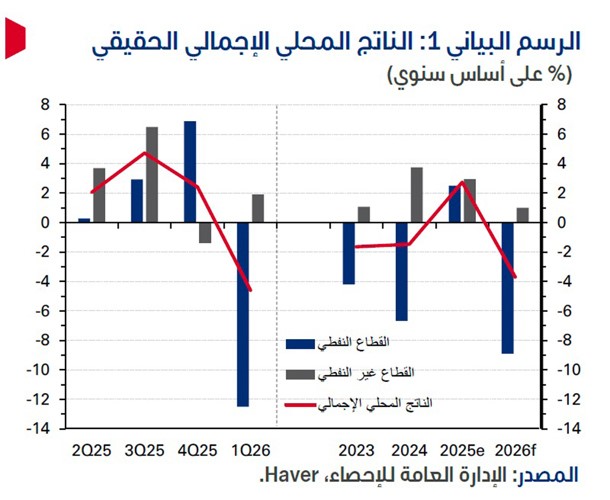
A report issued by National Bank of Kuwait stated that initial official estimates show that gross domestic product (GDP) fell by 4.6% on an annual basis in the first quarter of 2026, due to a contraction in non-oil GDP l
Translated by Qiyas from الأنباء — Original source
A report issued by National Bank of Kuwait stated that initial official estimates show that gross domestic product (GDP) fell by 4.6% on an annual basis in the first quarter of 2026, due to a contraction in non-oil GDP linked to a decline in crude oil production caused by the war between the United States and Iran. In contrast, non-oil GDP recorded moderate growth following the exceptional contraction witnessed in the previous quarter, despite weak performance in the transport and hospitality sectors. Since the first quarter included only one month of the conflict, GDP weakness is expected to persist during the second quarter, particularly as oil exports are severely affected by the closure of the Strait of Hormuz for most of the quarter.
The report noted that oil GDP, which accounts for approximately 42% of total GDP, contracted by 12.5% year-on-year in the first quarter of 2026, reversing three consecutive quarters of growth amid disruptions related to the regional conflict. Oil production fell to 1.2 million barrels per day in March, compared to around 2.58 million barrels per day in February and 2.41 million barrels per day a year earlier, after the effective closure of the Strait of Hormuz halted Kuwait’s oil exports. Production declined further, averaging 570,000 barrels per day during April and May, as local storage capacities filled up, forcing production cuts.
This was followed by a temporary improvement after a ceasefire agreement was signed between the United States and Iran in mid-June, which helped restore some exports and raise production to 1.65 million barrels per day in June. However, the resumption of confrontations between the United States and Iran in mid-July, along with Iran’s subsequent announcement to re-close the strait to shipping, is likely to negatively impact Kuwait’s oil production during the month.
This first-quarter contraction follows a period of improvement in the oil sector’s activity, supported by OPEC+’s decision to begin the gradual phase-out of voluntary production cuts that started in May 2025. Notably, the OPEC+7 group continued to raise production targets despite disruptions related to the conflict that limited actual output.
As a result, Kuwait’s production quota rose to 2.66 million barrels per day in August, and is expected to increase further to 2.68 million barrels per day in September with the completion of the final phase of the voluntary production cut phase-out. While actual production remains constrained by regional developments, the higher production quota provides significant growth potential for Kuwait’s oil sector once shipping conditions through the Strait of Hormuz return to normal and export flows resume.
Slowing expansion of the non-oil sector driven by contraction in the manufacturing sector
The report continued by stating that non-oil GDP rose by 1.9% on an annual basis in the first quarter of 2026, recovering from the 1.4% contraction recorded in the previous quarter.
This growth was supported by strong performance in key, high-weight sectors, including real estate and business activities (+7.2% year-on-year), public administration and defense (+4.1%), and financial intermediation and insurance (+2.5%). Growth was also robust in the health and social services (+7.8%) and telecommunications (+3.9%) sectors. Conversely, this positive performance was dampened by a sharp decline in the manufacturing sector (-8.6% year-on-year), driven by a drop in refined petroleum derivatives production to 668,000 barrels per day in March, bringing the quarterly average production to 1.143 million barrels per day (-9.7% year-on-year).
Additionally, disruptions stemming from the conflict affected tourism-related sectors, such as hotels, restaurants, and transport, which contracted by 9.1% and 8.7%, respectively. The electricity, gas, and water sector also performed weakly, with electricity and gas production falling by 9% year-on-year. With the conflict ongoing, its negative impact on the non-oil economy is likely to intensify, as reflected in recent high-frequency economic indicators.
Purchasing Managers’ Index (PMI) readings remained in contraction territory throughout the second quarter, while real estate activity remained weak, continuing the decline that began in the first quarter. Moreover, project contracting slowed significantly, falling by nearly half compared to the high levels recorded in the first quarter, amid rising uncertainty and a shift in government priorities toward increased defense spending.
Overall, current geopolitical tensions are likely to continue pressuring non-oil economic activity in the near term, leading to another weak economic performance in the second quarter.
Sharp Decline in GDP in the First Quarter
Reflecting the developments mentioned in both the oil and non-oil sectors, GDP contracted by 4.6% year-on-year in the first quarter of 2026, after registering growth of 2.4% in the fourth quarter of 2025. Economic performance is expected to remain under pressure in the coming quarters, given the continued closure of the Strait of Hormuz and escalating regional tensions.
Although visibility remains limited at present, we currently expect oil GDP to contract by 26% this year due to ongoing production disruptions, while non-oil GDP is projected to shrink by 2%, driven by declining business confidence, weak investment activity, and heightened uncertainty associated with the conflict.
Looking further ahead, the outlook for 2027 appears more positive. Oil production is expected to recover strongly as shipping activity returns to normal levels and Kuwait benefits from higher production quotas within OPEC+. Meanwhile, the non-oil economy is anticipated to benefit from a recovery in project activity, along with improved consumer and business confidence.
