"Gulf Cooperation Council: Iran's treacherous attacks and Houthi militia threats to the Bab al-Mandab necessitate a firm international stance"
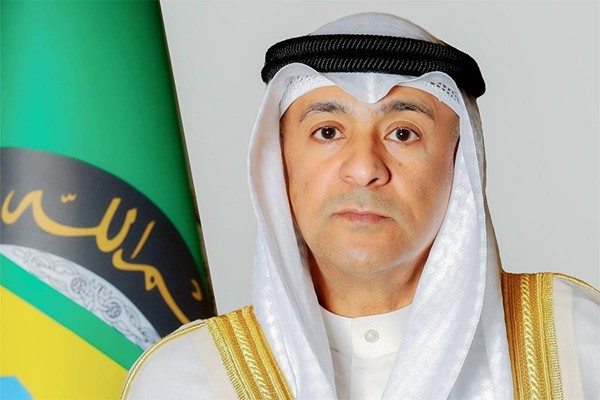
The Secretary-General of the Gulf Cooperation Council (GCC), Jassem Al-Bouaidi, stated that Iran’s treacherous attacks on GCC member states and the Houthi militias’ threats to close the Bab al-Mandab Strait necessitate i
Translated by Qiyas from الأنباء — Original source
The Secretary-General of the Gulf Cooperation Council (GCC), Jassem Al-Bouaidi, stated that Iran’s treacherous attacks on GCC member states and the Houthi militias’ threats to close the Bab al-Mandab Strait necessitate immediate accountability and a firm international stance to ensure respect for the rules of international law, guarantee freedom of navigation, and protect critical infrastructure related to energy and natural resources.
The GCC Secretariat noted in a statement that these remarks were made by Al-Bouaidi during a high-level open debate of the UN Security Council titled “Governance of Natural Resources: A Pillar for Peace, Security, and Prosperity,” held at the United Nations headquarters in New York.
Al-Bouaidi emphasized that the prudent management of natural resources, in accordance with the principles of governance, transparency, rule of law, and international cooperation, constitutes a fundamental pillar for achieving development and prosperity. He warned that exploiting these resources as a tool for war or political pressure, or targeting associated infrastructure and disrupting their supply routes, leads to destabilization and harms the global economy, as well as international peace and security.
He clarified that GCC member states have made good governance of natural resources a cornerstone of their national and collective policies. He pointed out that the region holds approximately 30 percent of global oil reserves and about 20 percent of natural gas reserves, contributing nearly a quarter of global oil production. This makes the GCC a reliable partner in maintaining the stability of global energy markets, even during crises and geopolitical fluctuations.
Furthermore, Al-Bouaidi noted that GCC countries have continued to invest revenues from their natural resources in diversifying their economies, investing in human capital, infrastructure, and innovation, alongside expanding renewable energy and low-emission hydrogen projects. This reflects their commitment to balancing energy security with climate action.
Al-Bouaidi stressed that natural resource security is closely linked to the protection of critical infrastructure, international sea lanes, and global supply chains. He affirmed that any attack on these routes or disruption of navigation there not only threatens the interests of exporting countries but also directly impacts global energy security, supply chains, and the stability of global markets.
He noted that since February 28, Iran has continued launching ballistic missile and drone attacks on GCC member states and other countries without any legitimate justification, in blatant violation of international law and the UN Charter. He called on the Security Council and the international community to uphold their legal responsibilities to halt these attacks and deter Iran’s aggressive policies, thereby preserving international peace and security.
The GCC Secretary-General added that these attacks do not target only the attacked states but also represent an extension of a policy that harms the Iranian people themselves, who are suffering under a regime that squanders the country’s resources on escalation and conflict policies rather than directing them toward development, prosperity, improving citizens’ living standards, and ensuring their future.
Al-Bouaidi strongly condemned the hostile statements issued by Houthi militias, which included threats to close the Bab al-Mandab Strait and false claims against the Kingdom of Saudi Arabia. He considered these threats a violation of international law and a direct threat to freedom of navigation and the safety of one of the world’s most important strategic sea lanes. He called for a firm international stance rejecting the use of international sea lanes as a tool for blackmail or as a means to undermine security and stability.
He affirmed that the Gulf Cooperation Council (GCC) states stand united in support of the measures undertaken by the Kingdom of Saudi Arabia to safeguard its security, sovereignty, and vital interests.
Al-Badawi also outlined what he described as dangerous Iranian practices in the Strait of Hormuz, including attacks on commercial vessels, the laying of naval mines, attempts to impose mandatory shipping routes within Iranian territorial waters, and repeated threats to close the strait. He noted that these practices have directly disrupted international trade and supply chains, causing hardship to more than 20,000 seafarers of various nationalities.
In this context, he emphasized the importance of supporting the efforts of the International Maritime Organization to ensure navigational safety and protect civilians.
Al-Badawi drew attention to United Nations Security Council Resolution 2817, adopted on March 11, which was submitted by the Kingdom of Bahrain on behalf of the GCC states and Jordan, and co-sponsored by 136 countries. He noted that this resolution received the broadest support in the Council’s history, condemned Iranian aggression against neighboring countries, and affirmed that any attempt to obstruct freedom of navigation in the Strait of Hormuz constitutes a threat to international peace and security.
He stressed that the 1982 United Nations Convention on the Law of the Sea guarantees the right of transit passage through international straits and prohibits the suspension of this right, affirming that freedom of navigation is not subject to any exceptions or conditions.
He added that natural resources should serve as bridges for cooperation, partnership, and development, rather than causes of conflict and division. He emphasized that protecting civilian facilities and critical infrastructure, safeguarding the security of sea lanes, respecting international law, and enhancing multilateral cooperation are all fundamental pillars for ensuring collective security and achieving sustainable development.
Concluding his speech, Al-Badawi reaffirmed the GCC states’ success in leveraging their natural resources to achieve sustainable development and promote prosperity, alongside their role in maintaining stability in global energy markets and providing humanitarian and developmental assistance. He reiterated their commitment to remaining a source of stability rather than disruption, a reliable partner in global energy security, and a voice supporting dialogue and de-escalation.
