War Scars on the Ancient Site of Deir ez-Zor in Northern Syria
&cropxunits=450&cropyunits=300&w=770)
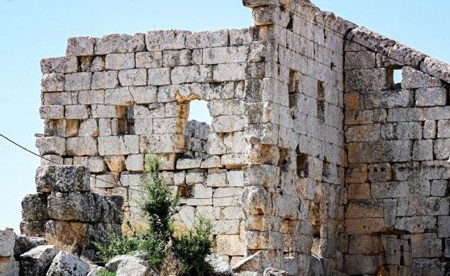
Surrounding the column on which it is said that Saint Simeon spent his years, stones are scattered throughout the abandoned Byzantine monastery in northern Syria, bearing witness to years of war, looting, and illegal excavations, exacerbated by the 2023 earthquake and neglect. A specialized French archaeological delegation visited the Monastery of Saint Simeon and the surrounding archaeological sites, which had been inaccessible during the war years (2011–2024), to assess the extent of the damage in preparation for the monastery’s restoration.
The Monastery of Saint Simeon is one of the most prominent Christian landmarks in Syria. Its vast religious complex was built in the fifth century CE before becoming one of the most famous Christian pilgrimage destinations in late antiquity. The monastery is part of the Ancient Villages of Northern Syria, inscribed on UNESCO’s World Heritage List in 2011 and on the List of World Heritage in Danger since 2013.
Among the stones of the completely collapsed western arch, Syrian-French archaeologist Micheline Kerdy made her way into the archaeological site in the countryside of Aleppo, carrying her camera and a small notebook, to a location where she had worked before the war, hoping to determine what could be saved and restored.
Kerdy, 42, a specialist archaeologist and engineer, told Agence France-Presse, “There is irreparable damage in the monastery’s southeastern section, but conversely, the church remains standing and in good condition, and there are parts we can reconstruct.”
Inside the monastery, cracked arches and partially collapsed stone walls were visible, while the buildings where the monks resided remain intact.
Symbol of the Church
The director of Qal’at Sim’an (Saint Simeon Castle), Araabi, estimated the damage caused by the war and the earthquake at between 30% and 40%, pointing to the collapse of the western arch along with its columns and varying structural damage, some requiring simple reinforcement and others large-scale projects.
He told Agence France-Presse: “The column of Saint Simeon is the symbol of the church. The base exists as a single coherent piece, but the rest of the column consists of broken stones that we will try to assemble and rebuild.”
The monastery was built around the column of Saint Simeon, a hermit monk who, according to Christian tradition, spent approximately forty years atop the column devoted to worship. The column became a pilgrimage destination after his death.
Abdeljalil emphasized that “the column requires a review of old plans so we can reconstruct the base along with the remaining part of it.”
Since the start of the war in Syria in 2011, the site has been subjected to “looting, illegal excavation, military use, and neglect,” according to the castle’s director. In May 2016, it was hit by an airstrike, while the violent February 2023 earthquake, which affected Syria and Turkey, left its mark on the arches and walls.
The French delegation, which included the French Chargé d’Affaires in Syria, Jean-Baptiste Favre, visited several archaeological and historical areas in northern Syria and met with officials from the Aleppo Directorate of Antiquities and Museums.
Favre, speaking from inside the Monastery of Saint Simeon, said, “This heritage is extremely important, not only for Syria’s past but also for its future. This activity is undoubtedly archaeological, but it is also economic and touristic.”
He added, “There will be cooperation between the Syrian General Directorate of Antiquities and Museums and French cultural institutions to help restore and develop this site.”
