Ministry of Health Approves Mechanism for Regulating Interactions Within Health Facilities
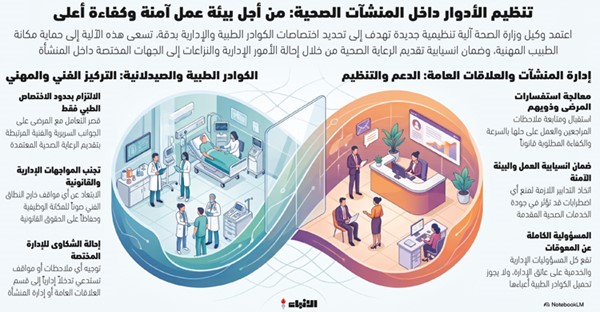
The Undersecretary of the Ministry of Health, Sheikh Dr. Salman Al-Sabah, has approved a mechanism regulating conduct within healthcare facilities, covering medical practitioners, allied health professionals, and pharmacists. According to the mechanism, published by Al-Anbaa, all medical practitioners, allied health professionals, and pharmacists must adhere to the following:
1. Strictly observe the professional scopes of practice stipulated by law and regulations, limiting patient interactions to medical, clinical, and technical aspects related to the provision of healthcare.
2. Avoid entering into confrontations or situations of an administrative, organizational, legal, or service-oriented nature that fall outside their professional scope, in order to safeguard their legal rights and preserve their professional standing.
3. Refer any claims, complaints, observations, or situations requiring administrative, organizational, or legal intervention to the healthcare facility’s administration or relevant departments, including the Public Relations Department, for appropriate action in accordance with established procedures.
**Healthcare Facilities and Public Relations**
The mechanism also stipulates that healthcare facility administrations and public relations departments must:
1. Receive and follow up on inquiries from patients, their families, and companions, and address them with the required speed and efficiency.
2. Remove obstacles and difficulties, including organizational and administrative ones, that may be faced by healthcare service recipients within the facility, and facilitate procedures related to receiving healthcare services.
3. Take necessary organizational measures to ensure smooth operations and maintain a safe, orderly health environment, thereby minimizing any disruptions or issues that could affect workflow or the quality of services provided.
4. Intervene immediately to resolve any incidents that disrupt order and hinder the smooth operation of the healthcare facility, taking appropriate measures in accordance with applicable systems and regulations.
**Administrative and Organizational Responsibilities**
The mechanism emphasized that administrative, organizational, and service-related responsibilities lie with the relevant authorities within the healthcare facility. It explicitly stated that medical practitioners and pharmacists must not be assigned responsibilities or roles that fall outside their legally mandated professional duties.
**Compliance with the Mechanism**
The mechanism binds all concerned parties to fully comply with and implement its provisions from the date of its issuance. It calls upon sector heads, health region directors, and hospital and health center managers to take necessary steps to implement it and monitor adherence to its provisions, each within their respective jurisdictions.
This comes in accordance with the provisions of Law No. (70) of 2020 concerning the practice of medicine and its allied professions and patients’ rights in healthcare facilities, and the provisions of Law No. (28) of 1996, amended by Law No. (30) of 2016, concerning the regulation of pharmacy and drug distribution, as well as the Decree-Law No. 15 of 1979 concerning the Civil Service and the Decree issued on April 4, 1972, regarding the Civil Service System and their amended laws.
**Principles of Professional Practice**
This also stems from the Ministry of Health’s commitment to consolidating principles of sound professional practice, enhancing the quality of healthcare services, and providing a safe and motivating work environment that enables medical and technical personnel to perform their duties in accordance with accepted professional, scientific, and legal standards. It is worth noting that the relationship between medical practitioners, pharmacists, patients, and their families is based on professional, legal, and ethical foundations that require clarity of roles, responsibilities, and jurisdictions, thereby ensuring the protection of all parties’ rights and the smooth operation within healthcare facilities.
