Ministry of Health Approves Unified Guidelines for General Appearance, Official Uniform, and Clinical Attire in the Public and Private Sectors
&cropxunits=450&cropyunits=348&w=600)
Abdulkarim Al-Abdullah: The Ministry of Health has issued a comprehensive guide to unify the general appearance, official attire, and professional dress code for staff working in government and private health facilities.
Translated by Qiyas from الأنباء — Original source
Abdulkarim Al-Abdullah: The Ministry of Health has issued a comprehensive guide to unify the general appearance, official attire, and professional dress code for staff working in government and private health facilities. This initiative implements the provisions of Ministerial Decision No. (70) of 2026, aiming to strengthen institutional identity, elevate professional appearance, improve healthcare quality, and support infection control standards and patient safety.
The guide establishes uniform regulations for wearing official and clinical attire across various health categories, including doctors, nursing staff, technicians, pharmacists, and personnel in supporting medical services, as well as engineering staff and emergency medical workers. These regulations adhere to precise technical specifications that consider the nature and duties of each specialty.
The Ministry confirmed the adoption of three standardized designs for clinical scrubs: men’s clinical attire, women’s clinical attire, and Islamic women’s clinical attire. Each design’s specifications are defined in terms of cut, sleeve length, collar type, pockets, and trouser length, along with hijab requirements for nursing staff.
The guide also mandates a unified professional uniform for nursing staff, including nursing leaders and training nurses, with specified official attire for both men and women to enhance professional identity and ensure a consistent appearance within the healthcare work environment.
Additionally, the guide adopts a standardized professional uniform for emergency medical personnel, in accordance with specifications approved by the Emergency Medical Services Department. It also introduces a specific uniform for Ministry of Health engineers and engineering staff, incorporating occupational safety standards, reflective strips, and a mechanism for attaching name tags, job titles, the Ministry’s logo, and the department name to the uniform.
The guide clarifies that staff in health facilities must adhere to one of the approved patterns for official, clinical, or professional attire, depending on the nature of their work. It emphasizes that medical coats must be loose-fitting and reach the knee. Dark blue or black woolen jackets are permitted. Wearing an abaya with a medical coat is allowed during direct patient care, while wearing dishdashas or jeans during direct patient care is prohibited.
The Ministry strictly prohibited wearing clinical attire or medical coats outside government or private health facilities, except in authorized cases such as home visits or field visits, to minimize infection transmission and maintain a professional image.
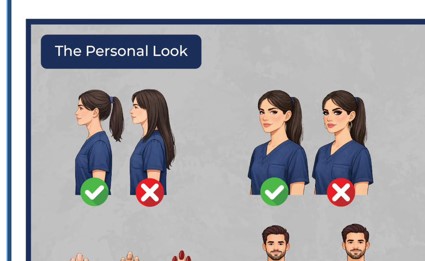
The guide also outlines several general appearance requirements, including maintaining clean and short nails, prohibiting artificial nails in areas of direct patient care, keeping hair neatly arranged and away from the face, limiting jewelry to simple pieces, using makeup discreetly, and wearing closed, non-slip shoes. Nursing staff are required to wear black shoes.
The guide stressed the full compliance with infection control policies and procedures within all health facilities, considering them an essential part of safety and healthcare quality standards.
Regarding professional categories not assigned a specific clinical attire color, the guide explained that new colors may be adopted through a regulatory mechanism starting with a proposal from the relevant sector, subject to review and approval by competent authorities, provided they do not conflict with the colors approved for other health categories. This ensures the clarity of visual identity for each specialty within the healthcare system.
