Kuwait affirms that implementing the 2030 Sustainable Development Plan requires fair and innovative measures and a safe environment
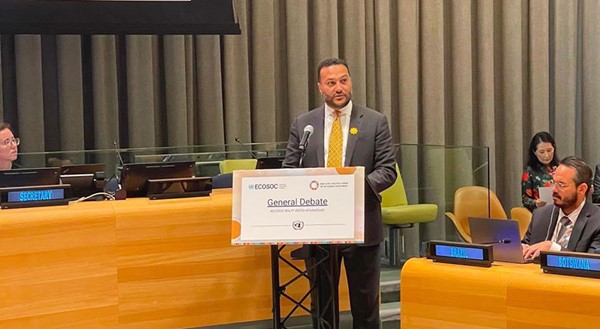
Kuwait has affirmed that the effective implementation of the 2030 Agenda for Sustainable Development requires fair, innovative, and coordinated measures, alongside the creation of a safe and conducive environment that enables countries to achieve their goals without violating sovereignty or targeting civilian and critical populations and infrastructure.
This was stated in a speech delivered by Minister Counselor Faisal Al-Anzi, the Chargé d’Affaires ad interim of the Kuwaiti delegation to the United Nations, during the general debate of the 2026 High-Level Political Forum on Sustainable Development at the UN headquarters.
Al-Anzi noted that the convening of the Forum comes at a critical juncture, with only four years remaining until the deadline for achieving the Sustainable Development Goals, emphasizing the necessity of providing a stable international environment that supports development efforts.
He expressed Kuwait’s concern over the negative economic, environmental, and developmental impacts of conflicts, particularly on countries not involved in them, warning that the expansion of conflicts leads to the depletion of national resources and the diversion of spending from education, health, and infrastructure sectors toward emergency response and reconstruction.
He pointed out that Kuwait continues to translate its national priorities into tangible achievements, citing the recent launch of the Kuwait Emergency Response Fund with an initial capital of $100 million to support national efforts to address damage to national infrastructure caused by Iranian aggression, mitigate its effects on affected groups and communities, and protect essential services.
Al-Anzi strongly condemned the attacks launched by Iran and its proxies on the territories of the Gulf Cooperation Council (GCC) countries and Jordan, which targeted civilian and critical infrastructure. He noted that the latest such attack involved the targeting of one of Kuwait Oil Company’s offshore drilling platforms in Kuwaiti territorial waters by a hostile drone, resulting in material damage and the injury of one worker.
The Minister Counselor reaffirmed Kuwait’s full commitment to its sovereignty and its legitimate right to take all necessary measures to protect its national security in accordance with international law and the UN Charter.
He clarified that Kuwait continues to enhance its water security by developing its water production and desalination systems, improving the efficiency of transmission and distribution networks, strengthening water treatment and reuse facilities, as well as developing the electricity and renewable energy sectors, improving consumption efficiency, and diversifying energy sources, based on the conviction that energy security constitutes a fundamental pillar of sustainable development.
Al-Anzi added that Kuwait is continuing to strengthen its digital infrastructure and develop e-government services to support innovation, service efficiency, and the business environment. He highlighted the launch of residential projects in 2025 in Al-Mutlaa, and in the east and west of Saad Al-Abdullah, under a sustainable public-private partnership model encompassing design, financing, construction, and operation.
He shed light on Goal 17, Partnerships for the Goals, as the cornerstone for accelerating the implementation of the Sustainable Development Agenda, explaining that the infrastructure and housing projects implemented by the State of Kuwait exemplify the importance of unifying the efforts of the government, the private sector, and international partners to bridge financing gaps, transfer technology, build capacity, and reform the international financial architecture.
In conclusion, the Minister Counselor reiterated the country’s commitment to continue working with all international partners and stakeholders to protect development gains, enhance the resilience of infrastructure and essential services, and translate international commitments into tangible results that benefit all peoples of the world, leaving no country or individual behind.
