Kamal El-Wazir: Egypt begins implementation of 8 international logistics corridors and inaugurates the 'Arab Trade Corridors' to link the Gulf and Europe
&cropxunits=450&cropyunits=300&w=770)
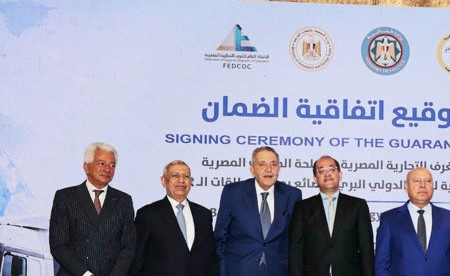
Cairo – Ahmed Sabry: Minister of Transport, Major General Kamal al-Wazir, witnessed the signing of a guarantee agreement between the Union of Egyptian Chambers of Commerce and the Egyptian Customs Authority, in the prese
Translated by Qiyas from الأنباء — Original source
Cairo – Ahmed Sabry: Minister of Transport, Major General Kamal al-Wazir, witnessed the signing of a guarantee agreement between the Union of Egyptian Chambers of Commerce and the Egyptian Customs Authority, in the presence of Minister of Finance Ahmed Kojok, Minister of Investment and Foreign Trade Dr. Mohamed Farid, President of the General Union of Egyptian Chambers of Commerce Ahmed al-Wakeel, Secretary-General of the International Road Transport Union (IRU) Umberto de Pretto, and President of the Arab Academy for Science, Technology and Maritime Transport Dr. Ismail Abdel Gaffar.
The Minister clarified that the signing of this agreement falls within the framework of the United Nations International Transport of Goods under TIR Carnets, and underscores that the Egyptian state is steadily advancing toward adopting best international practices to facilitate trade flows, simplify procedures, and enhance the smooth movement of goods across borders. This aligns with the rapid changes in the global trade system and supply chains. He noted that the Egyptian state has adopted a comprehensive vision for developing the transport sector, based on the premise that transport is the main driver of economic development, a key factor in attracting investments, supporting industry, increasing exports, and enhancing the competitiveness of the national economy.
The Minister pointed out that the Ministry of Transport’s strategy in recent years has evolved from the isolated construction of roads or railway lines to a more holistic concept of developing integrated developmental logistics corridors. He highlighted that Egypt has begun implementing eight integrated developmental international logistics corridors that link the ports of the Red Sea and the Mediterranean, along with the Suez Canal axis, to dry ports, industrial, agricultural, and mining zones. These corridors are supported by a modern, integrated network of railway lines, the high-speed electric train network, and highways, providing efficient transport routes for goods. This contributes to reducing transit times, lowering costs, and enhancing the competitiveness of the Egyptian economy. It embodies Egypt’s vision of integrated regional and international connectivity, positioning the country as a logistics hub linking the Gulf states, the Arab Mashreq, and North, East, and Central Africa, reaching European, Asian, and African markets. This further strengthens the flow of global trade and cements Egypt’s status as a regional center for transport, logistics, and transit trade.
The Minister of Transport explained that, in line with the directives of President Abdel Fattah el-Sisi to optimally utilize Egypt’s unique and exceptional geographic location, which sits at the heart of major global trade routes and connects Asia, Africa, and Europe, alongside the security and stability that serve as a cornerstone for attracting investments and enhancing confidence in the business climate, the integrated Egyptian international logistics corridors will be used to channel intra-trade between Europe and the Arab Gulf states through Egypt. This will occur via two main Arab trade corridors: the Northern Arab Trade Corridor, which links Europe with the Levant countries (Jordan, Iraq, and Syria) through integrated international logistics corridors, notably the Arish/Taba corridor, and via the fleet of the Arab Bridge Shipping Company; and the Southern Arab Trade Corridor, which connects Europe and all Arab Gulf states through Egypt and integrated international logistics corridors up to the port of Safaga, and from there to the NEOM port (formerly Duba) in the Kingdom of Saudi Arabia, via Egyptian national shipping fleets, and subsequently to other Gulf states. This is complemented by integration with other international corridors, such as the India-Middle East-Europe Economic Corridor (IMEC), China’s Belt and Road Initiative, and the Iraqi-Turkish Development Route, through strategic partnerships with major shipping lines.
The Minister highlighted the significant renaissance in Egypt’s transport sector, including roads and bridges, which has enabled Egypt to jump 100 places in global rankings for road quality, now holding the 18th position worldwide. He reviewed several important roads under construction or recently completed in Egypt, such as the Western Desert Road, where truck traffic has been separated onto a dedicated concrete lane, and the Aswan-Berenice Road, currently being developed into a concrete highway. He also pointed to major upgrades in land ports, including the Salloum land port, where the state invested 3 billion Egyptian pounds in recent years to transform it into a pivotal hub for logistics and trade between Egypt and Libya.
Furthermore, the Minister drew attention to significant developments in seaports, aimed at transforming Egypt into a regional center for transport, logistics, and transit trade. He emphasized the importance of the Ro-Ro (Roll-on/Roll-off) line connecting the port of Damietta with Trieste, Italy. This route no longer only transports Egyptian goods to Europe and vice versa; it has become a crucial bridge for moving goods from Europe to Saudi Arabia and Gulf states, and vice versa, utilizing Egyptian ports and land territories.
