Sheikh Hamad bin Khalifa: A Rich History of Strengthening Relations Between the Two Countries
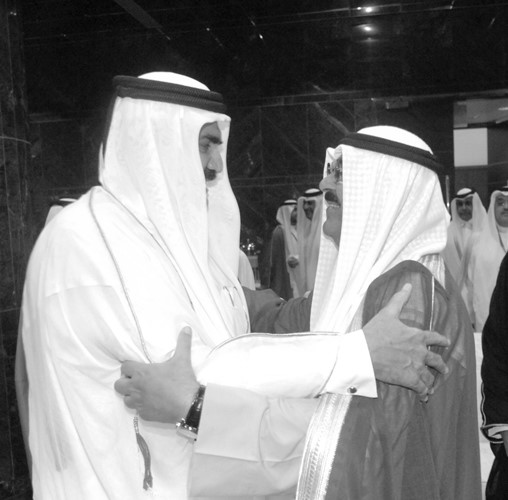
The ties binding Kuwait and Qatar exemplify the entrenched fraternal relations and close connections that prevail between sister states, given the numerous bonds uniting them. The late Emir, Sheikh Hamad bin Khalifa Al T
Translated by Qiyas from الأنباء — Original source
The ties binding Kuwait and Qatar exemplify the entrenched fraternal relations and close connections that prevail between sister states, given the numerous bonds uniting them. The late Emir, Sheikh Hamad bin Khalifa Al Thani, played a significant role in consolidating and developing these relations. He frequently expressed the robustness of Kuwaiti-Qatari relations on various occasions, most notably in his famous 2000 statement affirming that “what affects Kuwait affects Qatar,” and his constant calls for respecting Kuwait’s sovereignty, security, and territorial integrity.
The late Emir Sheikh Hamad bin Khalifa Al Thani had visited Kuwait several times, including during Gulf Cooperation Council (GCC) summits held in Kuwait, as well as on official visits. In May 2005, he visited Kuwait and met with the late Emir, Sheikh Sabah Al-Ahmad Al-Jaber Al-Sabah, to discuss bilateral relations between the two sister countries. In February 2011, he participated in Kuwait’s official celebrations marking the 50th anniversary of independence and the 20th anniversary of liberation, leading a high-level delegation.
A prime example of the strength of relations between the two countries was Qatar’s stance during the Iraqi invasion of Kuwait. At that time, the late Emir Sheikh Hamad bin Khalifa Al Thani was Crown Prince and Minister of Defense. Under his wise leadership, Qatar took an honorable position regarding Kuwait’s just cause against the Iraqi aggression. This was demonstrated through its condemnation, alongside other GCC states, of this brutal invasion at an emergency meeting, and its demand for Iraq to withdraw from Kuwait and comply with international legitimacy and relevant resolutions.
Kuwait always remembers the prominent role played by the late Emir Sheikh Hamad bin Khalifa Al Thani during the brutal Iraqi invasion of the country. He continuously monitored the actions of Qatari forces during the Battle of Khafji. Qatari forces participated in Kuwait’s liberation war, writing a heroic chapter alongside Saudi forces during the Battle of Khafji, which was the first land confrontation between Iraq and the international coalition forces, lasting from January 29 to February 1, 1991. The late Emir regularly inspected the troops.
Qatar did not limit itself to these notable military and political stances; during the occupation period, it hosted approximately 9,300 Kuwaiti citizens. Furthermore, Sheikh Khalifa bin Hamad Al Thani (may God have mercy on him) ordered the formation of the Supreme Qatari Committee for Kuwaiti Affairs, chaired by Sheikh Mohammed bin Khalifa Al Thani. This committee was tasked with providing suitable housing for Kuwaiti families residing in Qatar, offering them healthcare services, and facilitating the enrollment of their children in Qatari schools, institutes, and colleges.
Immediately after Kuwait’s liberation, Qatar provided logistical support by sending technicians and equipment to repair Kuwait International Airport, and offered various assistance to the health sector. The Kuwaiti-Qatari history is replete with evidence of deep cooperation across all eras. Following Qatar’s independence from Britain in September 1971, Kuwait, which was the first Arab country and the third in the world to recognize the State of Qatar, promptly established diplomatic relations with it at the ambassadorial level in the same year.
During the reign of His Highness the late Emir Sheikh Hamad bin Khalifa Al Thani, efforts to develop relations between the two countries continued. In 2002, the Supreme Joint Qatari-Kuwaiti Committee was established to enhance cooperation in political, economic, and commercial fields, as well as in military, security, educational, and cultural sectors.
In terms of economic cooperation, during the reign of His Highness the late Emir Sheikh Hamad bin Khalifa Al Thani, a joint Kuwaiti-Qatari financing company was launched in 1999 to provide Sharia-compliant financial services to Qatari consumers. The company had a capital of 50 million Qatari Riyals, with Kuwait owning 49% and Qatar owning 51%.
On the security front, the two countries are linked by a military cooperation protocol aimed at exchanging information and gaining further expertise. They participate, along with other GCC states, in periodic land, sea, and air drills and maneuvers under the “Peninsula Shield” exercise, to enhance troop readiness and preserve collective security within the GCC framework.
The Architect of Modern Qatar’s Renaissance
With the passing of Qatar’s Emir Emeritus, Sheikh Hamad bin Khalifa Al Thani, may God have mercy on him, whose death was announced by the Emir’s Diwan yesterday morning, Sunday, at the age of 74, Qatar has lost one of its historical leaders and the architect of its modern renaissance. During his reign, the country attained a high standing in the Arab and international arenas, and witnessed a broad economic and cultural upsurge. His name became synonymous with the most significant transformation in the nation’s modern history, as he led a project that elevated the state to the ranks of regional and international actors. Under his rule, the country’s permanent constitution was issued, and “Qatar National Vision 2030” was launched, aiming to enhance the transition to a knowledge-based economy. Qatar was transformed into an advanced state capable of achieving sustainable development and ensuring a decent standard of living for its people, generation after generation.
Sheikh Hamad bin Khalifa was born in Doha in 1952. He received his primary, preparatory, and secondary education in Qatari schools before joining the Royal Military Academy Sandhurst in the United Kingdom, graduating in July 1971.
Upon graduation, he joined the Qatar Armed Forces and was appointed commander of the 1st Mobile Battalion, which later became known as the Hamad Mobile Battalion. He was subsequently promoted to the rank of Major General and appointed Commander-in-Chief of the Qatar Armed Forces, becoming the first Qatari to hold this position.
The late Emir played a pivotal role in developing the Qatar Armed Forces, increasing their personnel numbers, establishing new units, and equipping them with the latest weapons. He also emphasized training officers and personnel in advanced military methods. Leveraging his military expertise through his position, he enhanced the capabilities and efficiency of the armed forces by establishing the Naval Force, the Amir’s Air Force, the Commando and Engineering Corps, the Military Police, the Special Forces, the Border Force, and the Command Defense Unit.
On May 31, 1977, Sheikh Hamad bin Khalifa was appointed Crown Prince and Minister of Defense, as well as Chairman of the Supreme Planning Council, tasked with developing and modernizing the country. This allowed him to exercise executive governance functions early on.
Since assuming power on June 27, 1995, Qatar has ushered in a new phase of comprehensive renaissance and institutional modernization. His reign witnessed qualitative and pivotal developments across political, economic, and developmental sectors, both locally and internationally.
On the external front, Qatar’s policy played important roles through active diplomacy with all parties and countries, striving to build bridges of understanding and cooperation with all nations in the regional and international spheres.
Locally, his reign saw significant developments in strategic planning, developmental programs, and reforms. These efforts took on diverse dimensions, launching a general renaissance that encompassed all fields.
During his rule, the economy and energy sectors witnessed major developments that contributed to making Qatar the world’s largest exporter of liquefied natural gas (LNG) and completing several important energy projects. Additionally, the country embraced economic openness and attracted global investments.
Qatar became a hub for political, economic, cultural, health, and scientific conferences, attaining a prestigious regional and international status in this regard. It also attracted several major global universities.
The late Emir was keen on supporting the youth and sports sectors, believing in the vital role they play in building and developing society. His country hosted several of the most important regional and international tournaments, most notably the announcement in December 2010 that Qatar would be the first Arab and Islamic country to win the right to host the FIFA World Cup.
His reign witnessed widespread changes in various fields, granting women the right to vote and run in local elections, work, and drive cars. Furthermore, he enhanced press freedom and increased investment in gas fields to accelerate the pace of comprehensive development.
During his rule, he sought to strengthen the country’s transition to a knowledge-based economy, transforming Qatar into an advanced state capable of achieving sustainable development and ensuring a decent standard of living for its people, generation after generation.
The late Emir visited numerous Arab and foreign countries to strengthen bilateral relations and sign agreements and memoranda of understanding. In recognition of his efforts to enhance bilateral relations and develop cooperation with these countries, he received numerous awards from Arab and foreign nations.
In 1995, he received the Order of Hussein bin Ali from Jordan and the Order of Oman, First Class, from the Sultanate of Oman. In 1997, he received the Order of the Republic of Tunisia (7th November Order). In 1998, he was awarded the Legion of Honor by France and the Order of the Lion by Senegal.
In 1999, he received the Nishan-e-Pakistan from Pakistan, the Order of Merit of the Federal Republic of Germany from Germany, and the Ordre National du Mérite from Romania. In 2000, he received the Order of the Cedar, Grand Cross, from Lebanon, the Order of Merit of the Italian Republic (Cavaliere di Gran Croce) from Italy, and the Order of the Republic from Yemen.
On June 25, 2013, Sheikh Hamad bin Khalifa announced in a speech addressed to the Qatari people that he was handing over power to his Crown Prince, Sheikh Tamim bin Hamad Al Thani, marking a new phase in Qatar’s journey of construction, development, and progress.
**The Dream of Hosting the 2022 World Cup Realized by the “Late Emir”**
*Nasser Al-Anzi*
May God have mercy on the former Emir of Qatar, Sheikh Hamad bin Khalifa Al Thani, the architect of modern Qatari sports renaissance. This was vividly illustrated in a memorable scene when the International Federation of Association Football (FIFA) announced on December 2, 2010, that Qatar had won the right to host the 2022 World Cup. He was present, may God have mercy on him, celebrating in a moment captured by media outlets worldwide.
Subsequently, Qatar hosted what the international federation and neutral media described as the best edition of the World Cup in the capital, Doha. The opening and closing ceremonies were spectacular, imbued with profound meaning. The Argentine national team was crowned champions in the presence of His Highness the Emir Emeritus, who championed the Qatari dream until it was realized.
May God have mercy on the Emir Emeritus, Sheikh Hamad bin Khalifa Al Thani, a lover of sports and athletes, and a steadfast supporter of all sports. He, may God have mercy on him, advocated for the construction of modern stadiums and the signing of global stars to play in the Qatari league. He, may God have mercy on him, attended matches without formal restrictions, distinguished by his humility with everyone.
