The People's Assembly Held Its First Session After Liberation, and Al-Sharq: Syria Writes a New History
&cropxunits=450&cropyunits=300&w=770)
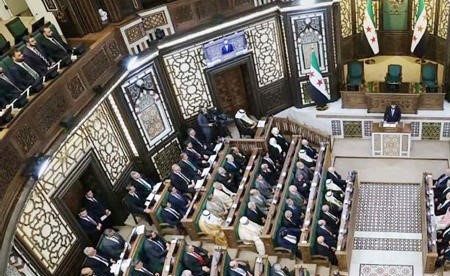
The new Syrian People’s Assembly held its first session yesterday following liberation, attended by President Ahmad al-Sharaa, Chairman of the Supreme Committee for the Assembly’s Elections Muhammad Taha al-Ahmad, Assemb
Translated by Qiyas from الأنباء — Original source
The new Syrian People’s Assembly held its first session yesterday following liberation, attended by President Ahmad al-Sharaa, Chairman of the Supreme Committee for the Assembly’s Elections Muhammad Taha al-Ahmad, Assembly members, and several ministers. The session featured a collective oath-taking by the members and the election of the Assembly’s Speaker and members of its Presidential Bureau.
In a speech to the Assembly members, President al-Sharaa stated that since its inception, humanity has continued to seek the optimal way to organize people’s affairs and find the best paths to manage their affairs and achieve their interests. He noted that there is no better method than bringing opinions together and fostering consultation to realize the common good, emphasizing that acceptance and consensus play a crucial role in eliminating division, rejecting discord, fostering agreement, and ensuring sound judgment.
President al-Sharaa added that Syria is writing a new history that reflects its civilization, values, and heritage, crafting a new chapter in the construction of modern Syria. He affirmed that everyone faces a great responsibility, and that the legacy of years of autocracy, war, and destruction affecting the people, infrastructure, and economy requires prioritizing the national interest, working with a spirit of unity, making service to the people the goal of every policy, and establishing the state as the benchmark for every decision.
He continued, saying that after the liberation of the country and the restoration of its freedom, Syria is transitioning to a phase of consolidating the state and building its institutions on the foundations of responsibility and competence—a state where dignity is preserved and will is respected. He pointed out that rebuilding the economy, improving service levels, creating an investment-friendly environment, providing job opportunities, and increasing production are national responsibilities shared by all state institutions, foremost among them the People’s Assembly, through legislation that keeps pace with the reconstruction phase, meets the aspirations of Syrians, and supports the path of development and prosperity.
President al-Sharaa urged Assembly members to make the institution a model of responsibility and competence, to contribute to consolidating the culture of dialogue, the rule of law, and respect for institutions, and to be partners in building a new Syria. He prayed that God would grant them success in fulfilling their duties, protect Syria and its people, and make the Assembly a platform for wisdom, a support for the state, and a voice for the people, wishing everyone success in building a prosperous Syria.
For his part, Muhammad Taha al-Ahmad, Chairman of the Supreme Committee for the People’s Assembly Elections, affirmed that the convening of the Assembly’s first session represents a historic turning point in Syria’s journey, reflecting the sacrifices and resilience of the Syrian people and announcing the launch of a new phase of national work. He stressed that what has been achieved today is the fruit of the sacrifices Syrians have made for freedom and sovereignty.
Al-Ahmad clarified that the elections covered 13 governorates and 57 electoral districts, with more than 500 candidates competing. An electoral body comprising over 6,800 members selected the People’s Assembly members, a process he considered a milestone in the birth of an Assembly that embodies the free will of the Syrian people and their aspiration for a stable and bright future.
Assembly members took their oath during the session in the presence of President al-Sharaa. In accordance with the Constitutional Declaration, the session was presided over by Osama al-Assaf, the oldest member, and Muhammad Fawaz al-Mahalli, the youngest member, who served as secretary. Bashir al-Hawi, Waseem Zaghoul, and Ahmad al-Amr were elected to the temporary Legal Committee to oversee the electoral process and vote counting, and to establish regulations for the election of the Assembly’s Presidential Bureau.
Al-Assaf opened the floor for nominations for the position of Assembly Speaker, with three members submitting their candidacies: Abdulhamid Akeel al-Awak, Muayyed Hayel al-Qubaisi, and Muhammad Ramzi Kurj. Al-Awak was elected Speaker after receiving 99 votes. He holds a law degree and served as a judge with the rank of counselor in the Ministry of Justice for 10 years.
206 members attended, and no member was absent from the first session. Al-Awak stated that the new Syria is not ruled by tyrants, nor does it exclude anyone; it lives united with all its sons, sects, and denominations to build a great nation. He added that Syrians have suffered for decades from oppression and displacement, and from a regime that turned the state into a farm, the people into hostages, and the country into a battlefield and tragedy. Today, he said, we want to open a new page in nation-building and write a new history that teaches generations the meaning of dignity.
The Syrian Arab News Agency (SANA) reported that with the completion of the quorum for the People’s Assembly following the announcement of the remaining third, the legislative body enters a phase of directly exercising its constitutional functions, marking a new milestone in completing the construction of state institutions during the transitional period, leading to the adoption of a permanent constitution and new legislative elections.
The formation of the People’s Assembly serves as a transitional constitutional mechanism stipulated by the temporary electoral system, aimed at ensuring the Assembly’s ability to operate under the exceptional circumstances the country is experiencing in the post-liberation phase. It is not considered a permanent legislative model for Syria, but rather a formula linked to the current stage.
